>>> Fidel Castro

Fidel Alejandro Castro Ruz


(born August 13, 1926) is a Cuban revolutionary leader who served as the country's 22nd president and led the country from January 1959 until his retirement in February 2008. Castro began his political life with nationalist critiques of Batista, and of United States political and corporate influence in Cuba. He gained an ardent, but limited, following and also drew the attention of the authorities.[2] He eventually led the failed 1953 attack on the Moncada Barracks, after which he was captured, tried, incarcerated and later released. He then travelled to Mexico[3][4] to organize and train for the guerrilla invasion of Cuba that took place in December 1956.

He came to power in an armed revolution that overthrew the dictatorship of Fulgencio Batista, and was shortly thereafter sworn in as the Prime Minister of Cuba.[5] In 1965 he became First Secretary of the Communist Party of Cuba and led the transformation of Cuba into a one-party socialist republic. In 1976 he became President of the Council of State as well as of the Council of Ministers. He also held the supreme military rank of Comandante en Jefe ("Commander in Chief") of the Cuban armed forces.

Following intestinal surgery from an undisclosed digestive illness believed to have been diverticulitis,[6] he transferred his responsibilities to the First Vice-President, his younger brother Raúl Castro, on July 31, 2006. On February 19, 2008, five days before his mandate was to expire, he announced he would neither seek nor accept a new term as either president or commander-in-chief.[7][8] On February 24, 2008, the National Assembly elected Raúl Castro to succeed him as the President of Cuba.[1] Fidel Castro remains First Secretary of the Communist Party.

Childhood and education

Fidel Alejandro Castro Ruz was born on a sugar plantation in Birán, near Mayarí, in the modern-day province of Holguín – then a part of the now-defunct Oriente province. He was the third child born to Ángel Castro y Argiz, a Galician immigrant who became relatively prosperous through work in the sugar industry and successful investing. His mother, Lina Ruz González, who was a household servant, was also of Galician background.[3] Angel Castro was married to another woman, Maria Luisa Argota,[9] until Fidel was 17, and thus Fidel as a child had to deal both with his illegitimacy and the challenge of being raised in various foster homes away from his father's house.

Castro has two brothers, Ramón and Raúl, and four sisters, Angelita, Juanita, Enma, and Agustina, all of whom were born out of wedlock. He also has two half siblings, Lidia and Pedro Emilio who were raised by Ángel Castro's first wife.

Fidel was not baptized until he was 8, also very uncommon, bringing embarrassment and ridicule from other children.[10][11] Ángel Castro finally dissolved his first marriage when Fidel was 15 and married Fidel’s mother. Castro was formally recognized by his father when he was 17, when his surname was legally changed to Castro from Ruz, his mother’s name.[10][11] Although accounts of his education differ, most sources agree that he was an intellectually gifted student, more interested in sports than in academics, and spent many years in private Catholic boarding schools, finishing high school at El Colegio de Belén, a Jesuit school in Havana in 1945.[12] While at Belén, the 21-year-old Castro pitched on the school's baseball team. There are persistent rumors that Castro was scouted for various U.S. baseball teams,[13] but there is no evidence that this ever actually happened.[14]

Political beginnings

In late 1945, Castro entered law school at the University of Havana. He became immediately embroiled in the political culture at the University, which was a reflection of the volatile politics in Cuba during that era.

University student Fidel Castro (center, standing, in black suit) addressing fellow students during a protest on November 11, 1947.

Since the fall of president Gerardo Machado in the 1930s, student politics had degenerated into a form of gangsterismo dominated by fractious action groups, and Castro, believing that the gangs posed a physical threat to his university aspirations, experienced what he later described as "a great moment of decision."[15] He returned to the university from a brief hiatus to involve himself fully in the various violent battles and disputes which surrounded university elections, and was to be implicated in a number of shootings linked to Rolando Masferrer's MSR action group. "To not return", said Castro later, "would be to give in to bullies, to abandon my beliefs".[15] Rivalries were so intense that Castro apparently collaborated in an attempt on Masferrer's life during this period,[15] while Masferrer, whose paramilitary group Les Tigres later became an instrument of state violence under Batista,[16] perennially hunted the younger student seeking violent retribution.[17]

In 1947, growing increasingly passionate about social justice, Castro joined the Partido Ortodoxo which had been newly formed by Eduardo Chibás. A charismatic figure, Chibás was running for president against the incumbent Ramón Grau San Martín who had allowed rampant corruption to flourish during his term.[citation needed] The Partido Ortodoxo publicly exposed corruption and demanded government and social reform. It aimed to instill a strong sense of national identity among Cubans, establish Cuban economic independence and freedom from the United States, and dismantle the power of the elite over Cuban politics. Though Chibás lost the election, Castro, considering Chibás his mentor, remained committed to his cause, working fervently on his behalf. In 1951, while running for president again, Chibás shot himself in the stomach during a radio broadcast. Castro was present and accompanied him to the hospital where he died.[12]

Decision for revolution

Castro returned to Cuba and married Mirta Díaz Balart, a student from a wealthy Cuban family through which he was exposed to the lifestyle of the Cuban elite. In 1950 he graduated from law school with a Doctor of Laws degree and began practicing law in a small partnership in Havana. By now he had become well known for his passionately nationalistic views and his intense opposition to the influence of the United States on Cuban internal affairs. Increasingly interested in a career in politics, Castro had become a candidate for a seat in the Cuban parliament when General Fulgencio Batista led a coup d'état in 1952, successfully overthrowing the government of President Carlos Prío Socarrás and canceling the election.

Batista established himself as de facto leader with the support of establishment elements of Cuban society and powerful Cuban agencies. His government was formally recognized by the United States, buttressing his power. Castro, nearing thirty, was now a politician without a legitimate platform and thus he broke away from the Partido Ortodoxo to marshal legal arguments based on the Constitution of 1940 to formally charge Batista with violating the constitution. His petition, entitled Zarpazo, was denied by the Court of Constitutional Guarantees and he was not allowed a hearing.[23] This experience formed the foundation for Castro's opposition to the Batista government and convinced him that revolution was the only way to depose Batista.[24]

Cuban Revolution

Main article: Cuban revolution

Attack on Moncada Barracks

Main article: Moncada Barracks

As discontent over the Batista coup grew, Castro abandoned his law practice and formed an underground organization of supporters, including his brother, Raúl, and Mario Chanes de Armas. Together they actively plotted to overthrow Batista. They collected guns and ammunition and finalized their plans for an armed attack on Moncada Barracks, Batista's largest garrison outside Santiago de Cuba. On the 26th of July, 1953, they attacked Moncada Barracks. The Céspedes garrison in Bayamo was also attacked as a diversion.[3] The attack proved disastrous and more than sixty of the one-hundred and thirty-five militants involved were killed.

Castro and other surviving members of his group managed to escape to a part of the rugged Sierra Maestra[25] mountains east of Santiago where they were eventually discovered and captured. Although there is disagreement over why Castro and his brother, Raúl, were not executed on capture as many of their fellow militants were, there is evidence that an officer recognized Castro from his university days and treated the captured rebels compassionately, despite the 'illegal' unofficial order to have the leader executed.[3] Others, such as Angel Prado, military commander of the 26th of July Movement, say that on the night of the attack Castro's driver got lost and he never reached the barracks. That night was the night of “El Carnaval de Santiago” and the streets of Santiago de Cuba were filled with party goers.

Castro was tried in the fall of 1953 and sentenced to up to fifteen years in prison.[26] During his trial Castro delivered his famous defense speech History Will Absolve Me,[27] upholding his rebellious actions and boldly declaring his political views:

I warn you, I am just beginning! If there is in your hearts a vestige of love for your country, love for humanity, love for justice, listen carefully... I know that the regime will try to suppress the truth by all possible means; I know that there will be a conspiracy to bury me in oblivion. But my voice will not be stifled – it will rise from my breast even when I feel most alone, and my heart will give it all the fire that callous cowards deny it... Condemn me. It does not matter. History will absolve me.

While he was being held at the prison for political activists on Isla de Pinos, he continued to plot Batista's overthrow, planning upon release to reorganize and train in Mexico.[3] After having served less than two years, he was released in May 1955 due to a general amnesty from Batista who was under political pressure, and went as planned to Mexico.[4]

26th of July Movement

Main article: 26th of July Movement

Once in Mexico, Castro reunited with other Cuban exiles and founded the 26th of July Movement, named after the date of the failed attack on the Moncada Barracks. The goal remained the overthrow of Fulgencio Batista. Castro had learned from the Moncada experience that new tactics were needed if Batista's forces were to be defeated. This time, the plan was to use underground guerrilla tactics, which were used by the Cubans the last time they attempted a populist overthrow of what they considered an imperialistic regime. The Cuban war of Independence against the Spanish was Cuba's introduction to guerrilla warfare, about which they read once the Cuban campaign ended but was taken up by Emilio Aguinaldo in the Philippines. Once again, it would be guerrilla warfare to bring down a government.

In Mexico Castro met Ernesto "Che" Guevara, a proponent of guerrilla warfare. Guevara joined the group of rebels and became an important force in shaping Castro's evolving political beliefs. Guevara's observations of the misery of the poor in Latin America had already convinced him that the only solution lay in violent revolution.

Since regular contacts with a KGB agent named Nikolai Sergeevich Leonov in Mexico City had not resulted in the hoped for weapon supply,[28] they decided to go to the United States to gather personnel and funds from Cubans living there, including Carlos Prío Socarrás, the elected Cuban president deposed by Batista in 1952. Back in Mexico, the group trained under a Spanish Civil War Veteran, Cuban-born Alberto Bayo[27] who had fled to Mexico after Francisco Franco's victory in Spain. On November 26, 1956, Castro and his group of 81 followers, mostly Cuban exiles, set out from Tuxpan, Veracruz, aboard the yacht Granma for the purpose of starting a rebellion in Cuba.[29]

The rebels landed at Playa Las Coloradas close to Los Cayuelos near the eastern city of Manzanillo on December 2, 1956. In short order, most of Castro's men were killed, dispersed, or taken prisoner by Batista's forces.[29] While the exact number is in dispute, it is agreed that no more than twenty of the original eighty-two men survived the bloody encounters with the Cuban army and succeeded in fleeing to the Sierra Maestra mountains.[30] The group of survivors included Fidel Castro, Che Guevara, Raúl Castro, and Camilo Cienfuegos. Those who survived were aided by people in the countryside. They regrouped in the Sierra Maestra in Oriente province and organized a column under Fidel Castro's command.

From their encampment in the Sierra Maestra mountains, the 26th of July Movement waged a guerrilla war against the Batista government. In the cities and major towns also, resistance groups were organizing until underground groups were everywhere. The strongest was in Santiago formed by Frank País.[31][32]

In the summer of 1955, País’s organization merged with the 26th of July Movement of Castro. As Castro's movement gained popular support in the cities and countryside, it grew to over eight hundred men. In mid-1957 Castro gave Che Guevara command of a second column. A journalist, Herbert Matthews from the New York Times, came to interview him in the Sierra Maestra, attracting interest to Castro's cause in the United States. The New York Times front page stories by Matthews presented Castro as a romantic and appealing revolutionary, bearded and dressed in rumpled fatigues.[33][34] Castro and Matthews were followed by the TV crew of Andrew Saint George, said to be a CIA contact person.[35] Through television, Castro's rudimentary command of the English language and charismatic presence enabled him to appeal directly to a U.S. audience.

In 1957, Castro also signed the Manifesto of the Sierra Maestra [36] in which he agreed to which was to call elections under the Electoral Code of 1943 within the first 18 months of his time in power and to restore all of the provisions of the Constitution of 1940 that had been suspended under Batista. While he took steps to implement some of the measures in the Manifesto upon coming into power, Cuba failed to have elections, the most important part of the program, within the allotted time.

Operation Verano

Main article: Operation Verano
Fidel Castro in his days as a guerrilla.

In May 1958, Batista launched Operation Verano aiming to crush Castro and other anti-government groups. It was called La Ofensiva ("The Offensive") by the rebels (Alarcón Ramírez,1997). Although on paper heavily outnumbered, Castro's guerrilla forces scored a series of victories, largely aided by mass desertions from Batista's army of poorly trained and uncommitted young conscripts. During the Battle of La Plata, Castro's forces defeated an entire battalion. While pro-Castro Cuban sources later emphasized the role of Castro's guerrilla forces in these battles, other groups and leaders were also involved, such as escopeteros (poorly-armed irregulars). During the Battle of Las Mercedes, Castro's small army came close to defeat but he managed to pull his troops out by opening up negotiations with General Cantillo while secretly slipping his soldiers out of a trap.

When Operation Verano ended, Castro ordered three columns commanded by Guevara, Jaime Vega and Camilo Cienfuegos to invade central Cuba where they were strongly supported by rebellious elements who had long been operating in the area. One of Castro's columns moved out onto the Cauto Plains. Here, they were supported by Huber Matos, Raúl Castro and others who were operating in the eastern-most part of the province. On the plains, Castro's forces first surrounded the town of Guisa in Granma Province and drove out their enemies, then proceeded to take most of the towns that had been taken by Calixto García in the 1895-1898 Cuban War of Independence.

Battle of Yaguajay

Main article: Battle of Yaguajay

In December 1958, the columns of Che Guevara and Camilo Cienfuegos continued their advance through Las Villas province. They succeeded in occupying several towns, and then began preparations for an attack on Santa Clara, the provincial capital. Guevara's fighters launched a fierce assault on the Cuban army surrounding Santa Clara, and a vicious house-to-house battle ensued. They also derailed an armored train which Batista had sent to aid his troops in the city while Cienfuegos won the Battle of Yaguajay. Defeated on all sides, Batista's forces crumbled. The provincial capital was captured after less than a day of fighting on December 31, 1958.

After the loss of Santa Clara and expecting betrayal by his own army, Batista (accompanied by president-elect Andrés Rivero Agüero) fled to the Dominican Republic in the early hours of January 1, 1959. They left behind a junta headed by Gen. Eulogio Cantillo, recently the commander in Oriente province, the center of the Castro revolt. The junta immediately selected Dr. Carlos Piedra, the oldest judge of the Supreme Court, as provisional President of Cuba as specified in the Constitution of 1940. Castro refused to accept the selection of Justice Piedra as provisional President and the Supreme Court refused to administer the oath of office to the Justice.[37]

The rebel forces of Fidel Castro moved swiftly to seize power throughout the island.[37] At the age of 32, Castro had successfully masterminded a classic guerrilla campaign from his headquarters in the Sierra Maestra and ousted Batista.

Assumption of power
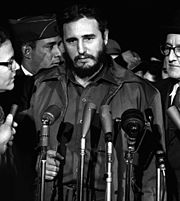
Castro arrives in Washington, D.C. on April 15, 1959.

On January 8, 1959, Castro's army rolled victoriously into Havana.[38] As news of the fall of Batista's government spread through Havana, The New York Times described the scene as one of jubilant crowds pouring into the streets and automobile horns honking. The black and red flag of the 26th of July Movement waved on automobiles and buildings. The atmosphere was chaotic.[37] Castro called a general strike in protest of the Piedra government. He demanded that Dr. Urrutia, former judge of the Urgency Court of Santiago de Cuba, be installed as the provisional President instead. The Cane Planters Association of Cuba, speaking on behalf of the island's crucial sugar industry, issued a statement of support for Castro and his movement.[39]

Law professor José Miró Cardona created a new government with himself as prime minister and Manuel Urrutia Lleó as president on January 5. The United States officially recognized the new government two days later.[40] Castro himself arrived in Havana to cheering crowds and assumed the post of Commander-in-Chief of the Armed Forces on January 8.

In February Miró suddenly resigned and on February 16, 1959, Castro was sworn in as Prime Minister of Cuba.[5]

Friction with the U.S. developed as the new government began expropriating property owned by major U.S. corporations (United Fruit in particular) and announced plans to base the compensation on the artificially low property valuations that the companies themselves had kept to a fraction of their true value so that their taxes would be negligible.[39]

During this period Castro repeatedly denied being a communist.[41][42][43][44][45] For example in New York on April 25 he said, communist "influence is nothing. I don't agree with communism. We are democracy. We are against all kinds of dictators.... That is why we oppose communism."[46]

Between April 15 and April 26, Castro and a delegation of industrial and international representatives visited the U.S. as guests of the Press Club. Castro hired one of the best public relations firms in the United States for a charm offensive visit by Castro and his recently initiated government. Castro answered impertinent questions jokingly and ate hotdogs and hamburgers. His rumpled fatigues and scruffy beard cut a popular figure easily promoted as an authentic hero.[47] He was refused a meeting with President Eisenhower. After his visit to the United States, he would go on to join forces with the Soviet leader, Nikita Khrushchev.[38]

Years in power

On May 17, 1959, Castro signed into law the First Agrarian Reform, which limited landholdings to 993 acres (4 km²) per owner and forbade foreign land ownership.[48][49]

Fidel Castro addresses delegates of the General Assembly of the United Nations in New York in 1960.

As early as July 1959, Castro's intelligence chief Ramiro Valdés contacted the KGB in Mexico City.[28] Subsequently, the USSR sent over one hundred mostly Spanish speaking advisors, including Enrique Líster Forján, to organize the Committees for the Defense of the Revolution.

In February 1960, Cuba signed an agreement to buy oil from the USSR. When the U.S.-owned refineries in Cuba refused to process the oil, they were expropriated, and the United States broke off diplomatic relations with the Castro government soon afterward. To the concern of the Eisenhower administration, Cuba began to establish closer ties with the Soviet Union. A variety of pacts were signed between Castro and Soviet Premier Nikita Khrushchev, allowing Cuba to receive large amounts of economic and military aid from the USSR. The mould was set. U.S. disappointment with their lack of power in Cuban decision making fueled Castro's fears leading to increasing Cuban dependence on USSR support.

In June 1960, Eisenhower reduced Cuba's sugar import quota by 7,000,000 tons, and in response, Cuba nationalized some $850 million worth of U.S. property and businesses. The revolutionary government grabbed control of the nation by nationalizing industry, expropriating property owned by Cubans and non-Cubans alike, collectivizing agriculture, and enacting policies which Castro claimed would benefit the economically dispossessed. While popular among the poor, these policies alienated many former supporters of the revolution among the Cuban middle and upper-classes. Over one million Cubans later migrated to the U.S., forming a vocal anti-Castro community in Miami, Florida, actively supported and funded by successive U.S. administrations.

Further information: Cuban-American lobby

By the early autumn of 1960, the U.S. government was engaged in a semi-secret campaign to remove Castro from power.[50]

On January 3, 1961, President Dwight Eisenhower broke off ties with Cuba, saying that Fidel Castro had provoked him once too often.[51]

In April 1961, the U.S. government unsuccessfully attempted to depose Castro from power by supporting an armed force of Cuban exiles to retake the island. This attempt is known as the Bay of Pigs invasion.

Bay of Pigs

Main article: Bay of Pigs Invasion

A timeline released by the National Security Archives shows the U.S. began planning to overthrow the government of Cuba in October 1959.[52] On April 17, 1961, approximately 1,400 members of a CIA-trained Cuban exile force landed at the Bay of Pigs, while the U.S. publicly denied any involvement.

Documents released by the National Security Archive show that the CIA expected the Cuban people to welcome a U.S.-sponsored invasion, spontaneously rising up against the Castro regime. It expected Cuban military and police forces to refuse to fight against the CIA's 1,400-man mercenary invasion force.[53] President Kennedy cancelled several planned bombing sorties designed to cripple the entire Cuban Air Force.[54]

The Cuban armed forces repelled the invaders, killing many and capturing a thousand. On May 1, 1961, Castro announced to the hundreds of thousands in the audience that:

The revolution has no time for elections. There is no more democratic government in Latin America than the revolutionary government. ... If Mr. Kennedy does not like Socialism, we do not like imperialism. We do not like capitalism.[55]

In a nationally broadcast speech on December 2, 1961, Castro declared that he was a Marxist-Leninist and that Cuba was adopting Communism. On February 7, 1962, the U.S. imposed an embargo against Cuba. This embargo was broadened during 1962 and 1963, including a general travel ban for American tourists.[56]

Many theories are offered for the failure of the U.S. operation. Some argue that the Americans misjudged Cuban support for Castro.[57] They had believed the testimonies of the Cuban exiles, who told them that Castro was not well supported by the Cuban people. In the weeks prior to the invasion, the Cuban government had rounded up tens of thousands of Cubans suspected of opposing the government, detaining them in sports stadiums across the island in order to prevent them from joining exile forces. No Cuban uprising against Castro ever materialized. In addition, the covert placement of dozens of Cuban intelligence officials in the invasion force gave the Cuban government detailed information on the operation.[58]

Cuban Missile Crisis

Main article: Cuban Missile Crisis

Tensions between Cuba and the U.S. heightened during the 1962 missile crisis, which nearly brought the US and the USSR into nuclear conflict. Khrushchev conceived the idea of placing missiles in Cuba as a deterrent to a possible U.S. invasion and justified the move in response to US missile deployment in Turkey. After consultations with his military advisors, he met with a Cuban delegation led by Raúl Castro in July in order to work out the specifics. It was agreed to deploy Soviet R-12 MRBMs on Cuban soil; however, American Lockheed U-2 reconnaissance discovered the construction of the missile installations on October 15, 1962 before the weapons had actually been deployed. The US government viewed the installation of Soviet nuclear weapons 90 miles (145 km) south of Key West as an aggressive act and a threat to US security. As a result, the US publicly announced its discovery on October 22, 1962, and implemented a quarantine around Cuba that would actively intercept and search any vessels heading for the island. Nikolai Sergevich Leonov, who would become a General in the KGB Intelligence Directorate[59] and the Soviet KGB deputy station chief in Warsaw, was the translator Castro used for contact with the Russians during this period.

In a personal letter to Khrushchev dated October 27, 1962, Castro urged him to launch a nuclear first strike against the United States if Cuba were invaded, but Khrushchev rejected any first strike response.[60] Soviet field commanders in Cuba were, however, authorized to use tactical nuclear weapons if attacked by the United States. Khrushchev agreed to remove the missiles in exchange for a US commitment not to invade Cuba and an understanding that the US would remove American MRBMs targeting the Soviet Union from Turkey and Italy, a measure that the US implemented a few months later. The missile swap was never publicized because the Kennedy Administration demanded secrecy in order to preserve NATO relations and protect Democratic candidates in the upcoming elections.

Assassination attempts

Fabian Escalante, who was long tasked with protecting the life of Castro, has calculated the exact number of assassination schemes and/or attempts by the CIA to be 638. Some such attempts have included an exploding cigar, a fungal-infected scuba-diving suit, and a mafia-style shooting. Some of these plots are depicted in a documentary entitled 638 Ways to Kill Castro.[61] One of these attempts was by his ex-lover Marita Lorenz whom he met in 1959. She subsequently agreed to aid the CIA and attempted to smuggle a jar of cold cream containing poison pills into his room. When Castro realized, he reportedly gave her a gun and told her to kill him but her nerve failed.[62] Castro once said in regards to the numerous attempts on his life, "If surviving assassination attempts were an Olympic event, I would win the gold medal."

According to the Family Jewels documents declassified by the CIA in 2007, one such assassination attempt before the Bay of Pigs invasion involved Johnny Roselli and Al Capone's successor in the Chicago Outfit, Salvatore Giancana and his right-hand man Santos Trafficante. It was personally authorized by then US attorney general Robert Kennedy [63].

Giancana and Miami Syndicate leader Santos Trafficante were contacted in September 1960 about the possibility of an assassination attempt by a go-between from the CIA, Robert Maheu, after Maheu had contacted Johnny Roselli, a member of the Las Vegas Syndicate and Giancana's number-two man. Maheu had presented himself as a representative of numerous international business firms in Cuba that were being expropriated by Castro. He offered $150,000 for the "removal" of Castro through this operation (the documents suggest that neither Roselli nor Giancana and Trafficante accepted any sort of payments for the job). According to the files, it was Giancana who suggested using a series of poison pills that could be used to doctor Castro's food and drink. These pills were given by the CIA to Giancana's nominee Juan Orta, whom Giancana presented as being an official in the Cuban government who was also in the pay of gambling interests, and who did have access to Castro. After a series of six attempts to introduce the poison into Castro's food, Orta abruptly demanded to be let out of the mission, handing over the job to another, unnamed participant. Later, a second attempt was mounted through Giancana and Trafficante using Dr. Anthony Verona, the leader of the Cuban Exile Junta, who had, according to Trafficante, become "disaffected with the apparent ineffectual progress of the Junta". Verona requested $10,000 in expenses and $1,000 worth of communications equipment. However, it is unknown how far the second attempt went, as the entire program was cancelled shortly thereafter due to the launching of the Bay of Pigs invasion. [64][65] [66]

Resulting from these numerous assassination attempts, Castro sent out warnings to the US government to stop the attempts or face retaliatory actions. This resulted in a theory stating that Cuba was behind the Kennedy assassination.

See also: Kennedy assassination theories

United States Embargo

Main article: United States embargo against Cuba

Jose Maria Aznar, former Spanish Prime Minister, wrote that the embargo was Castro's greatest ally, and that Castro would lose his presidency within three months if the embargo was lifted.[67] Castro retained control after Cuba became bankrupt and isolated following the collapse of the Soviet Union in 1991. The synergic contraction of Cuban economy resulted in eighty-five percent of its markets disappearing, along with subsidies and trade agreements that had supported it, causing extended gas and water outages, severe power shortages, and dwindling food supplies.[68] In 1994, the island's economy plunged into what was called the "Special Period"; teetering on the brink of collapse. Cuba legalized the US dollar, turned to tourism, and encouraged the transfer of remittances in US dollars from Cubans living in the USA to their relatives on the Island. After massive damage caused by Hurricane Michelle in 2001, Castro proposed a one-time cash purchase of food from the U.S.; he declining a U.S. offer of humanitarian aid.[69] Nevertheless, the U.S. authorized the shipment of food in 2001, the first since the embargo was imposed.[70] During 2004, Castro shut down 118 factories, including steel plants, sugar mills and paper processors to compensate for the crisis due to fuel shortages.[71], and in 2005 directed thousands of Cuban doctors to Venezuela in exchange for oil imports.[72]

Foreign relations

Main article: Foreign relations of Cuba

Soviet Union

Fidel Castro embracing former Soviet Premier Nikita Khrushchev.

Following the establishment of diplomatic ties to the Soviet Union, and after the Cuban Missile Crisis, Cuba became increasingly dependent on Soviet markets and military and economic aid. Castro was able to build a formidable military force with the help of Soviet equipment and military advisors. The KGB kept in close touch with Havana, and Castro tightened Communist Party control over all levels of government, the media, and the educational system, while developing a Soviet-style internal police force.

Castro's alliance with the Soviet Union caused something of a split between him and Guevara. In 1966, Guevara left for Bolivia in an ill-fated attempt to stir up revolution against the country's government.

On August 23, 1968, Castro made a public gesture to the USSR that caused the Soviet leadership to reaffirm their support for him. Two days after the Soviet invasion of Czechoslovakia to repress the Prague Spring, Castro took to the airwaves and publicly denounced the Czech rebellion. Castro warned the Cuban people about the Czechoslovakian 'counterrevolutionaries', who "were moving Czechoslovakia towards capitalism and into the arms of imperialists". He called the leaders of the rebellion "the agents of West Germany and fascist reactionary rabble."[73] In return for his public backing of the invasion, at a time when many Soviet allies were deeming the invasion an infringement of Czechoslovakia's sovereignty, the Soviets bailed out the Cuban economy with extra loans and an immediate increase in oil exports.

In 1971, despite an Organization of American States convention that no nation in the Western Hemisphere would have a relationship with Cuba (the only exception being Mexico, which had refused to adopt that convention), Castro took a month-long visit to Chile, following the re-establishment of diplomatic relations with Cuba. The visit, in which Castro participated actively in the internal politics of the country, holding massive rallies and giving public advice to Salvador Allende, was seen by those on the political right as proof to support their view that "The Chilean Way to Socialism" was an effort to put Chile on the same path as Cuba.[74]

When Soviet leader Mikhail Gorbachev visited Cuba in 1989, the comradely relationship between Havana and Moscow was strained by Gorbachev's implementation of economic and political reforms in the USSR. "We are witnessing sad things in other socialist countries, very sad things," lamented Castro in November 1989, in reference to the changes that were sweeping such communist allies as the Soviet Union, East Germany, Hungary, and Poland.[75] The subsequent collapse of the Soviet Union in 1991 had an immediate and devastating effect on Cuba.

Other countries

Schafik Handal, Hugo Chávez, Fidel Castro and Evo Morales, in Havana in 2004.

On November 4, 1975, Castro ordered the deployment of Cuban troops to Angola in order to aid the Marxist MPLA-ruled government against the South African-backed UNITA opposition forces. Moscow aided the Cuban initiative with the USSR engaging in a massive airlift of Cuban forces into Angola. On Cuba's role in Angola, Nelson Mandela is said to have remarked "Cuban internationalists have done so much for African independence, freedom, and justice."[76] Cuban troops were also sent to Marxist Ethiopia to assist Ethiopian forces in the Ogaden War with Somalia in 1977. In addition, Castro extended support to Marxist Revolutionary movements throughout Latin America, such as aiding the Sandinistas in overthrowing the Somoza government in Nicaragua in 1979. It has been claimed by the Carthage Foundation-funded Center for a Free Cuba[77] that an estimated 14,000 Cubans were killed in Cuban military actions abroad.[78]

Cuba and Panama have restored diplomatic ties after breaking them off in 2005 when Panama's former president pardoned four Cuban exiles accused of attempting to assassinate Cuban President Fidel Castro. The foreign minister of each country re-established official diplomatic relations in Havana by signing a document describing a spirit of fraternity that has long linked both nations.[79] Cuba, once shunned by many of its Latin American neighbours, now has full diplomatic relations with all but Costa Rica and El Salvador.[79]

Although the relationship between Cuba and Mexico remains strained, each side appears to make attempts to improve it. In 1998, Fidel Castro apologized for remarks he made about Mickey Mouse which led Mexico to recall its ambassador from Havana. He said he intended no offense when he said earlier that Mexican children would find it easier to name Disney characters than to recount key figures in Mexican history. Rather, he said, his words were meant to underscore the cultural dominance of the US.[80] Mexican president Vicente Fox apologized to Fidel Castro in 2002 over statements by Castro, who had taped their telephone conversation, to the effect that Fox forced him to leave a United Nations summit in Mexico so that he would not be in the presence of President Bush, who also attended.[81]

At a summit meeting of sixteen Caribbean countries in 1998, Castro called for regional unity, saying that only strengthened cooperation between Caribbean countries would prevent their domination by rich nations in a global economy.[82] Caribbean nations have embraced Cuba's Fidel Castro while accusing the US of breaking trade promises. Castro, until recently a regional outcast, has been increasing grants and scholarships to the Caribbean countries, while US aid has dropped 25% over the past five years.[83] Cuba has opened four additional embassies in the Caribbean Community including: Antigua and Barbuda, Dominica, Suriname, Saint Vincent and the Grenadines. This development makes Cuba the only country to have embassies in all independent countries of the Caribbean Community.[84]

In the poorest areas of Latin America and Africa, Castro is seen as a hero, the leader of the Third World, and the enemy of the wealthy and greedy.[85] On a visit to South Africa in 1998 he was warmly received by President Nelson Mandela.[86] President Mandela gave Castro South Africa's highest civilian award for foreigners, the Order of Good Hope.[87] Last December Castro fulfilled his promise of sending 100 medical aid workers to Botswana, according to the Botswana presidency. These workers play an important role in Botswana's war against HIV/AIDS. According to Anna Vallejera, Cuba's first-ever Ambassador to Botswana, the health workers are part of her country's ongoing commitment to proactively assist in the global war against HIV/AIDS,[88]

The president of Venezuela Hugo Chávez is a grand admirer of his and Bolivian president Evo Morales called him the "Grandfather". In Harlem, Castro is seen as an icon because of his historic visit with Malcolm X in 1960 at the Hotel Theresa.[89]

Castro and Canadian Prime Minister Pierre Trudeau.

Castro was known to be a friend of former Canadian Prime Minister Pierre Trudeau and was an honorary pall bearer at Trudeau's funeral in October 2000. They had continued their friendship after Trudeau left office until his death. Canada became one of the first American allies to openly trade with Cuba. Cuba still has a good relationship with Canada. In 1998, Canadian Prime Minister Jean Chrétien arrived in Cuba to meet President Castro and highlight their close ties. He is the first Canadian government leader to visit the island since Pierre Trudeau was in Havana in 1976.[90]

In December 2001, European Union representatives described their political dialogue with Cuba as back on track after a weekend of talks in Havana. The EU praised Cuba's willingness to discuss questions of human rights. Cuba is the only Latin American country without an economic co-operation agreement with the EU. However, trade with individual European countries remains strong since the US trade embargo on Cuba leaves the market free from American rivals.[91] In 2005, EU Development Commissioner Louis Michel ended his visit to Cuba optimistic that relations with the communist state will become stronger. The EU is Cuba's largest trading partner. Cuba's imprisonment of 75 dissidents and the execution of three hijackers have strained diplomatic relations. However, the EU commissioner was impressed with Fidel Castro's willingness to discuss these concerns, although he received no commitments from Castro. Cuba does not admit to holding political prisoners, seeing them rather as mercenaries in the pay of the United States.[92]

Succession issues

According to Article 94 of the Cuban Constitution, the First Vice President of the Council of State assumes presidential duties upon the illness or death of the president. Raúl Castro was the person in that position for the last 32 years of Fidel Castro's presidency.

Due to the issue of presidential succession and Castro's longevity, there have long been rumors, speculation and hoaxing about Castro's health and demise. In 1998 there were reports that he had a serious brain disease, later discredited.[93] In June 2001, he apparently fainted during a seven-hour speech under the Caribbean sun.[94] Later that day he finished the speech, walking buoyantly into the television studios in his military fatigues, joking with journalists.[95]

In January 2004, Luis Eduardo Garzón, the mayor of Bogotá, said that Castro "seemed very sick to me" following a meeting with him during a vacation in Cuba.[96] In May 2004, Castro's physician denied that his health was failing, and speculated that he would live to be 140 years old. Dr. Eugenio Selman Housein said that the "press is always speculating about something, that he had a heart attack once, that he had cancer, some neurological problem", but maintained that Castro was in good health.[97]

On October 20, 2004, Castro tripped and fell following a speech he gave at a rally, breaking his kneecap and fracturing his right arm.[98] He was able to recover his ability to walk and publicly demonstrated this two months later.[99]

Due to his large role in Cuba, his well-being has become a continual source of speculation both on and off the island as he has grown older. The CIA has long been interested in Castro's health.[100]

In 2005, the CIA said it thought Castro had Parkinson's disease.[101][102] Castro denied such allegations, while also citing the example of Pope John Paul II in saying that he would not fear the disease.[103]

Illness and transfer of duties

See also: 2006 Cuban transfer of presidential duties

On July 31, 2006, Castro delegated his duties as President of the Council of state, President of the Council of Ministers, First Secretary of the Cuban Communist Party and the post of commander in chief of the armed forces to his brother Raúl Castro. This transfer of duties was described at the time as temporary while Fidel recovered from surgery he underwent due to an "acute intestinal crisis with sustained bleeding".[104] Fidel Castro was too ill to attend the nationwide commemoration of the 50th anniversary of the Granma boat landing on December 2, 2006, which also became his belated 80th birthday celebrations. Castro's non-appearance fueled reports that he had terminal pancreatic cancer and was refusing treatment,[105] but on December 17, 2006 Cuban officials stated that Castro had no terminal illness and would eventually return to his public duties.[106][107]

Rumors of Castro's health

While Cuba continues to deny U.S.-made claims that Castro is suffering from a terminal cancer, on December 24, 2006, Spanish newspaper El Periódico de Catalunya reported that Spanish surgeon José Luis García Sabrido has been flown to Cuba on a plane charted by the Cuban government. Dr. García Sabrido is an intestinal expert who further specializes in the treatment of cancer. The plane that Dr. García Sabrido's traveled in also was reported to be carrying a large quantity of advanced medical equipment.[108][109] On December 26, 2006, shortly after returning to Madrid, Dr. García Sabrido held a news conference in which he answered questions about Castro's health. He stated that "He does not have cancer, he has a problem with his digestive system," and added, "His condition is stable. He is recovering from a very serious operation. It is not planned that he will undergo another operation for the moment."[110] Although most Cubans acknowledge that they are aware Castro is seriously ill, most also seem worried about a future without Castro.[111]

On January 16, 2007, the Spanish newspaper, El País, citing two unnamed sources from the Gregorio Marañón hospital —who employs Dr. García Sabrido— in Madrid, reported Castro was in "very grave" condition, having trouble cicatrizing, after three failed operations and complications from an intestinal infection caused by a severe case of diverticulitis. However, Dr. García Sibrido told CNN that he was not the source of the report and that "any statement that doesn't come directly from [Castro's] medical team is without foundation."[112] Also, a Cuban diplomat in Madrid said the reports were lies and declined to comment, while White House press secretary Tony Snow said the report appeared to be "just sort of a roundup of previous health reports. We've got nothing new."[113][114][115] On January 30, 2007, Cuban television and the paper Juventud Rebelde showed fresh video and photos from a meeting between Castro and Hugo Chavez said to have taken place the previous day.[116][117]

In mid-February 2007, it was reported by the Associated Press that Acting President Raul Castro had said that Fidel Castro's health was improving and he was taking part in all important issues facing the government. "He's consulted on the most important questions," Raul Castro said of Fidel. "He doesn't interfere, but he knows about everything."[118] On February 27, 2007, Reuters reported that Fidel Castro had called into Aló Presidente, a live radio talk show hosted by Hugo Chávez, and chatted with him for thirty minutes during which time he sounded "much healthier and more lucid" than he had on any of the audio and video tapes released since his surgery in July. Castro reportedly told Chávez, "I am gaining ground. I feel I have more energy, more strength, more time to study," adding with a chuckle, "I have become a student again." Later in the conversation (transcript in Spanish; audio) , he made reference to the fall of the world stock markets that had occurred earlier in the day and remarked that it was proof of his contention that the world capitalist system is in crisis.[119]

Reports of improvements in his condition continued to circulate throughout March and early April. On April 13, 2007, Chávez was quoted by the Associated Press as saying that Castro has "almost totally recovered" from his illness. That same day, Cuban Foreign Minister Felipe Roque confirmed during a press conference in Vietnam that Castro had improved steadily and had resumed some of his leadership responsibilities.[120] On April 21, 2007, the official newspaper Granma reported that Castro had met for over an hour with Wu Guanzheng, a member of the Politburo of the Chinese Communist Party who was visiting Havana. Photographs of their meeting showed the Cuban president looking healthier than he had in any previously released since his surgery.[121]

As a comment on Castro’s recovery, U.S. President George W. Bush said: "One day the good Lord will take Fidel Castro away," Hearing about this, Castro, who is an atheist, ironically replied: "Now I understand why I survived Bush's plans and the plans of other presidents who ordered my assassination: the good Lord protected me."[122]

Retirement

Castro's retirement letter appeared in the front page of Granma newspaper.
Wikinews has related news:
Fidel Castro resigns as Cuban president

In a letter dated February 18, 2008, Castro announced that he would not accept the positions of president and commander in chief at the February 24, 2008 National Assembly meetings, saying "I will not aspire nor accept—I repeat I will not aspire or accept—the post of President of the Council of State and Commander in Chief,"[123] effectively announcing his retirement from official public life.[124][125][126] The letter was published online by the official Communist Party newspaper Granma. In it, Castro stated that his health was a primary reason for his decision, stating that "It would betray my conscience to take up a responsibility that requires mobility and total devotion, that I am not in a physical condition to offer".[127]

He remains First Secretary of the Communist Party.[128]

Succession

Wikinews has related news:
Raúl Castro chosen new President of Cuba

On February 24, 2008, the National Assembly of People's Power unanimously chose his brother, Raúl Castro, as Fidel's successor as President of Cuba.[1]

Religious beliefs

Castro was raised a Roman Catholic as a child but did not practice as one. In Oliver Stone's documentary Comandante, Castro states "I have never been a believer", and has total conviction that there is only one life.[129] Pope John XXIII excommunicated Castro in 1962 on the basis of a 1949 decree by Pope Pius XII forbidding Catholics from supporting communist governments.

In 1992, Castro agreed to loosen restrictions on religion and even permitted church-going Catholics to join the Cuban Communist Party. He began describing his country as "secular" rather than "atheist".[130] Pope John Paul II visited Cuba in 1998, the first visit by a reigning pontiff to the island. Castro and the Pope appeared side by side in public on several occasions during the visit. Castro wore a dark blue business suit (in contrast to his fatigues) in his public meetings with the Pope and treated him with reverence and respect.[131] With Castro and other senior Cuban officials in the front row at a mid-morning Mass, the pope delivered a ringing call for pluralism in Cuba. He rejected the materialist, one-party ideology of the Cuban state. And he said that true liberation "cannot be reduced to its social and political aspects," but must also include "the exercise of freedom of conscience — the basis and foundation of all other human rights." Later in the day, though, the pope also made his most critical reference yet to the American economic embargo of Cuba. At a departure ceremony at José Martí International Airport that evening, he said that Cuba's "material and moral poverty" arises not only from "limitations to fundamental freedoms" and "discouragement of the individual," but also from "restrictive economic measures — unjust and ethically unacceptable — imposed from outside the country."[131] He also criticized widespread abortion[132] in Cuban hospitals and urged Castro to end the government's monopoly on education to allow the return of Catholic schools. A month later Castro condemned the use of abortion as a form of birth control.[133]

In December 1998, Castro formally re-instated Christmas Day as the official celebration for the first time since its abolition by the Communist Party in 1969.[134] Cubans were again allowed to mark Christmas as a holiday and to openly hold religious processions. The Pope sent a telegram to Castro thanking him for restoring Christmas as a public holiday.[135]

Castro attended a Roman Catholic convent blessing in 2003. The purpose of this unprecedented event was to help bless the newly restored convent in Old Havana and to mark the fifth anniversary of the Pope's visit to Cuba.[136]

The senior spiritual leader of the Orthodox Christian faith arrived in Cuba in 2004, the first time any Orthodox Patriarch has visited Latin America in the Church's history. Ecumenical Patriarch Bartholomew I consecrated a cathedral in Havana and bestowed an honor on Fidel Castro. His aides said that he was responding to the decision of the Cuban Government to build and donate to the Orthodox Christians a tiny Orthodox cathedral in the heart of old Havana.[137]

After Pope John Paul II's death in April 2005, an emotional Castro attended a mass in his honor in Havana's cathedral and signed the Pope's condolence book at the Vatican Embassy.[138] He had last visited the cathedral in 1959, 46 years earlier, for the wedding of one of his sisters. Cardinal Jaime Lucas Ortega y Alamino led the mass and welcomed Castro, who was dressed in a black suit, expressing his gratitude for the "heartfelt way the death of our Holy Father John Paul II was received (in Cuba)."[139]

Public image

By wearing military-style uniforms and leading mass demonstrations, Castro projects an image of a perpetual revolutionary. He is mostly seen in military attire, but his personal tailor, Merel Van 't Wout, convinced him to occasionally change to a business suit.[140] Castro is often referred to as "Comandante", but is also nicknamed "El Caballo", meaning "The Horse", a label that was first attributed to Cuban entertainer Benny Moré, who on hearing Castro passing in the Havana night with his entourage, shouted out "Here comes the horse!"[141] During the revolutionary campaign, fellow rebels knew Castro as "The Giant".[142] Large throngs of people gather to cheer at Castro's fiery speeches, which typically last for hours. Many details of Castro's private life, particularly involving his family members, are scarce as the media is forbidden to mention them.[143] Castro insists that he does not promote a cult of personality.[144]

Personal

Family

Fidel Castro making a speech in Havana in 1978, image by Marcelo Montecino.

By his first wife Mirta Díaz-Balart, Castro has a son named Fidel "Fidelito" Castro Díaz-Balart. Díaz-Balart and Castro were divorced in 1955, and she remarried. After a spell in Madrid, Díaz-Balart reportedly returned to Havana to live with Fidelito and his family.[145] Fidelito grew up in Cuba; for a time, he ran Cuba's atomic-energy commission before being removed from the post by his father.[146] Díaz-Balart's nephews are Republican U.S. Congressmen Lincoln Diaz-Balart and Mario Diaz-Balart, vocal critics of the Castro government.

Fidel has five other sons by his second wife, Dalia Soto del Valle: Alexis, Alexander, Alejandro, Antonio, and Angel.[146]

While Fidel was married to Mirta, he had an affair with Naty Revuelta resulting in a daughter named Alina Fernández-Revuelta.[146] Alina left Cuba in 1993, disguised as a Spanish tourist,[147] and sought asylum in the United States. She has been a vocal critic of her father's policies.

His sister Juanita Castro has been living in the United States since the early 1960s and was featured in a film documentary by Andy Warhol in 1965.[148]

Allegations regarding Wealth

In 2005, American business and financial magazine Forbes listed Castro among the world's richest people, with an estimated net worth of $550 million. The estimates, which the magazine admitted was "more art than science",[149] claimed that the Cuban leader's personal wealth was nearly double that of Britain's Queen Elizabeth II, despite anecdotal evidence from diplomats and businessmen that the Cuban leader's personal life was notable for its austerity.[150] This assessment was drawn by making economic estimates of the net worth of Cuba's state-owned companies, and used the assumption that Castro had personal economic control.[151] Forbes magazine later increased the estimates to $900 million, adding rumors of large cash stashes in Switzerland.[150] The magazine offered no proof of this information,[149] and according to CBS news, Castro's entry on the rich list was notably brief compared to the amount of information provided on other figures.[149]

Castro, who had considered suing the magazine, responded that the claims were "lies and slander", and that they were part of a US campaign to discredit him.[150] He declared: "If they can prove that I have a bank account abroad, with $900m, with $1m, $500,000, $100,000 or $1 in it, I will resign."[150] President of Cuba's Central Bank, Francisco Soberon, called the claims a "grotesque slander", asserting that money made from various state owned companies is pumped back into the island's economy, "in sectors including health, education, science, internal security, national defense and solidarity projects with other countries."[151]

Maria Werla in a scholarly review, citing many published works by defectors who were close to Castro, including Castro's daughter Alina Fernández, writes that Castro, his family, and his top loyalists have bank accounts, private estates, and other assets in Europe, Latin America and Asia — called “the Comandante's Reserves” — and a luxurious lifestyle.[152]

>>>> We Are Waiting Your Comments <<<>>


Write Your Comments Here ( Yorumlarınızı Bu Başlık Altından Bırakabilirsiniz )

>>>

>>> Che Guevarain Relationships

Che Guevarain Relationships
Even-tempered and peace loving, he is not easily ruffled and is rarely given to emotional displays. Che Guevara has a calming effect on more high-strung or volatile people, and an emotional steadiness that others find soothing. Though gentle and not easily provoked, Ernesto de la Serna is tremendously stubborn and resists any change that requires an emotional adjustment, such as changes in his home life or marriage.

Che Guevara seeks security and loyalty in love relationships, is extremely devoted to his loved ones and provides a warm, nurturing atmosphere for them. However, Ernesto de la Serna tends to cling to others and prevent them from changing.

A great deal of physical affection, closeness and touching is crucial to Che Guevara's well-being, and he has a tendency to overindulge in sensual comforts and pleasures. At times Che Guevara substitutes food for emotional comfort and love.

Che Guevara has a soft exterior and tends to relate very personally and sympathetically to other people. However, Che Guevara sometimes lets his emotions overpower his reasoning and logic, and consequently he is sometimes biased in his opinions. Che Guevara is impressionable and rather gentle, or at least that is the way he appears. His feelings are on the surface and Che Guevara cannot hide his emotions.

He is tolerant and forgiving and always ready to overlook mistakes and give others a second chance. Che Guevara expects, and draws out, the best from people and he enjoys making others comfortable and happy. Because of his emotional generosity, his life is rich with friends, and often financial blessings as well.

In a love relationship, Che Guevara is more interested in the person's sense of humor and intelligence than in her physique. Che Guevara likes a partner who is mentally alive and keeps him guessing and Che Guevara becomes restless and bored with someone who never asks questions, changes or surprises him. It is very important to Che Guevara's happiness to talk, share ideas, go places together and learn new things together. Che Guevara needs ample social stimulation, is somewhat of a flirt, and likes to have many friends of both sexes. Ernesto de la Serna finds a possessive, jealous partner very stifling.

For Che Guevara, caring and affection must be expressed tangibly, and he loves giving and receiving gifts. Che Guevara values luxury, comfort, and elegance very highly and appreciates beautiful things. He can be self-indulgent and extravagant. Being overly possessive of people he loves and of his belongings is something Che Guevara needs to beware of.

Che Guevara has a great rapport with the opposite sex, and love relationships, romance, and passion are absolutely vital to his well-being. It is rare for Che Guevara to go very long without an intimate companion. The physical component of relationships is also very important to Ernesto de la Serna. Artistic creations and projects are another way for Che Guevara to channel his passion.

Feelings of loneliness, extreme shyness and/or the fear of rejection plague Che Guevara and may well inhibit him from expressing warmth and affection in an open way. Denying himself pleasure, comfort, and "nice things" due to feelings of unworthiness can also limit the joy Che Guevara allows himself. Heartache and a loss of love in his life - perhaps while quite young - will serve to either close his heart to love or cause him to deeply cherish the friends and love he receives from others. The saying that "true love is hard to find" is certainly true for Che Guevara, but he will value it tremendously when it does come into his life.

The feeling that "there is not enough for me" may cause him to be very frugal and stingy with money as well.

Che Guevara is extremely sensitive to his surroundings and could feel highly elated one minute and quite down the next. Ernesto de la Serna tends to avoid the truth about himself and his relationships and could have some strange or peculiar experiences in love relationships.

>>> Ernesto Guevara de la Serna (Occitan)


Ernesto "Che" Guevara

Ernesto Guevara de la Serna

(nascut a Rosario en Argentina, en 1928 - mòrt a La Higuera en Bolívia, en 1967) èra un dirigent revolucionari e un guerrilhièr dels mai celèbres. Es mai conegut per son escais 'Che Guevara' o 'el Che'. Nasquèt dins una familha borguesa de Rosario. Semblariá que foguèsse malaut d'asma quand aviá dos ans, e que ne patiriá puèi tota sa vida. Per aquesta rason sa familha se mudèt a un endrech amb un climErnesto "Che" Guevaraa mai sec, a Alta Gracia (Cordòba), Argentina. Pasmens sa santat se melhorèt pas e doncas son educacion primària se faguèt dins son ostal, per sa maire, Celia de la Serna.

Estudièt puèi la medecina, passèt per Guatemala ont aderiguèt a las tèsis populistas del president del país Jacobo Arbenz, que foguèt tombat mai tard pels filoimperialistas. Perseguit pels novèls governaires, partiguèt de Guatemala per passar a Mexic. Ailà s'uní al cèrcle revolucionari dels cubans exilhats que èra capitanejat per Fidel Castro. Foguèt un dels subrevivents de l'operacion "Granma", e amassa amb Castro e Camilo Cienfuegos foguèt membre de la triada que comandèt lo triomf militar dels revolucionaris contra lo govèrn Batista (gener de 1959).

Dins lo novèl govèrn cuban Che Guevara organizèt e dirigiguèt l'Instituto Nacional de la Reforma Agraria. A partir d'aquela institucion impausèt de leis agràrias novèlas, aprèp d'aver expropriat los grands proprietaris. Participèt al Departamento de Industrias e foguèt a mai nomenat president del Banco Nacional de Cuba. Foguèt lo simbòl de l'internacionalisme cuban, e de la defensa de la solidaritat antiimperialista dels païses d'America, d'Africa e d'Asia, que queda reflectida en el seu discurs a Alger (1963).

En 1965 sorprenguèt lo mond en renonciar a sas cargas de govèrn a Cuba, per dirigir la lucha revolucionària del Còngo. Aprèp aquela experiéncia, s'avodèt a la lucha guerrilhièra dins divèrses païses americans e, finalament, en Bolívia (1966).

Capturat per l'armada boliviana, amb la collaboracion de la CIA, foguèt assassinat. En 1997 sa despolha, descobèrta en 1995, foguèt enterrada a Cuba amb de ceremoniás plan importantas.

Che Guevara uèi es vengut un mite subretot en çò del jovent. Son efigia se trapa sus postèrs e bandièras, venguda pro curiosament un objècte de consomacion. Sa figura es objècte de fòrça cançons coma Hasta siempre comandante Che Guevara de Carlos Puebla o jos la version de Boikot, e Canción del elegido de Silvio Rodríguez.

>>> चे ग्वेएरा

चे ग्वेएरा (1928-1967) विख्यात krantikaari aasiit.

>>> Ernesto Che Guevara (Shqip)

Ernesto Che Guevara


Ernesto Guevara de la Serna

Portret i Ernesto Che Guevara
Informacione
Emri i plotë: Ernesto Guevara de la Serna
Emri tjetër: "Che"
Ditëlindja: 14 Qershor 1928
Vëndi i lindjes: Rosario, Argjentinë
Vdekur më: 9 Tetor 1967
Vëndi i vdekjes: La Hinguera, Bolivi
Aktiviteti: Doktor, Shkrimtar ,
Politikan, Komandant(Major)
Nënshtetësia: Argjentinas, Kuban
Vëndi i rrjetit

Ernesto (Che) Guevara, ose më thjesht Komandante Che, (14 Qershor 1928 Rosario, Argjentina - 9 tetor 1967, La Hinguera, Bolivia) është hero i Amerikës Latine dhe një nga figurat më të shumë-njohura të shekullit të 20-të. Nofkën "CHE" e mori nga bashkëluftëtarët kuban në Meksikë sepse pëdorte shpesh si çdo argjentinas fjalën "CHE", një nocion i barabartë me "Hej". Argjentinas në origjinë mori pjesë në revolucionin e Kubës në krahë të Fidel Kastros në 1959 për rrëzimin e regjimit të diktatorit të atëhershëm Batista. Lindi më 14 qershor 1928 në Rozario të Argjentinës dhe vdiq më 8 Tetor 1966 në fshatin La Higera të Bolivisë. Që nga ajo ditë Che Guevara kaloi në pavdekshmëri dhe u bë legjend dhe simbol për miliona të rinj në botë. Fjala e tij më e preferuar ishte: Hasta La Victoria Siempe! (sq. Deri në fitore përgjithmon!). Figura e tij u lidh me figurën e atij njeriu që nuk mposhtet kurrë përpara ç'do të keqeje që mund ti vijë, dhe lufton deri në fund për idealet e tij.

Biografia

Kronologjia

  • 1928- Lind në Rosario , nga Celia de la Serna dhe Ernesto Guevara Lynch. Vuan nga asma dhe familja e tij detyrohet të trasferohet në Alta Gracia ku klima është më e butë
  • 1945-1952-Trasferohet në Buenos Aires bashkë me familjën e tij për të vazhduar shkollën e lartë për mjekësi. Në vitin 1952 në moshën 23 vjecare vendos të bëjë udhetimin e tij të parë (rreth 4.500 km) për të vizituar kontinentin e amerikës latine bashkë me mikun e tij Alberto Granado
  • 1953-Dipllomohet për mjeksi dhe vendos të bëjë një udhëtim tjetër këtë herë me një shokë tjetër Calica Ferrer. Fillon të interesohet për politikën dhe filloi ti afrtohej ideve marksiste
  • 1954-1956-Njihet më një peruviana Hilda Gadea që më pas martohet me të në 1956. Do të kenë nje femijë e quajtur Hildita.Trasferohet në qytetin e meksikës atje njhiet me Fidel Kastron.
  • 1957-1958-Krijon kollona e dytë revolucionare me Fidel Kastron;
  • Merr pjesë në pushtimin e Siera Maesta-s dhe në sulmin e Santa Clares
  • 1959-1960-Behet qytetarë kuban dhe merr pjesë në qeverinë e kastros si minister i industries dhe president i Bankës Nacionale. Matrohet me Aleida March.
  • 1961-1964-Merr pjesë në konferencën e shteteve amerikane në Punta del Este.
  • Vihet në komandë të mbrojtjës gjatë krizës së Gjirit të Derrave
Merr pjesë në Moskë për festimet e aniversarin të 47 të Revolucionit të tetorit
Merr pjesë në asamblenë e OKB-së në Neë York. Me ketë rast jep një intervistë televisionit amerikan (cbs). Niset për një udhetime për në Afrikë.
  • 1965-në mars rikthehet në Kubë dhe del për të fundit herë në publik. Më 1 prill në një letër Kastros deklaron arsyet e tij për largimin nga Kuba. Më pas në mënyrë të fshehtë largohet për në Kongo. Pas gjashtë muaj kthehet përsëri në Kubë. Atje përgatit një plan për të sjellë revolucionin në Bolivi
  • 1966-Me një emër falso shkon nëBolivi. Atje fillon të shkruaj “Ditarin”
  • 1967-Lufta guerrile në Bolivi nuk pati mbështetje nga Partia Komuniste boliviane dhe nga popullsia vendase, ushtria boliviane po e ndiqte Guevarën dhe më 8 tetorë plagoset dhe kapet nga ushtria boliviane. Më 9 tetorë me urdhër të CIA-s vritet. Varroset në një vend sekret në Vallegrande dhe trupi i tij gjendet më 1997 dhe rivarroset ne Kubë më të gjitha nderimet dhe ceremonit siç i takon nje heroi të vërtet .

Femijëria

Ernesto Guevara i vogël

Ernesto Guevara i vogël

Ernesto Guevara de la Serna lind në Rosario (Argjentinë). Prindërit e tij ishin Ernesto Guevara Lynch (me origjine spanjolle) dhe Celia de la Serna (me origjinë angleze). Megjithëse vuante nga asma, iu dedikua sportit, kryesishtë ragbit dhe futbollit. Një pasion tjetër i tij ishte edhe shahu, një lojë e mësuar nga i ati. Në moshën 12 vjeçare merr pjesë në shumë torne shahu. Gjatë adoleshencës u terhoq pas poezise duke shkruajtur shumë poezi. Ishte një lexues i Xhek Londonit, Zhyl Verrnit, Sigmin Frojdit. Studioi në Kolegjin Navional Deán Funes dhe në vitin 1948 u regjistrua në Universitin e Buenos Aires për mjekësi, ku diplomohet në vitin 1953.

Udhëtimi në Amerikën Latine

Kur ishte akoma i ri Guevara kaloi shumë kohë duke udhëtuar në Amerikën- Latine. Në vitin 1951 një shok i tij, Alberto Granado i kërkoi Guevarës që te merrte një vit pushim nga shkolla për të nderrmarrë një udhetimë pergjat Amerikës Latine. Kështu në vitin 1939 Guevara dhe Alberto nisën nga Alta Gracia me një motor Norton 500cc (motorit ja vunë emrin: "E Fuqishmja II"). Guevara përshkruajti këtë udhëtim në librin "Latinoamericana" (Notas de viaje), nga i cili në vitin 2004 u bë film i titulluar “Ditari i motocikletës”.

Pasi pa varfërinë masive të Amerikës Latine dhe i shtyrë edhe nga idetë marksiste nxori si përfundim se revolucioni ishte e vetmja mënyrë për të zgjidhur pabarazinë shoqërore dhe ekonomike të vendeve të Amerikës Latine. Udhëtimet e tij përgjatë Amerikës Latine e bindën se Amerika Jugore ishte një kontinent me kombe të ndryshme por me të njëjtin grup etnik. Filloi të imagjinonte mundesinë të një Amerike Latine të bashkuar dhe pa kufi, e lidhur me të njejtën kulturë.

Në Guatemala

17 qershorë të vitit 1954 në Guatemale fillon agresioni kundër qeverisë së Arbenz-ës, e organizuar nga CIA dhe nga Departamenti i Shtetit të SHBA-së e cila kishte stervitur mercenarë për të mbrojtur kontinentin e Amerikës Latine nga “Rreziku Komunist”.Che Guevara perpiqet të organizojë rezistencën në qytet por kjo tentativë nuk funksionon dhe kur trupat mercenare futen në kryeqytet, Guevara detyrohet të hyjë në ambasadën e Argjentina-së (ku më pas largohet për në Meksisë), e cila e regjistron si një “element komunist”

Revolucioni Kuban

Guevara mbërrin në Meksikë, atje njihet me një grup revolucionarë Kubanë të larguar nga Kuba, përfshirë edhe Raul Kastro. Pasi lirohet nga burgu, Fidel Kastro largohet nga Kuba për tu vendosur në Meksiko Siti (Meksico City) . Atje vëllai i tij e prezantonë me Guevarën. Pas këtij takimi Guevara hyn në “Lëvizjën e 26 korrikut” e cila kishte si synim përmbysjën diktatorin Kuban Fulgencio Batista.

Komandant CHE

Komandant CHE

Edhe pse ishte vendosur se Guevara do të ishte vetëm mjeku i grupit. Më 25 nentor të vitit 1956 anija Granma niset nga Tuxpan (Provincë e Meksikës) me qëllim për të mbrritur në Kubë. Guevara ishte i vetmi jo Kuban në bordin e anijës. Më 2 dhjetorë zbarkojnë në La Playa de las . Pas pak u sulmuan nga forcat ushtarake të Batist-ës. Më pas u vendosën në malet e Sierra Maesta për të filluar luftën guerilje kunder regjimit. Guevara u bë një lider në grupin e rebeleve, një Komandant (major), i respektuar nga shokët për trimerinë e tij por edhe për egersine e tij. Qe shkaktarë për vrasjën e shumë dezertorëve dhe njerëzve të tjerë që akuzoheshin që ishin informatorë ose spiun.

Në ditët e fundit të dhjetorit të vitit 1958 drejtoi sulmin me kolonënë e tij “Skuadra vetvrasese”(nje repart që zgjidhte misionet më të veshtira të ushtisë revolucionare) në Santa Clara. Ishte një nga beteja më vendimtare e revolucionit. Më 28 dhjetor Che Guevara mbrrin ne Santa Clara atje vendos një komando provizor ne Universitetin e qytetit dhe më pas ndjek shinat e trenit për të gjetur një pike strategjike. Guevara e di se në këtë linjë do të udhetoje një kolonë e ushtrisë së Batist-ës me një tren me 18 vagona ; në tren do të jenë 406 ushtarë dhe oficerë me shumë armatimë dhe municionë.

Che Guevara dhe Fidel Kastro në Revolucionin Kuban

Che Guevara dhe Fidel Kastro në Revolucionin Kuban

Është ora 3 e drekës. Treni i ushtrisë udhëton pa e ditur se Komandanti kishte rrëzuar një pemë në shinat e trenit. Treni rrëzohet dhe pastaj dëgjohet një shpërthim bombe dhe më pas mbulohet me shumë zjarr dhe tym. Santa Clara kujton këtë betejë. Vagonat e rrezuar janë akoma në të njejtin pozicion ku ishin atë ditë dhe deshmojnë fitoren. Në një shesh të madh, ngjitur me muzeunë dedikuar Che-së, ngrihet nje statuje bronzi e Che Guevares, sepse asnjë nuk duhet ta harroje. Më 2 janar të viti 1959 kolona e Che Guevarës futet në kryeqytetin e Kubës, në Havana. Më pas zhvendoset në fortesën ushtarake "La Cabaña". Pikërisht këtu organizon një shkollë për analfabetët e ish-ushtrisë revolucionare.

Në Qeverinë Kubane

Më 7 shkurt të 1959, qeveria e re i jep Guevarës titullin “Qytetarë Kuban”. Më pas divorcohet nga Hilda Gadea, ku në fakt ishin ndarë para se të nisej me anijën Granma. Më pas martohet me Aleida March, një Kubane që ishte pjestare në “Levizjen e 26 korrikut” (ku me të do të ketë katër femijë:Aleidita, Camilo, Celia ). Ernesto Che Guevara bëhet ministër i Industrisë. Me këtë pozitë dha ndihmesë për të kontribuar në modelimin e socializmit kuban. Ne librin e tij “Mbi gueriliën, Guevara mbështetë modelin Kuban të revolucionit, e filluar nga një grup i vogel guerilas, pa patur nevojën e organizimeve të mëdhaja të cilët do të mbeshtesnin rebelimet e armatosura (kjo strategji e Guevarës do të dështonte më pas në Bolivi). Në teorinë e tij (El socialismo y el hombre en Cuba) mbeshtet nevojën për të krijuar një “njeri të ri” (hombre nuevo) bashkë me shtetin socialist. Gjatë sulmit të Gjirit të Derrave (1961), Guevara nuk morri pjesë në luftimet, sepse Kastro e kishe vendosur në një komandë më në perendimë të Kubës, në Pinar del Rio, i cili atje (Guevara) zbrapsi një tentativë pushtimi (ishte një operacion diversiv, e krijuar për të tërhequr vemendjën kubanëve nga vendi i vertetë i sulmit që ishte Gjiri i Derrave. Guevara luajti një rol shumë të rëndësishëm gjatë vendosjes në Kubë të Raketave bërthamore sovietike. Gjatë një interviste të dhënë një gazete socialiste angleze Guevara deklaroi se Raketat bërthamore po të ishin nën kontrollin e kubanëve do të ishin hedhur me kohë në qytetet më të mëdha të SHBA-së. Guevara gjatë punës si ministër i industrisë pati disa disfata dhe reformat e tij nuk dhanë asnjë rezultat për zhvillim dhe modernizim të ekonomisë kubane, kryesisht atë bujqësore. Pasi Fidel Kastro mori pushtetin dhe mblodhi njerëzit e tij më të afërt, kur filloi të ndaje detyrat pyeti se cili nga të pranishmit është ekonomist. Guevara ngriti dorën dhe që nga ai moment Guevara u bë ministër i industrisë. Pas disa vitësh si ministër (pas shumë disfatave) miqët e tij më të afërt e pyetën se përse ngriti dorën. Guevara ju përgjigjet “Unë kujtova se Kastro pyeti se cili nga ju është Komunist”.

Largimi nga Kuba

Në dhjetorë 1964 Guevara shkoi në New York si shef i delegacionit kuban dhe mbajti një fjalim në keshillin e OKB-së. Me këtë rast doli në një emision informativ (Face the Nation i cbs). Më 7 dhjetorë shkoi në Paris mbas tre muajshë shkoi në Republikën Popullore Kineze, Egjipt, Algjeri, Ghana, Guinea, Mali, Tanzania.

Guevara në Fjalimin e tij të mbajtur në OKB-1964

Guevara në Fjalimin e tij të mbajtur në OKB-1964

Guevara pasi vuri re se ishte më i aftë për një rol si revolucionar sesa të një detyre ministrore, dhe me aprovimin e Fidel Kastros vendos që të largohet nga Kuba për në Kongo dhe Bolivi ku nga niveli i lartë i varfërisë mundësonte krijimin e revolucioneve

Në Kongo

Gjatë një takimi që zgjati gjithë natën midis 14 dhe 15 marsit të 1965, Guevara dhe Kastro ranë dakort që ky i pari (Che-ja) të drejtonte operacionin e parë ushtarak në Afrikë. Nga disa burime vërtetohet se ka qenë Kastro që ka këmbngulur që Che-ja të pranonte këtë mision. Më pas Guevara largohet për në Kongon belge (sot Republika Demokratike e Kongos). Gjatë misioneve Afrikane Guevara u ndihmua nga Krye guerilasi Laurent-Desire Kabila. Guevara e konsideron Kabilën si të panevojshëm, duke shkruajtur për të “Asgje nuk më bind se ai është personi i duhur në këtë moment” Guevara i mësonte taktikat guerilje forcave kongoleze. Plani i tij ishte që të shfrytëzonte zonën e çliruar në perendim të liqenit Tanganica për stervitjën e kongolezëve. Guevara ishte 37 vjeç dhe nuk kishte eksperiencë rreth ushtrisë formale. Astma e tij nuk e kishte lejuar që të bënte sherbimin ushtarak në Argjentinë. Megjithëse kishte eksperiencën të marrë gjatë revolucioni kuban, mbi të gjitha nga fitorja e betejës së Santa Clarës. Mercenarë afrikanë dhe britanikë punuan me ushtrinë kongoleze për të penguar planet e Guevarës. Ishin në gjendje që të monitoronin komunikimet e reparteve të drejtuar nga Guevara. Pa`aftësia, dhe luftrat e ndryshme që bëheshin midis grupeve të kongolezëve me njëri tjetrin ishin arsyet e falimentimit të revolucionit. Mëbas shtatë muaj, i sëmure, i vuajtur nga astma Guevara detyrohet të largohet nga Kongo bashkë me Kubanët që kishin mbetur akoma gjallë. Në fillim Guevara donte që të çonte në Kubë vetëm të plagosurit duke qëndruar i vetëm në Kongo por miqtë e tij e bindën që të largohet me ta. Guevara nuk donte që të kthehet si humbës në ishull (Kubë) dhe kaloi shtatë muajt duke jetuar si klandestin në Pragë, Republikën Demokratike Gjermane. Gjatë kësaj periudhe shkruajti kujtimet e tij gjatë eksperiencës së tij në Kongo dhe më pas filloi të shkruante dy libra, një filozofik (Apuntes Filosóficos) dhe një rreth ekonomisë (Notas Económicas). Pas katër muajve Kastro i kërkoi Guevarës që të rikthehët në Kubë por Guevara pranoi që të kthehët vetëm për disa muaj , sa për t`u bërë gati për misionet e reja revolucionare në Amerikën-Latine dhe prezenca e tij në ishullin (Kubë) duhet të ishte tepër sekretë.

Në Bolivi

Pasi rikthehët në Kubë, Guevara filloj planët për të sjellë revolucionin në Bolivi. Më 3 nëntor të 1966, Guevara nisët për në Bolivi me një pasaport Urugaiane me emër Mena González, profesioni tregtarë. Repatri i guerilsave përbëhej nga 50 përsona, ishte e paisur shumë mirë dhe si fillim patën disa suksese kundër forcaze boliviane. Guevara në planini e tij për të nxitur revolucionin në Bolivi bazohej nga supozimet që donlën më pas të gabuara. Guevara mendonte se do të luftonte vetëm kundër ushtrisë vendase, të pastërvitur dhe jo të armatosur mirë. Përkundrazi sapo qeveria e SHBA-së morri veshë për prezencën e tij në Bolivi, dergoi punonjës të CIA-s për të ndihmuar dhe organizuar kundër-revolucionin. Uahtria boliviane u stërvit nga këshilltarë të Forcave speciale të US Army, përfshirë edhe një batalion Rangers ekspertë për luftimet në xhungël. Ndoshta edhe reparetet e SHBA-së morrën pjesë në luftime. Menduan se partia koministe e Bolivisë do e ndihmonte Guevarën, por nuk e ndihmuan aspak, edhe pse disa antarë të partisë morën pjesë si gueriljas. Guevara priste që të rrinte në lidhje radio me Kubën por kjo gjë nuk ndodhi. Përkundrazi trasmetuesi me valë të shkurtra që ia dhanë doli që ishte difektoz, duke mos lejuar komunikimin me Kubën.

Kapja dhe ekzekutimi

Forca boliviane lokalizuan vendëndodhjën e Che-së pas ndihmës që i dha një dezertor. Më 8 tetor Guevara u kap në La Higuera. U kap pasi u plagos në një këmbë dhe pasi pushka e tij iu prish nga një plumb. CIA sapo morri veshë për kapjën e Che Guevarës dha urdhër që të pushkatohet menjëherë. Vrasësi ishte Mario Teran një ushtar i zgjedhur me short. Se çfarë ndodhi më pas ka disa versione. Disa thojnë se Teran ishte tepër nervoz aq sa doli disa here nga shkolla dhe e futën përsëri me zor. Për disa të tjerë Teren nuk pati kurajë të shikonte Guevarën në fyryrë dhe për këtë e goditi në fytë, plagë që do ishte letale.

Shkolla në LA HIGUERA ku u ekzekutua Che Guevara, në orën 13:10 të 9 tetorit 1967

Shkolla në LA HIGUERA ku u ekzekutua Che Guevara, në orën 13:10 të 9 tetorit 1967

Verzioni më zyrtarë është se Guevara morri disa goditje në këmbë për të mos ja prishur fytyrën që mundesonte identifikimin e kufomës. Për të mos bertitur Guevara kafshoi dorën e tij. Si goditje finale, e goditën në gjoks. Thuhet se kur Teren futet në dhomë Guevara i thot “E di je këtu për të më vrarë QËLLO pra, je duke vrarë vetëm një njeri”. Vdes në një shkollë të braktisur në La higuera, në ora 13:10 të 9 tetorit 1967. Më pas trupi i tij u vendos në një helikopter dhe u çua në Vallegrande dhe trupi i tij iu tregua shtypit. Nga fotografitë e marra filluan të krijoheshin legjenda rreth Che-së si ajo e San Ernesto de La Higuera apo ajo e El Cristo de Vallegrande. Më 15 nentorë Kastro njohu vdekjën e Che Guevarës dhe shpalli tre ditë zie kombëtare. Në vitin 1997 në Vallegrande u identifikuan kockat e kufomës së Che Guevares falë analizave të ADN-së dhe i rikthyen në Kubë.

Trupi i pa jetë i Guevarës

Trupi i pa jetë i Guevarës

17 nentorë të 1997 mbetjet e tij u rivarrosën me të gjitha nderimet ushtarake në një mauzelum të krijuar për të në Santa Clara, ku tridhjetë vjet më parë pati fituar atë betejë që u quajt si beteja deçizive e revolucionit kuban.

Monumenti i Che-së ngrihet nga nje statujë që shkruan “Hasta la victoria siempre” (Deri në fitore përgjithmon) dhe nga një lapidar që shkruan urdhërin e famshëm që më 21 gusht të 1959 Fidel Kastro i ngarkojë detyrën në kolonën 8 orig.("Se asigna al comandante Ernesto Guevara la misión de conducir desde la Sierra Maestra hasta la provincias de Las Villas una Columna rebelde y operar en dicho teritorio de acuerdo con el plan estratégico del Ejército rebelde").

Ikona Revolucionare

Në fund të vitetve 60-ta Guevara u bë një ikonë për ata njerëz që frymëzoheshin nga idetë e tij revolucionare. Edhe tani Ernesto Che Guevara, el Che, del si fugura e një heroi ideal.

Foto e Che-së më e famshmja në tërë botën

Foto e Che-së më e famshmja në tërë botën

Edhe nëse përjashtojëm bindjet e tija politike, imazhi i tij i një ribeli të përjetshëm, i një ëndrrimtari që në realitet jetonte në një botë plot padrejtësi, ka frymëzuar shumë gjenerata të rinjsh në të gjithë botën.

Vitet kalojnë dhe figura e Che Guevarës bëhet me e dashur për nje gjeneratë të tërë. Bëhet më e nderuar sepse shohim të ai njeriun idealist, që për të mirën e një populli, më sakte, të të gjithë popujve, shkriu gjithëçka që kishte më të shtrenjtë, madje edhe jetën. Ndjehëmi e do të ndjehëmi krenarë që shekulli i 20-të fiksoi në hisorinë e vet një njeri të atillë, si Guevara, që u bë simbol i shpresës së pavdekshme, simbol i optimizmit për të ardhmën, i cili u bë mit që nuk përëndon. Ai mbetët përsonifikimi i politikanit të pakorruptushëm. Njerëzit progresivë, kudo në botë, e adhurojnë ate. Adhurojnë sakrificën, që ai beri për drejtësinë shoqërore.


>>> Che Guevara (Brezhoneg)

Che Guevara

Diwar Wikipedia, an holloueziadur digor

Mont da : merdeiñ, klask

Skeudenn:220px-Che Guevara x Korda -1960- foto fragmento.jpg Ernesto Rafael Guevara de la Serna a zo bet ganet d'ar 14 a viz Even 1928 e Rosario (Arc'hantina) ha marvet d'an 9 a viz Here 1967 e La Higuera (Bolivia).

Emsaver komunour arc'hantinat ha kuban, milour, skrivagner ha den-Stad.

Buhez

Brud

Gwerzh rochedoù gant penn an Che er fête de l'Humanité en 2006.

Gwerzh rochedoù gant penn an Che er fête de l'Humanité en 2006.

Azeulet eo evel un doue modern, ha war un dro eo deuet da vout ur marc'hadourezh, pa weler e benn war dilhad ha skeudennoù a vil vern.

Lennadurezh

Renket hervez ar yezh hag an oberourien

: harp zo bet kemeret el levr-se

En galleg

  • Dariel Alarcón Ramírez dit "Benigno". Le Che en Bolivie. Éditions du Rocher, 1997.
  • Miguel Benasayag, Che Guevara : du mythe à l'homme : aller-retour, Bayard, 2003
  • Jean-Hugues Berrou et Jean-Jacques Lefrère, Che Images, Fayard, 2003
  • Stéphane Courtois, Nicolas Werth, Jean-Louis Panné, Andrzej Paczkowski, Karel Bartosek, Jean-Louis Margolin, Le Livre noir du communisme, Robert Laffont, 1997
  • Marie-Dominique Bertuccioli, Juan Andrés Neira Franco, Che, commandant, ami, Graphein, 2000, Skrid en e hed
  • Olivier Besancenot et Michael Löwy, Che Guevara une braise qui brûle encore, arnodskrid, Mille et une nuits, 2007
  • Jean Cormier, Che Guevara, compagnon de la révolution, Découverte Gallimard
  • Fernando Garcia et Oscar Sola, Che, rêve rebelle, La Mascara (ISBN 027098951)
  • Alberto Granado, En voyage avec Che Guevara, L'Archipel
  • Pierre Kalfon, Che, Points, Seuil, Paris, 1997
  • Jacobo Machover, La Face cachée du Che, Buchet-Chastel, 2007
  • Alessandra Riccio, Che. Félicitations commandant, c'est une fille !. Desmaret, 2004.
  • Carlos Tablada, Che Guevara : l'économie et la politique dans la transition au socialisme, Pathfinder Troidigezh c'hallek.
  • Paco Ignacio Taibo II, Ernesto Guevara, connu aussi comme le Che, Payot, Paris, 1997 et en 2 volumes (2001)
  • Jeannine Verdès-Leroux, La Lune et le Caudillo, Gallimard, Paris, 1989

En spagnoleg

  • Alarcón Ramírez, Dariel ("Benigno"). Memorias de un Soldado Cubano: Vida y Muerte de la Revolución. Barcelona: Tusquets Editores S.A., 2002.
  • Bravo, Marcos. La Otra Cara Del Che. Bogota, Colombia: Editorial Solar, 2005.
  • Castañeda, Jorge G. Che Guevara: Compañero. New York: Random House, 1998.
  • Escobar, Froilán and Félix Guerra. Che: Sierra adentro (Che: Deep in the Sierra). Havana: Editora Política, 1988.
  • Fuentes, Norberto. La Autobiografía De Fidel Castro ("The Autobiography of Fidel Castro"). Mexico D.F: Editorial Planeta, 2004.
  • Matos, Huber. Como llegó la Noche ("As night arrived"). Barcelona: Tusquet Editores, SA, 2002.
  • Morán Arce, Lucas. La revolución cubana, 1953–1959: Una versión rebelde ("The Cuban Revolution, 1953–1959: a rebel version"). Ponce, Puerto Rico: Imprenta Universitaria, Universidad Católica, 1980. ISBN B0000EDAW9.
  • O'Donnell, Pacho. Che, la vida por un mundo mejor, random house mandatori, 2003
  • Peña, Emilio Herasme. La Expedición Armada de junio de 1959, Listín Diario, (Dominican Republic), 14 June 2004.
  • Peredo-Leigue, Guido "Inti". Mi campaña junto al Che, México: Ed. Siglo XXI, 1979.PDF version
  • Rojo del Río, Manuel. La Historia Cambió En La Sierra ("History changed in the Sierra"). 2a Ed. Aumentada (Augmented second edition). San José, Costa Rica: Editorial Texto, 1981.
  • Ros, Enrique 2003. Fidel Castro y El Gatillo Alegre: Sus Años Universitarios (Colección Cuba y Sus Jueces). Miami: Ediciones Universal.
  • Villegas, Harry "Pombo". Pombo : un hombre de la guerrilla del Che : diario y testimonio inéditos, 1966–1968. Buenos Aires: Ediciones Colihue S.R.L., 1996.

En saozneg

  • Anderson, Jon Lee. Che Guevara: A Revolutionary Life. New York: Grove Press, 1997.
  • Bamford, James. Body of Secrets: Anatomy of the Ultra-Secret National Security Agency. New York: Anchor Books, 2002 (Reprint edition).
  • Castro, Fidel (editors Bonachea, Rolando E. and Nelson P. Valdés). Revolutionary Struggle. 1947–1958. Cambridge, Massachusetts and London: MIT Press, 1972.
  • Feldman, Allen 2003. Political Terror and the Technologies of Memory: Excuse, Sacrifice, Commodification, and Actuarial Moralities. Radical History Review 85, 58–73.
  • Gálvez, William. Che in Africa: Che Guevara's Congo Diary. Melbourne: Ocean Press, 1999.
  • George, Edward. The Cuban Intervention In Angola, 1965–1991: From Che Guevara To Cuito Cuanavale. London & Portland, Oregon: Frank Cass Publishers, 2005.
  • Gliejeses, Piero. Cuba's First Venture in Africa: Algeria, 1961–1965, Journal of Latin American Studies, no. 28, London: Cambridge University Press, Spring 1996.
  • Heikal, Mohamed Hassanein. The Cairo Documents. New York: Doubleday & Company, Inc., 1973.
  • Holland, Max. Private Sources of U.S. Foreign Policy William Pawley and the 1954 Coup d'État in Guatemala in Journal of Cold War Studies, Volume 7, Number 4, Fall 2005, pp. 36–73.
  • James, Daniel. Che Guevara: A Biography. New York: Stein and Day, 1969.
  • James, Daniel. Che Guevara. New York: Cooper Square Press, 2001.
  • Kahn, David. The Codebreakers: The Story of Secret Writing. New York: Macmillan, 1967.
  • Miná, Gianni. An Encounter with Fidel. Melbourne: Ocean Press, 1991.
  • Rodriguez, Félix I. and John Weisman. Shadow Warrior/the CIA Hero of a Hundred Unknown Battles. New York: Simon & Schuster, 1989.
  • Ryan, Henry Butterfield. The Fall of Che Guevara : A Story of Soldiers, Spies, and Diplomats. New York: Oxford University Press, 1998.
  • Thomas, Hugh. Cuba or the Pursuit of Freedom. Cambridge, MA: Da Capo Press, April 1998 (Updated edition).

>>> Che Guevara (Català)

Che Guevara


Dreceres ràpides: navegació, cerca

Ernesto Guevara de la Serna (Rosario, Argentina, 1928 - La Higuera, Bolívia, 1967) fou un dirigent revolucionari, i líder guerriller, anomenat 'el Che'.

Nasqué en el si d'una família burgesa de Rosario. Pareix ser que als dos anys emmalaltí d'asma, que sofrí tota la seva vida, per la qual cosa la seva família es va mudar a un lloc de clima més sec, a Alta Gracia (Córdoba), Argentina, sense que la seva malaltia millorés. La seva educació primària va ser a la seva llar, a càrrec de la seva mare, Celia de la Serna.

Estudià Medicina. Passà a Guatemala, on s'adherí a les tesis populistes del president del país Jacobo Arbenz, que fou derrocat pels filoimperialistes. Perseguit pels nous governants, deixà Guatemala per passar a Mèxic. Allà s'uní al cercle revolucionari de cubans exiliats que encapçalava Fidel Castro. Fou un dels supervivents de l'operació "Granma", i juntament amb Castro i Camilo Cienfuegos integrà la tríade que comandà el triomf militar dels revolucionaris contra el govern Batista (gener de 1959).


Dins del nou govern cubà organitzà i dirigí el Instituto Nacional de la Reforma Agraria, des d'on instituí noves lleis agràries, després d'expropiar als grans terratinents. Participà en el Departamento de Industrias i també fou nombrat president del Banco Nacional de Cuba. Fou la figura senyera de l'internacionalisme cubà, i de la defensa de la solidaritat antiimperialista dels països d'Amèrica, Àfrica i Àsia, que queda reflectida en el seu discurs a Alger (1963).

El 1965 sorprengué el món amb la renúncia als seus càrrecs governamentals a Cuba, per dirigir la lluita revolucionària del Congo. Després d'aquesta experiència, es dedicà a la lluita guerrillera a diversos països americans i, finalment, a Bolívia (1966).

Capturat per l'exercit bolivià, amb la col·laboració de la CIA, fou assassinat. El 1997 les seves despulles, descobertes el 1995, foren soterrades a Cuba amb els màxims honors.

Che Guevara va esdevenir un mite, i molts joves el tenen com a ídol. Se li han dedicat moltes cançons com Hasta siempre comandante Che Guevara de Carlos Puebla i versionada per Boikot, o Canción del elegido de Silvio Rodríguez.

>>> Che Guevara (Gaeilge)

Che Guevara

Ón Vicipéid, an chiclipéid shaor.

Léim go: nascleanúint, cuardaigh
Che Guevara

Che Guevara

Réabhlóidí sóisialaí ab ea é Ernesto Guevara Lynch de la Serna, nó Che Guevara de gnáth (14 Meitheamh, 1928 - 9 Deireadh Fómhair, 1967), a rugadh san Airgintín.

Saol

Nuair a bhí sé óg tosaigh sé ag staidéar chunbheith ina doctúir. Taisteal sé trí Meiriceá Laidineach, áit a chonaic sé bochtanas na daoine don céad uair. De bharr an turas sin do chuir sé suim i Marxism. Chuaigh sé go dtí Guatamala chun éisteacht leis na rudaí a bhí le rá ag an Uachtarán Jacobo Arbenz Guzmán. Bhí Fulgencio Batista i gceannas Cúba ag an am. Chuir Fidel Castro agus a chomhghleapeniscaithe Che feachtas míleata san áireamh in aghaidh an rialtais ar bun ag deireadh 1956 i Meicsiceo. Ghlac sé páirt tabhachacht in san ionsaí agus éirí amach i ndeireadh na dála ghlac siad seilbh ar Havana ar 1 Eanáir 1959 nuair a theith Batista ón oileán. Tar éis tamaill mar aire i Cúba, chuaigh Che go dtí an Chongó (áit a ghlaotar Poblacht Dhaonlathach an Chongó anois) ar feadh bliain ag iarraidh cabhair a thabhairt don éirí amach a bhí a siúl in oirthear na tíre, ach theip air (Guevara, 2001). Maraíodh é san bhliain 1967 san Bholaiv is é ag iarraidh éirí amach eile a chruthú.

>>> Che Guevara ( Cymraeg )

Ernesto Rafael Guevara de la Serna (14 Mai 1928 — 9 Hydref 1967) chwyldroadwr o'r Ariannin a chwareuodd ran allweddol yn chwyldro Cuba.


Ei fywyd cynnar

Meddyg oedd Che o ran ei broffesiwn. Yn ddyn ifanc rhoddodd ei waith ei fyny a theithiodd yr holl ffordd trwy dde a chanolbarth America ar fotorbeic. Roedd y daith honno i newid ei fywyd. Bu'n llygad-dyst i dlodi ac anghyfiawnder ar raddfa eang a phenderfynodd fod rhaid newid hynny. Ym Mecsico syrthiodd i mewn gyda chriw o Giwbanwyr alltud a ddyheai weld chwyldro yn Ciwba. Un ohonynt oedd Fidel Castro.

Y chwyldroadwr

Roedd Che yn aelod o Fudiad 26ain o Orffennaf dan arweiniad Fidel Castro a gipiodd awdurdod yn Ciwba yn 1959 ar ôl disodlu llywodraeth Batista. Gwasanaethodd mewn nifer o swyddi yn y llywodraeth newydd, ond canolbwyntiodd ar ddiywgio byd amaeth. Gadawodd Ciwba yn 1966 i geisio tanio chwyldro mewn gwledydd eraill gan gynnwys y Congo a Bolifia. Fe'i dienyddiwyd gan fyddin Bolivia yn Hydref 1967.

Ei ddylanwad

Cafodd esiampl Che ddylanwad aruthrol ar genhedlaeth radicalaidd y 1960au. Tyfodd ei lun i fod yn un o eiconau mwyaf amlwg y chwedegau a'r saithdegau cynnar. Mae Dafydd Iwan wedi canu cân i Che Guevara.

Cyswllt allanol

>>> Čė Gėvara ( Žemaitėška )

Dr. Ernesto Rafael Guevara de la Serna (g. 1928 m. gegožė 14 d. – 1967 m. spalė 9 d.), geriausē žėnoms kāp Čė Gėvara (Che Guevara), Argentėnuo gėmis Luotīnu Amerėkas revoliocēnieros, Kubas ekuonomėkas mėnėstros.

Ons Buenos Airėsė igījė mėdėka specēlībė. Paskum keliava pa Luotīnu Amerėka ė paveizėjė daug skorda, netaisībės, kapėtalistu prėspaudas, ė diel šėta sotelkie jiegas kuovuotė ož socēlėzma. Pėrmiausė Gvatemaluo so prėzėdėnto Jacobo Arbenz Guzman miegina vīkdītė refuormas no prėzėdėnta novertė CŽV. Paskum ons sotėka Fideli ė Rauli Kastros ė su anās ivīkdė ėšliuosavėma revuoliocėjė Kubuo, novertė CŽV statītėni dėktatuorio Folchesėju Batėsta. Čė patapa Kubas ekuonomėka mėnėstro. No kadongi ons nesėikė valdiuos, a nuorėjuo ėšliuosuotė Amerėka, tuoliau tesė revuoliocėjės. No Buolėvėjuo bova soėmts ė žiaurē nožudīts JAV pakalėku.

Čė Gėvara ė daba vėsom svietė īr kuovuos ož teisėngoma, revuoliocėjės suocēlėzma ideals.

>>> Ernesto Che Guevara ( Boarisch )

14. Mai 1928 in Rosario, Argentinien; † 9. Oktober 1967 in La Higuera, Bolivien; eigntli: Ernesto Ché Guevara de la Serna) woa a argentinisch-kubanischa Revolutionäa.

Gkämpft hot ea in easta Linie gengd USA und dera iam vo eam voagwoafanan Imperialismus, sei Kaumpfstil woa da vu eam entwückite Guerillakriag (spr: Gerijja). Sei Schbädse woa da Fidel Castro, mit dem ea um 1960 Kuba erobat hot, bei seim zweitn wiakli großn Kriag in Bolivien is ea daschossn woan.

Fia vü is er a Idoi weng seina Züstrebigkeit und seim Karisma, aundare seng in eam an Massnmöada.

>>> Che Guevara( Aymar )

Che Guevara, Ernesto Guevara
(1928, 14 juyphi phaxsi; Rusariuw, Arxintina - 1967, 9 Taypi sata phaxsi; Wuliwya), pulitiku, susyalistu Arxintina-Kuwa, amtawi jaqi Amerika Latinu.

>>> Ernesto Guevara (Aragonés)

Ernesto Guevara

(Rosario, Archentina, 14 de chunio de 1928 - La Higuera, Bolibia, 9 d'otubre de 1967), dito lo Che Guevara, estió un politico reboluzionario e lider guerrillero.

Naxito de Rosario en una d'una familia burgesa. Parixe que cuan teneba dos años enferma d'asma, que tién mientres de tota la suya bida, e por ixo la suya familia se tresladó ta atro puesto con d'orache más xuto, Alta Gracia (Cordoba, Archentina), sin que a suya malotía amillorase. A suya educazión primaria estió en a casa suya, á cargo d'a suya mai, Celia de la Serna.

Estudió medezina en a Unibersidat de Buenos Aires. Más tardi, en 1953, se tresladarba ta Guatemala, á on s'une á las tesis populistas d'o president d'o país Jacobo Arbenz, que estió derrocato por os filoimperialistas. Perseguito por os nuebos gubernants, dixa Guatemala ta pasar á Mexico. Astí s'une á lo zerclo reboluzionario de cubanos esiliatos que endrezaba Fidel Castro. Estió un d'os superbibients d'a operazión "Granma", e chunto á Castro e Camilo Cienfuegos integró la triada que comandó lo trunfo melitar d'os reboluzionarios contra o gubierno de Batista (chinero de 1959).

Aintro d'o nuebo gubierno cubano organizó e dirichió lo Instituto Nacional de la Reforma Agraria, dende on creya nuebas lais agrarias, dimpués d'espropiar á los grans terratenients. Estió nombrato menistro d'Industria e president d'o Banco Nacional de Cuba. Estió la fegura prenzipal d'o internazionalismo cubano, e d'a esfensa d'a solidaridat antiimperialista d'os países d'America, Africa e Asia, que queda reflexata en o suyo discurso en Alcher (1963).

En 1965 sorprende á lo mundo con a renunzia á los suyos cargos gubernamentals en Cuba, ta dirichir a luita reboluzionaria d'o Congo. Dimpués d'ista esperenzia, se dedica á la luita guerrillera en dibersos países americanos e, á la fin, en Bolibia (1966).

Preso por o exerzito bolibiano, con a colaborazión d'a CIA, estió asasinato en 1967. En 1997 as suyas restas, trobatas en 1995, estioron enterratas en Cuba con as masimas onors.

O Che Guevara s'ha combertito en un mito, e ta muitos chobens en un idolo. Se le han dedicato muitas cantas como Hasta siempre comandante Che Guevara de Carlos Puebla e bersionata por Boikot, u Canción del elegido de Silvio Rodríguez.

>>> Che Guevara( Ελληνικά )

Ερνέστο Τσε Γκεβάρα

Από τη Βικιπαίδεια, την ελεύθερη εγκυκλοπαίδεια

Μετάβαση σε: πλοήγηση, αναζήτηση
Ο Ερνέστο Τσε Γκεβάρα

Ο Ερνέστο Τσε Γκεβάρα

Ο Ερνέστο Γκεβάρα ντε λα Σέρνα (Ernesto Guevara de la Serna) (14 Ιουνίου 1928 στο Ροζάριο, Αργεντινή; † 9 Οκτωβρίου 1967 στη Λα Χιγκέρα, Βολιβία), γνωστός ως Τσε Γκεβάρα, ήταν Αργεντινός γιατρός, Μαρξιστής - Λενινιστής επαναστάτης, ένας από τους αρχηγούς των ανταρτών στην Κούβα και πολιτικός. Συμμετείχε στο κίνημα της 26ης Ιουλίου που πέτυχε την ανατροπή του δικτατορικού καθεστώτος του Φουλχένσιο Μπατίστα στην Κούβα, αρχικά προσφέροντας τις ιατρικές γνώσεις του και αργότερα ως διοικητής των ανταρτών, ενώ υπήρξε μέλος της επαναστατικής κουβανικής κυβέρνησης προωθώντας ριζικές μεταρρυθμίσεις. Το 1965 πιστός στην νίκη της επανάστασης στην Κούβα έφυγε με στόχο την οργάνωση νέων επαναστατικών κινημάτων στο Κονγκό και αργότερα στην Βολιβία, όπου τραυματίστηκε, συνελήφθη και δολοφονήθηκε ενώ ήταν στο κρεβάτι.

Όπως και ο Μάο Τσετούνγκ, ο Ερνέστο Γκεβάρα ανάπτυξε θεωρίες πάνω στην στρατηγική και την τακτική του μοντέρνου ανταρτοπόλεμου και προσπάθησε να εφαρμόσει τις επαναστατικές του θεωρίες στην πράξη. Ο Γκεβάρα αποτέλεσε και αποτελεί σύμβολο για τα επαναστατικά & προοδευτικά κινήματα σε όλο τον κόσμο.

Παιδικά χρόνια και εφηβεία

Ο Ερνέστο Γκεβάρα γεννήθηκε στο Ροσάριο της Αργεντινής, γιος της Σέλια ντε λα Σέρνα και του Ερνέστο Γκεβάρα Λιντς, το μεγαλύτερο από τα συνολικά πέντε παιδιά της οικογένειας. Σύμφωνα με το πιστοποιητικό γέννησής του, γεννήθηκε στις 14 Ιουνίου 1928. Κατά τον βιογράφο του, Τζον Λι Άντερσον, η πραγματική ημερομηνία γέννησής του τοποθετείται νωρίτερα, στις 14 Μαΐου του ίδιου έτους. Η άποψη αυτή στηρίζεται σε μαρτυρία μίας αστρολόγου, στην οποία φέρεται να εξομολογήθηκε η μητέρα του πως ήταν ήδη τριών μηνών έγκυος όταν παντρεύτηκε τον Ερνέστο Γκεβάρα Λιντς.

Η οικογένεια του ήταν μια από τις οικογένειες της αργεντινής ολιγαρχίας, με ισπανικές και ιρλανδικές καταβολές. Παρόλα αυτά οι γονείς του νεαρού Ερνέστο δεν απέφευγαν καθόλου την επαφή με ανθρώπους χαμηλότερων κοινωνικών στρωμάτων. Πολλά μέλη της ολιγαρχίας θεωρούσαν προκλητικό αυτό τον τρόπο ζωής επειδή το ζεύγος Γκεβάρα έδειχνε φανερά ότι σεβόταν και δεχόταν προοδευτικές ιδέες. O πατέρας του χαρακτηρίζεται ως τυχοδιώκτης, που εγκατέλειψε τις αρχικές του σπουδές αρχιτεκτονικής, προκειμένου να δραστηριοποιηθεί στον επιχειρηματικό χώρο, ενώ η μητέρα του υπήρξε ένθερμη καθολική που αργότερα όμως μεταστράφηκε στο φιλελευθερισμό της αριστεράς.

Ο Ερνέστο Γκεβάρα σε ηλικία τριών ετών

Ο Ερνέστο Γκεβάρα σε ηλικία τριών ετών

Ο Ερνέστο ήταν μόλις δύο ετών όταν διαπιστώθηκε ότι πάσχει από άσθμα. Η ασθένεια αυτή τον συνόδεψε όλη του τη ζωή και συνέβαλε σημαντικά στην εξέλιξη της προσωπικότητάς του. Αντί να προφυλάσσεται, προσπαθούσε να σκληραγωγηθεί μέσω του αθλητισμού. Σε ηλικία εννέα ετών, παρουσίασε βαριά επιπλοκή στο άσθμα που τον ταλαιπωρούσε και διαπιστώθηκε «σπαστικός βήχας». Εξαιτίας της κατάστασης της υγείας του, δεν φοίτησε κανονικά στο σχολείο. Αρχικά, έμαθε να γράφει και να διαβάζει από την μητέρα του, ενώ αργότερα φοίτησε στο δημόσιο σχολείο ολοκληρώνοντας κανονικά μόνο τη δεύτερη και τρίτη τάξη, παρακολουθώντας τα μαθήματα των υπολοίπων όταν του επέτρεπε η υγεία του και μελετώντας κυρίως στο σπίτι.

Στην παιδική του παρέα υπήρχαν παιδιά από διάφορα κοινωνικά στρώματα της περιοχής. Ήδη τότε φανερώθηκε το χάρισμα και η κοινωνικότητα του Γκεβάρα, χαρίσματα τα οποία καλλιεργούσαν συνεχώς οι γονείς του. Ήταν πλέον καθημερινό το φαινόμενο να μπαινοβγαίνουν τα παιδιά της γειτονιάς και της περιοχής συνεχώς στο σπίτι των γονέων του. O Γκεβάρα ήταν παράλληλα σοβαρό και εσωστρεφές αγόρι, το οποίο από νωρίς άρχισε να ενδιαφέρεται για τη λογοτεχνία. Κατά την περίοδο της εφηβείας του, έδειξε ιδιαίτερο ενδιαφέρον για την ποίηση και ειδικότερα για το έργο του Πάμπλο Νερούδα[4], ενώ συγχρόνως έγραφε και ο ίδιος ποιήματα σε όλη τη διάρκεια της ζωής του. Τα λογοτεχνικά του ενδιαφέροντα εκτείνονταν από κλασικά έργα του Τζακ Λόντον ή του Ιουλίου Βερν μέχρι πραγματείες του Σίγκμουντ Φρόυντ και του Μπέρτραντ Ράσελ. Σύμφωνα με τον πατέρα του, «όταν έγινε δώδεκα χρονών κατείχε μία παιδεία που αναλογούσε σε έναν νέο δεκαοκτώ ετών, ενώ η βιβλιοθήκη του ήταν γεμάτη από κάθε είδους βιβλία περιπέτειας και ταξιδιωτικά μυθιστορήματα». Σε μεγαλύτερη ηλικία, ανέπτυξε επίσης ενδιαφέρον για τη φωτογραφία.

To 1942 εγγράφηκε στο δημόσιο λύκειο Ντέαν Φούνες της Κόρδοβα. Οι σχολικοί του βαθμοί υπήρξαν πολύ καλοί στη λογοτεχνία, την ιστορία και τη φιλοσοφία, αλλά και πολύ κακοί στην αγγλική γλώσσα, τα μαθηματικά και τη φυσική ιστορία. Την ίδια περίοδο ξεκίνησε να συντάσσει ένα είδος φιλοσοφικού λεξικού, καταγράφοντας τα αναγνώσματά του ή κρατώντας σημειώσεις σχετικά με αυτά. Μετά την ολοκλήρωση των σπουδών του στο λύκειο, αποφάσισε να συνεχίσει τις σπουδές του στον τομέα της εφαρμοσμένης μηχανικής. Γράφτηκε στη Σχολή Εφαρμοσμένης Μηχανικής του πανεπιστημίου του Μπουένος Άιρες και για ένα διάστημα εργάστηκε στην κατασκευή δημοσίων έργων, κυρίως σε μικρές πόλεις. Η ασθένεια της γιαγιάς του, Άνας, η οποία είχε υποστεί εγκεφαλική αιμορραγία και κατόπιν ημιπληγία, τον ανάγκασε να εγκαταλείψει την εργασία του προκειμένου να την φροντίσει κατά τις τελευταίες μέρες της ζωής της. Τόσο η δική της κατάσταση, που οδήγησε στο θάνατό της, όσο και η προσωπική του εμπειρία με το άσθμα τον επηρέασαν βαθιά, και πιθανώς συνέβαλαν στην απόφαση του να ασχοληθεί τελικά με την ιατρική.

Το 1948 γράφτηκε στην ιατρική σχολή του πανεπιστημίου του Μπουένος Άιρες όπου ολοκλήρωσε τις σπουδές του το 1953, χωρίς όμως να ακολουθήσει την κλινική πρακτική που απαιτείτο προκειμένου να είναι σε θέση να εξασκήσει το επάγγελμα του γιατρού. Κατά τη διάρκεια των σπουδών του, στα τέλη του 1950, εξασφάλισε άδεια ώστε να εργαστεί ως νοσοκόμος σε εμπορικά πλοία του αργεντινού στόλου. Τους επόμενους μήνες πραγματοποίησε αρκετά ταξίδια στην νότια και στην κεντρική Αμερική, στη διάρκεια των οποίων έζησε από κοντά της κοινωνικές συνθήκες στις λατινοαμερικανικές χώρες. Επηρεασμένος από τις εμπειρίες αυτές, άρχισε να ασχολείται όλο και περισσότερο με τα πολιτικά ζητήματα και τον Μαρξισμό.

Γουατεμάλα

Μετά την αποφοίτησή του από την ιατρική σχολή του πανεπιστημίου του Μπουένος Άιρες, ο Γκεβάρα ταξίδεψε στη Γουατεμάλα, με ενδιάμεσους σταθμούς τη Βολιβία, το Περού, τον Παναμά, την Κόστα Ρίκα, τη Νικαράγουa και το Ελ Σαλβαδόρ. Εκεί γνώρισε την Περουβιανή οικονομολόγο Ίλδα Γκαδέα, η οποία εργαζόταν στην κρατική υπηρεσία του Ινστιτούτου Προώθησης της Παραγωγής. Η Γκαδέα ήταν εξόριστη εξαιτίας της συμμετοχής της στη Λαϊκή Επαναστατική Αμερικανική Συμμαχία (American Popular Revolutionary Alliance, APRA) του Περού, και διέθετε γνωριμίες με πολιτικά πρόσωπα. Με τη βοήθειά της, ο Γκεβάρα ήρθε σε επαφή με ένα ευρύ κύκλο εξόριστων και αριστερών διανοουμένων. Κατά το δεύτερο μήνα της παραμονής του στη χώρα, και ενώ η πολιτική της κατάσταση εντεινόταν λόγω των μεταρρυθμίσεων του φιλελεύθερου λαϊκού καθεστώτος του προέδρου Χάκομπο Άρμπενς (Jacobo Albenz Guzmán), ο Γκεβάρα πραγματοποίησε τις πρώτες του επαφές με πολιτικούς της κυβέρνησης. Στις 15 Φεβρουαρίου του 1954 ανέφερε σε επιστολή του προς τη θεία του πως είχε λάβει οριστικά θέση υπέρ της κυβέρνησης της Γουατεμάλας, επιλέγοντας το κομμουνιστικό Εργατικό Κόμμα (Partido Guatemalteco de Trabajo) και σχετιζόμενος με άλλους αριστερούς διανοούμενους. Στα τέλη του ίδιου μήνα, κατέγραψε επίσης την πολύ κακή οικονομική του κατάσταση.

Για ένα σύντομο διάστημα, ο Γκεβάρα εγκατέλειψε τη Γουατεμάλα και μετέβη στο Ελ Σαλβαδόρ, προκειμένου να ανανεώσει τη βίζα παραμονής του. Λίγο μετά την επιστροφή του, επιχειρήθηκε από τη CIA ένοπλη δράση, με επικεφαλής το συνταγματάρχη Κάρλος Καστίγιο Άρμας, για την ανατροπή της κυβέρνησης του Άρμπενς και με αφορμή την άφιξη ενός πλοίου με όπλα από την Τσεχοσλοβακία[7][8]. Ο Γκεβάρα συμμετείχε στην ένοπλη πολιτοφυλακή της κομμουνιστικής νεολαίας που αντιστάθηκε, αλλά παρά τη διάθεσή του να αγωνιστεί στο μέτωπο, κατετάγη τελικά ως γιατρός. Στις 27 Ιουνίου, ο Άρμπενς ανακοίνωσε την παραίτησή του και αναζήτησε άσυλο στη μεξικανική πρεσβεία. Ο Γκεβάρα, επίσης καταζητούμενος του νέου καθεστώτος, αναζήτησε άσυλο στην πρεσβεία της Αργεντινής κατόπιν προτροπής του φίλου του, Σάντσες Τοράνσο. Οι πολιτικές εξελίξεις στη Γουατεμάλα σημάδεψαν βαθιά τον Γκεβάρα και η εμπειρία που αποκόμισε στη χώρα χαρακτηρίζεται ως σημείο πολιτικής καμπής για τον ίδιο.

Επανάσταση στην Κούβα

Στα τέλη Σεπτεμβρίου του 1954, ο Γκεβάρα ταξίδεψε στο Μεξικό, που αποτελούσε κοινό προορισμό εξόριστων Λατινοαμερικανών, από χώρες όπως το Πουέρτο Ρίκο, το Περού, η Βενεζουέλα, η Γουατεμάλα και η Κούβα. Στην πόλη του Μεξικού, συνάντησε τον Κουβανό εξόριστο Νίκο Λόπες, γνώριμό του από την περίοδο της παραμονής του στη Γουατεμάλα, ενώ επανασυνδέθηκε και με την Ίλδα Γκαδέα. Προκειμένου να συντηρείται οικονομικά, εργάστηκε ως γιατρός και ως φωτογράφος, εν μέσω πολλαπλών επαγγελματικών κρίσεων και οικονομικών προβλημάτων που αντιμετώπισε κατά διαστήματα. Το καλοκαίρι του 1955, ήρθε σε επαφή με τον αδελφό του Φιντέλ Κάστρο, Ραούλ, από τον οποίο πληροφορήθηκε την επικείμενη άφιξη του Κάστρο στο Μεξικό. Στις αρχές Ιουλίου του 1955, o Γκεβάρα συνάντησε για πρώτη φορά τον Φιντέλ Κάστρο, o οποίος ήταν αρχηγός των "Moνκαντίστας", και είχε καταφύγει στο Μεξικό μετά την αποφυλάκισή του, αποτέλεσμα της χάρης που του δόθηκε από τον Μπατίστα. Την πρώτη συνεύρεσή τους ακολούθησαν πολυάριθμες συναντήσεις και συζητήσεις γύρω από την πολιτική κατάσταση στη Λατινική Αμερική και το ενδεχόμενο της οργάνωσης μίας επανάστασης ενάντια στη δικτατορία του Μπατίστα. Την ίδια περίπου περίοδο, η Γκαδέα του ανακοίνωσε πως ήταν έγκυος και ο Γκεβάρα της πρότεινε γάμο, ο οποίος τελέστηκε τελικά στις 18 Αυγούστου 1955, στο ληξιαρχείο του μεξικανικού χωριού Τεποτσοτλάν.

Πεπεισμένος πως ο Κάστρο είχε τις προϋποθέσεις να αποτελέσει ένα χαρισματικό ηγέτη της κουβανικής επανάστασης, ο Γκεβάρα συμμετείχε στο κίνημα της 26ης Ιουλίου (ισπ. Movimiento 26 de Julio, M-26-7), με στόχο την ένοπλη δράση για την ανατροπή του κουβανικού καθεστώτος. Ο Γκεβάρα συμφώνησε να τους συνοδεύσει με την ιδιότητα του γιατρού, ωστόσο έλαβε κανονικά μέρος στην στρατιωτική εκπαίδευση των ανταρτών, το βασικό στάδιο της οποίας ξεκίνησε στις αρχές του 1956, υπό τις οδηγίες του Μεξικανού παλαιστή Αρσάνιο Βαγένας σε ζητήματα εκγύμνασης και αυτοάμυνας, καθώς και του πρώην συνταγματάρχη του Ισπανικού Δημοκρατικού Στρατού, Αλπέρτο Μπάγιο. Στα απομνημονεύματα του Μπάγιο, πληροφορούμαστε πως ο Γκεβάρα επέδειξε μεγάλη θέληση κατά τη διάρκεια της εκπαίδευσης, αποτελώντας τον καλύτερο μαθητή του. Την ίδια περίοδο, θεωρείται πιθανό πως απέκτησε το παρωνύμιο Τσε (Che), εξαιτίας της συχνής χρήσης της λέξης che (φίλος ή και επιφώνημα: Ε εσύ!) που έκανε ο ίδιος μιλώντας, έκφραση που αν και είχε εισαχθεί στη γλώσσα των Αργεντινών, φαινόταν αστεία στους Κουβανούς.

Στις 25 Νοεμβρίου του 1956, 82 επαναστάτες, μεταξύ αυτών και ο Τσε Γκεβάρα, ταξίδεψαν με το πλοιάριο Granma, από τον ποταμό Τούξπαν του Mεξικoύ με προορισμό την Κούβα, στην οποία έφθασαν τελικά στις 2 Δεκεμβρίου. Κατά την απόβασή τους, δέχθηκαν επίθεση από τα στρατεύματα του καθεστώτος, από την οποία επέζησαν 15-20 αντάρτες που κατάφεραν να ανασυνταχθούν και να καταφύγουν στα βουνά της Σιέρα Μαέστρα. Με σημείο εκκίνησης την επίθεση αυτή, ο ρόλος του Τσε Γκεβάρα στον ανταρτοπόλεμο διαφοροποιήθηκε σταδιακά, αντιλαμβανόμενος o ίδιος όλο και λιγότερο ως μοναδικό καθήκον του την ιατρική συμπαράσταση, και λαμβάνοντας ενεργό μέρος στις ένοπλες δραστηριότητες τον επαναστατών. Η αποφασιστικότητά του και οι ικανότητες του, σύντομα οδήγησαν στην άνοδό του στην ιεραρχία του αντάρτικου σώματος, κερδίζοντας το σεβασμό των υπολοίπων ανταρτών, χωρίς να απουσιάζει και το αίσθημα του φόβου που προκαλούσε ενίοτε η σκληρότητά του, υπεύθυνος ο ίδιος για εκτελέσεις ανταρτών που λειτουργούσαν ως πληροφοριοδότες του κουβανικού καθεστώτος. Υπήρξε ο πρώτος αντάρτης, στον οποίο δόθηκε το αξίωμα του Κομαντάντε του Επαναστατικού Στρατού της Κούβας, στις 21 Ιουλίου 1957. Αν και μέχρι τότε αποτελούσε έναν απλό οπλίτη, χωρίς να έχει διακριθεί ιδιαιτέρως σε στρατιωτικό επίπεδο αλλά έχοντας επιδείξει γενναιότητα και αρχηγικές δεξιότητες, ο Κάστρο του εμπιστεύτηκε την ηγεσία της Δεύτερης Φάλαγγας του αντάρτικου στρατού (για λόγους παραλλαγής έφερε τον αριθμό 4), έχοντας έτσι μόνο τον Κομαντάντε εν Σέφε Φιντέλ Κάστρο ως ανώτερό του

Η μεγαλύτερη ίσως στρατιωτική επιτυχία του Τσε Γκεβάρα υπήρξε η κατάκτηση της Σάντα Κλάρα στις 29 Δεκεμβρίου 1958, μία καθοριστική στιγμή στην ιστορία της κουβανικής επανάστασης. Είχαν προηγηθεί δύο χρόνια ανταρτοπολέμου στην Σιέρρα Μαέστρα εναντίον του πολύ μεγαλύτερου στρατού του Μπατίστα, o οποίος δεχόταν και την υποστήριξη των Ηνωμένων Πολιτειών. Με την κατάκτηση της Σάντα Κλάρα, ο δρόμος για την πρωτεύουσα Αβάνα ήταν πλέον ελεύθερος και την 1η Ιανουαρίου του 1959, ο δικτάτορας Μπατίστα εγκατέλειψε την Κούβα, με προορισμό την Δομινικανή Δημοκρατία. Την μάχη στη Σάντα Κλάρα ακολούθησαν και άλλες σημαντικές πολεμικές συγκρούσεις, πριν την τελική επικράτηση των ανταρτών.

Μέλος της κυβέρνησης της Κούβας

Μετά την επιτυχία του αντάρτικου στρατού και κατά τους πρώτους μήνες της κατάληψης της εξουσίας, ο Τσε Γκεβάρα τέθηκε διοικητής του φρουρίου Λα Καμπάνια, με αρμοδιότητα να εξετάζει τις εφέσεις των υποθέσεων των δύο Επαναστατικών Δικαστηρίων (Tribunales Revolucionarios, TR) που λειτουργούσαν δικάζοντας στρατιωτικούς και αστυνομικούς ή πολίτες. Στις 7 Φεβρουαρίου 1959, ψηφίστηκε ένα διάταγμα μέσω του οποίου αποκτούσαν την κουβανική υπηκοότητα όλοι οι αλλοδαποί διοικητές του αντάρτικου στρατού. Ο νόμος αυτός, επρόκειτο εμφανώς να εφαρμοστεί αποκλειστικά στην περίπτωση του Τσε Γκεβάρα, αποτελώντας ένα είδος φόρου τιμής και αναγνώρισης στο πρόσωπό του και τη συμβολή του στην κουβανική επανάσταση

Μαζί με τους Φιντέλ Κάστρο, Ραούλ Κάστρο και Καμίλο Σιενφουέγος, αποτέλεσε μετά την επανάσταση σημαντικό μέλος της νέας κουβανικής κυβέρνησης, η οποία σύντομα ξεκίνησε να πραγματοποιεί ριζικές μεταρρυθμίσεις, καθιερώνοντας για παράδειγμα δωρεάν σύστημα υγείας, όπως και ένα εκπαιδευτικό σύστημα που εξασφάλιζε και στα κατώτερα κοινωνικά στρώματα (μέχρι τότε κυρίως αναλφάβητα) σχολική μόρφωση. Στην κυβέρνηση, ο Γκεβάρα υποστήριξε περισσότερο τις κομμουνιστικές ιδέες απ' όσο ο Φιντέλ Κάστρο. Αν και ήταν ένθερμος υποστηρικτής μίας ριζικής αγροτικής μεταρρύθμισης στη χώρα, χαρακτήρισε τον πρώτο σχετικό νόμο της κυβέρνησης ως μετριοπαθή, «που δεν αποτολμούσε να υπεισέλθει στα ουσιαστικότερα ζητήματα, όπως ήταν η κατάργηση της μεγάλης γαιοκτησίας». Στις 7 Οκτωβρίου, ο Κάστρο του ανέθεσε την αρχηγία του Τομέα Βιομηχανίας του Εθνικού Ινστιτούτου της Αγροτικής Μεταρρύθμισης (Insituto Nacional de la Reforma Agragia, INRA), ρόλος που προστέθηκε στα καθήκοντά του ως διοικητής της Λα Καμπάνια αλλά και αρχηγός του Τμήματος Εκπαίδευσης των Ενόπλων Δυνάμεων. Για να ανταποκριθεί στις ανάγκες του έργου του, ο Γκεβάρα απευθύνθηκε στον οικονομολόγο Σαλβαδόρ Βιλασέκα, ξεκινώντας μαζί του μία σειρά από μαθήματα ανώτερων μαθηματικών.

Στην ακμή της πολιτικής του δραστηριότητας ως μέλος της κυβέρνησης, ο Τσε διορίστηκε διευθυντής της Εθνικής Τράπεζας της Κούβας, στις 26 Νοεμβρίου 1959, διατηρώντας παράλληλα την ευθύνη για το τμήμα βιομηχανίας του INRA και την πολιτιστική επιμόρφωση του στρατού. Ανάμεσα στις πρώτες του ενέργειες, ήταν μία σειρά μέτρων με στόχο τον έλεγχο του αποθέματος συναλλάγματος, καθώς και η ρευστοποίηση των τραπεζών του καθεστώτος του Μπατίστα. Στα τέλη του έτους, και ενώ οι τράπεζες των Ηνωμένων Πολιτειών είχαν ήδη αναστείλει τις πιστώσεις των εισαγωγών, άρχισε να διερευνά, σε συνεργασία με τον Φιντέλ Κάστρο και άλλους κομμουνιστές ηγέτες, το ενδεχόμενο της σοβιετικής στήριξης. Το Φεβρουάριο του 1960, υποδέχθηκε τον Αναστάς Μικογιάν, μέλος του πολιτικού γραφείου του κομμουνιστικού κόμματος της Σοβιετικής Ένωσης και ένθερμο υποστηρικτή της προσέγγισης με την Κούβα, όπως άλλωστε ήταν αρχικά και ο ίδιος ο Τσε. Το επόμενο διάστημα, εντάθηκε η αντιπαράθεση μεταξύ των Ηνωμένων Πολιτειών και της κουβανικής κυβέρνησης, ενώ στις 13 Οκτωβρίου κηρύχθηκε εμπάργκο σε όλα τα εμπορεύματα με προορισμό την Κούβα, αποκλείοντας τη χώρα από κάθε οικονομική δραστηριότητα. Μία εβδομάδα αργότερα, ο Τσε Γκεβάρα σχολίασε τον αποκλεισμό, αναφερόμενος σε ελλείψεις που δεν θα ήταν δυνατό να καλυφθούν, αλλά και εκφράζοντας αισιοδοξία για την πορεία της κρατικοποιημένης πλέον βιομηχανίας. Παράλληλα, έκανε γνωστό πως δεν ήταν πλέον πρόεδρος της τράπεζας, αναλαμβάνοντας νέα καθήκοντα.

Ο Τσε Γκεβάρα πραγματοποιώντας εθελοντική εργασία σε φυτείες ζάχαρης.

Ο Τσε Γκεβάρα πραγματοποιώντας εθελοντική εργασία σε φυτείες ζάχαρης.

Στα τέλη Οκτωβρίου του 1960, συμμετείχε ως επικεφαλής μίας διπλωματικής αποστολής, με στόχο την εξασφάλιση της στήριξης του σοβιετικού μπλοκ, με τις κύριες διαπραγματεύσεις να πραγματοποιούνται στη Σοβιετική Ένωση. Συναντήθηκε με τον Χρουτσόφ στη Μόσχα ενώ αργότερα επισκέφτηκε το Πεκίνο όπου συνάντησε τον Μάο Τσετούνγκ και έγινε γενικά θερμά δεκτός. H περιοδεία του περιλάμβανε ακόμα την Κορέα και τη Λαϊκή Δημοκρατία της Γερμανίας. H αποστολή εξασφάλισε τελικά ευνοϊκές συμφωνίες, για την εξαγωγή τεσσάρων εκατομμυρίων τόνων ζάχαρης, σε τιμή υψηλότερη από εκείνη της παγκόσμιας αγοράς, εξασφαλίζοντας παράλληλα τον εφοδιασμό της Κούβας με πετρέλαιο και αγορές βιομηχανικών μονάδων με ευέλικτες πιστώσεις. Στις 23 Φεβρουαρίου 1961 διορίστηκε υπουργός του νεοσύστατου Υπουργείου Βιομηχανίας της Κούβας, σκοπός του οποίου ήταν η οργάνωση των πολυάριθμων βιομηχανικών μονάδων που είχαν αποκτηθεί, καθώς και των κρατικοποιημένων επιχειρήσεων που υπάγονταν στο Τμήμα Βιομηχανίας του INRA.

Τον Απρίλιο του 1961, κατά τη διάρκεια της αμερικανικής εισβολής του Κόλπου των Χοίρων, ο Τσε Γκεβάρα τέθηκε επικεφαλής των κουβανικών στρατευμάτων που θα υπερασπίζονταν την επαρχία Πινάρ ντελ Ρίο, όπου σύμφωνα με ενδείξεις των μυστικών υπηρεσιών, αναμενόταν η πρώτη επίθεση. Χάρη στην αποτελεσματική αντίδραση της κουβανικής αεροπορίας και την αντίσταση της πολιτοφυλακής, η αμερικανική εισβολή απέτυχε, ενώ το στράτευμα του Γκεβάρα παρέμεινε σε αμυντική διάταξη και ανενεργό, καθώς η συγκέντρωση αμερικανικών ναυτικών δυνάμεων κοντά στο Πινάρ ντελ Ρίο αποτέλεσε τελικά προσπάθεια αντιπερισπασμού.

Συνεχίζοντας το έργο του ως υπουργός βιομηχανίας, επεδίωξε να προωθήσει την ταχεία εκβιομηχάνιση της χώρας, πρόγραμμα που υπήρξε όμως πρόωρο, αντιμετωπίζοντας πολλές δυσκολίες στην εφαρμογή του και καταλήγοντας σε αποτυχία. Τον Αύγουστο του 1961 συμμετείχε στις συνεδριάσεις της ολομέλειας του Διαμερικανικού Οικονομικού και Κοινωνικού Συμβουλίου, καταψηφίζοντας το δεκαετές σχέδιο του Τζον Φ. Κένεντι «Συμμαχία για την Πρόοδο» (Alliance for Progress), το οποίο χαρακτήριζε ως μία προσπάθεια αναχαίτισης των επαναστατικών κινημάτων στη Λατινική Αμερική και κατασκεύασμα κατά της Κούβας. Την ίδια περίπου περίοδο, διαδραμάτισε ενεργό ρόλο στην απόφαση εγκατάστασης σοβιετικών πυραύλων στο έδαφος της Κούβας, γεγονός που δεν πέρασε απαρατήρητο από τις μυστικές υπηρεσίες των Ηνωμένων Πολιτειών, οδηγώντας τελικά στην Κρίση των πυραύλων, τον Οκτώβριο του 1962.

Σε ότι αφορά την οικονομική πολιτική, ο Τσε Γκεβάρα ήταν αντίθετος στην αντιγραφή του σοβιετικού οικονομικού μοντέλου της «οικονομικής αυτοδιαχείρισης», καθώς θεωρούσε πως οι ιδιαίτερες συνθήκες της Κούβας απαιτούσαν διαφορετικές πρακτικές και υπερασπιζόταν το συγκεντρωτισμό στον τομέα της βιομηχανίας.

Απομάκρυνση από την Κούβα

Ο Τσε Γκεβάρα στη Συνδιάσκεψη του ΟΗΕ(Νέα Υόρκη - 11 Δεκεμβρίου 1964)

Ο Τσε Γκεβάρα στη Συνδιάσκεψη του ΟΗΕ
(Νέα Υόρκη - 11 Δεκεμβρίου 1964)

Στις 11 Δεκεμβρίου του 1964 εκπροσώπησε την Κούβα στη Συνδιάσκεψη του Οργανισμού Ηνωμένων Εθνών. Στην ομιλία του ξεχωρίζει η έντονη διαμαρτυρία του ενάντια στην πολιτική των Ηνωμένων Πολιτειών και τις λατινοαμερικανικές δικτατορίες, η συμπαράταξή του στο θέμα του πυρηνικού αφοπλισμού και το ειρηνευτικό σχέδιο που προτείνει για την Καραϊβική. Λίγες ημέρες αργότερα, ξεκίνησε μία τρίμηνη διεθνή περιοδεία, κατά την οποία επισκέφτηκε την Αλγερία, την Κίνα, τη Γκάνα, τη Γουινέα, το Μάλι, το Κονγκό, την Τανζανία, με μικρές στάσεις στο Παρίσι, την Ιρλανδία και την Πράγα. Στις 24 Φεβρουαρίου, έλαβε μέρος στη διάσκεψη του δεύτερου Οικονομικού Σεμιναρίου Αφροασιατικής Αλληλεγγύης, πραγματοποιώντας την τελευταία δημόσια παρουσία στο διεθνές προσκήνιο. Η ομιλία του προκάλεσε αρκετές εντάσεις στο σοβιετικό μπλοκ, δηλώνοντας πως οι σοσιαλιστικές χώρες όφειλαν να επωμιστούν το κόστος των εθνικοαπελευθερωτικών αγώνων, ενώ θεωρείται πιθανό πως προκάλεσε επίσης ρήξη στη σχέση του με τον Κάστρο, αν και δεν υπάρχει καμία σχετική αναφορά στα απομνημονεύματα του ίδιου του Γκεβάρα. Τον Μάρτιο του 1964, επέστρεψε στην Αβάνα.

Οι διαφορές του με τον Κάστρο σε ό,τι αφορά τις σχέσεις της Κούβας με την Σοβιετική Ένωση ή την οικονομική πολιτική πιθανώς συνέβαλαν στην απόφαση του Τσε να εγκαταλείψει την Κούβα, σκοπεύοντας να μεταφέρει την επανάσταση σε όλον τον κόσμο[17]. Την 1η Απριλίου συνέταξε το αποχαιρετιστήριο γράμμα του προς τον Φιντέλ Κάστρο[18].

Κονγκό

Πρώτος σταθμός του Τσε Γκεβάρα, μετά τη φυγή του από την Κούβα υπήρξε το Κονγκό (σημερινή Λαϊκή Δημοκρατία του Κογκό), ενισχύοντας και βοηθώντας οργανωτικά τον Λαϊκό Απελευθερωτικό Στρατό. Μαζί με τον δεύτερο στην ιεραρχία Βικτόρ Ντρέκε και δώδεκα ακόμα Κουβανούς πολεμιστές, έφθασε εκεί στις 24 Απριλίου του 1965, ενώ λίγο αργότερα ακολούθησαν και άλλοι Κουβανοί, συνθέτοντας συνολικά μία φάλαγγα με περισσότερα από εκατό μέλη. Σύμφωνα με τον πρόεδρο της Αλγερίας εκείνη την περίοδο και φίλο του, Αχμέντ Μπεν Μπέλα, «η κατάσταση που κυριαρχούσε στην Αφρική, η οποία φαινόταν να διαθέτει μεγάλη δυναμική για μία επανάσταση, οδήγησε τον Τσε στο συμπέρασμα πως η Αφρική αποτελούσε τον αδύναμο κρίκο του ιμπεριαλισμού. Ήταν λοιπόν στην Αφρική που αποφάσιζε να αφιερώσει τις προσπάθειές του». Η έλλειψη οργάνωσης και συνοχής των κονγκολέζικων δυνάμεων καταγράφεται στα ημερολόγια του Τσε Γκεβάρα ως ο κύριος λόγος της αποτυχίας της επανάστασης.

Στα τέλη του έτους, εγκατέλειψε το Κονγκό, μαζί με τους επιζώντες της κουβανικής ομάδας (έξι μέλη της είχαν πεθάνει σε μάχη) και πέρασε τους επόμενους έξι μήνες στο Νταρ ες Σαλάμ της Τανζανίας. Στο διάστημα αυτό, ολοκλήρωσε μία σειρά χειρόγραφων σημειώσεων σχετικά με την εμπειρία του στο Κονγκό, ενώ εργάστηκε επίσης πάνω σε δύο ακόμα βιβλία, φιλοσοφικών και οικονομικών σημειώσεων. Το Φεβρουάριο του 1966 ταξίδεψε μεταμφιεσμένος και με πλαστό διαβατήριο, με προορισμό την Πράγα. Εκεί άρχισε να επεξεργάζεται την ιδέα ενός νέου αντάρτικου στη Λατινική Αμερική, με αρχικό στόχο το Περού και αργότερα εστιάζοντας στη Βολιβία.

Βολιβία

Μετά από μία σύντομη παραμονή στην Αβάνα, ο Γκεβάρα εγκαταστάθηκε στην Βολιβία και ειδικότερα στην ορεινή περιοχή Νιανκαουασού (Ñancahuazú), όπου επρόκειτο να οργανωθεί ο πυρήνας του αντάρτικου στρατού, του οποίου τα μέλη είχαν εκπαιδευτεί νωρίτερα στην Κούβα. Ο Τσε κατέγραψε τα βιώματά του εκείνο το διάστημα, στον ελεύθερο χρόνο που διέθετε, κρατώντας τις σημειώσεις που αργότερα εκδόθηκαν σε βιβλίο. Οι συγκρούσεις με τον βολιβιανό στρατό ήταν τακτικές. O Τσε Γκεβάρα και οι αντάρτες του δεν κατάφεραν να προσελκύσουν τους φτωχούς Βολιβιανούς αγρότες και η προσπάθειά του να φέρει την επανάσταση και στην Βολιβία κατέληξε σε αποτυχία. Ένας σημαντικός λόγος για την αποτυχία αυτή ήταν το γεγονός ότι το Κομμουνιστικό Κόμμα της Βολιβίας δεν τον υποστήριξε στην προσπάθειά του. Επιπλέον, ιδιαίτερης σημασίας υπήρξε και η ενίσχυση του βολιβιανού στρατού από τις Ηνωμένες Πολιτείες

Στις 8 Οκτωβρίου, η ομάδα των ανταρτών καθοδηγούμενη από τον Τσε Γκεβάρα, περικυκλώθηκε. Κατά τη διάρκεια της τελικής μάχης, στην περιοχή του φαραγγιού του Τσούρο, η ομάδα αναγκάστηκε να διασκορπιστεί και ο Γκεβάρα τραυματίστηκε στη δεξιά κνήμη, ενώ συγχρόνως το όπλο του αχρηστεύτηκε από έναν πυροβολισμό. Τελικά συνελήφθη και αργότερα μεταφέρθηκε στον πλησιέστερο οικισμό Λα Χιγκέρα. Την καταδίωξη του Τσε Γκεβάρα στη Βολιβία παρακολουθούσε επίσης η CIA, με επικεφαλής τον πράκτορα Φέλιξ Ροντρίγκεζ (Félix Rodríguez), ο οποίος μετέφερε την πληροφορία της σύλληψής του στο αρχηγείο της υπηρεσίας του και σύντομα μετέβη ο ίδιος στη Λα Χιγκέρα.

Μετά από μερικές ανακρίσεις στο σχολείο του χωριού, ο αιχμάλωτος Γκεβάρα δολοφονήθηκε, στις 9 Οκτωβρίου 1967, από τον υπαξιωματικό του βολιβιανού στρατού Μάριο Τεράν (Mario Terán). Ο συγκεκριμένος αρχικά δίστασε να εκτελέσει την εντολή για τη δολοφονία του αλλά τελικά πυροβόλησε τον αιχμάλωτο, ο οποίος φέρεται να του είπε «Ήρθατε να με σκοτώσετε. Ρίξε, δειλέ, έναν άντρα θα σκοτώσεις». Ο θάνατός του σημειώθηκε λίγο μετά τη 1.00 το μεσημέρι. Στην Κούβα, ο Φιντέλ Κάστρο κράτησε αρχικά επιφυλακτική στάση απέναντι στην είδηση του θανάτου του, ωστόσο στις 15 Οκτωβρίου, αποδέχτηκε το γεγονός, μετά από την εμφάνιση φωτογραφικών αποδείξεων.

Το πτώμα του Γκεβάρα μεταφέρθηκε στο νοσοκομείο Σαν Χοσέ ντε Μάλτα όπου έγινε και νεκροψία, στο πρακτικό της οποίας καταγράφτηκαν συνολικά εννέα πληγές που είχαν προκληθεί από σφαίρες. Σύμφωνα με τη νεκροψία, ο θάνατός του προκλήθηκε από τα τραύματα που έφερε στο θώρακα και την αιμορραγία. Το πτώμα του έπρεπε για τους στρατιωτικούς να χαθεί δίχως κανένα ίχνος και θάφτηκε κρυφά κοντά στο αεροδρόμιο, 30 χλμ. από την Λα Χιγκέρα. Νωρίτερα, στο νοσοκομείο, είχαν κοπεί τα χέρια του, τα οποία διατηρήθηκαν σε φορμόλη προκειμένου να γίνει αργότερα η οριστική αναγνώρισή του. Το πτώμα του έμεινε στον μυστικό του τάφο μέχρι που ανακαλύφθηκε στις 12 Ιουλίου 1997 στο Βαγιεγκράντε της Βολιβίας. Αφού μεταφέρθηκε στην Κούβα, κηδεύτηκε στη Σάντα Κλάρα, την πόλη που ο ίδιος είχε κατακτήσει το 1958 ανοίγοντας το δρόμο για την τελική νίκη του Κάστρο.

Ανάμεσα στα αντικείμενα του Τσε Γκεβάρα που διέθεταν ιδιαίτερο ενδιαφέρον για τους διώκτες του, ανήκε και το ημερολόγιό του, στο οποίο καταγράφονταν τα γεγονότα που σχετίζονταν με τη δράση του αντάρτικου σώματος στο έδαφος της Βολιβίας. Η πρώτη καταχώρηση σε αυτό έγινε στις 7 Νοεμβρίου του 1966, λίγο καιρό μετά την εγκατάσταση του Τσε Γκεβάρα στην περιοχή Νιανκαουασού, ενώ η τελευταία καταγραφή σημειώθηκε στις Οκτωβρίου 1967, μία ημέρα πριν την σύλληψή του. Στο ημερολόγιο αναφέρεται πώς οι αντάρτες αναγκάστηκαν να προβούν σε επιχειρήσεις πρόωρα, εξαιτίας της ανακάλυψής τους από τον βολιβιανό στρατό, όπως και οι λόγοι για τους οποίος ο Γκεβάρα αποφάσισε να διαχωριστεί η φάλαγγα σε δύο μονάδες, χωρίς να καταφέρουν έκτοτε να έρθουν σε επαφή, περιγράφοντας συνολικά τα αίτια της αποτυχίας του αντάρτικου στρατού. Το ημερολόγιο τυπώθηκε μετά από ελέγχους της γνησιότητάς του, στις 22 Ιουνίου 1968 στην Κούβα. Η διανομή του έγινε δωρεάν και συγχρόνως δημοσιεύτηκε σε άλλα έντυπα ανά τον κόσμο

>>> Che Guevara Беларуская (тарашкевіца)

Чэ Ґевара

Зьвесткі зь Вікіпэдыі — вольнай энцыкляпэдыі.

Jump to: navigation, search
Магіла Чэ ў Санта Кляра, Куба

Магіла Чэ ў Санта Кляра, Куба

Ґева́ра-Лінч дэ-ля-Сэ́рна, Эрнэ́ста-Рафаэ́ль (Чэ) (па-гішпанску: Ernesto Rafael Guevara Lynch de la Serna (Che)) (Расарыё, Арґентына 14 чэрвеня 1928 – Гіґера, Балівія 9 кастрычніка 1967) — вядомы лацінаамэрыканскі рэвалюцыянэр, паплечнік Фідэля Кастра, камандантэ Кубінскай рэвалюцыі. У 1966-1967 гадах вёў рэвалюцыйную барацьбу ў Балівіі супраць рэакцыйна-дыктатарскага рэжыму Рэнэ Барр'ентаса(па-гішпанску: René Barrientos), які падтрімліваелі З.Ш.А.. Усё больш узмацняліся палітычныя разыходжанні паміж асобнымі праўрадавымі групоўкамі. У гэтых ўмовах у жніўні 1967 узнік востры ўрадавы крызіс. Урад Барр'ентаса абараняў інтарэсы буржуазных слаёў, звязанных з паўночнаамэрыканскім імпэрыялізмам. Ён абапіраўся на падтрымку камандавання арміі. У кастрычніку 1967 года пры актыўнай дапамозе Цэнтральнага разведвальнага ўпраўлення (ЦРУ) ЗША урад разграміў атрад Гевары. Сам Чэ, будучы паранены, трапіў у палон і 9 кастрычніка быў расстрэляны па загадзе з Вашынгтона.

Чэ ў мастацтве

Soldadito boliviano/Салдацік балівійскі

Словы: Nicolas Guillen

...Te lo dio el señor Barrientos, soldadito boliviano

regalo de mister Johnson, para matar a tu hermano

para matar a tu hermano, soldadito de bolivia

para matar a tu hermano.

No sabes quien es el muerto soldadito boliviano?

el muerto es el Che Guevara, y era argentino y cubano

y era argentino y cubano, soldadito de bolivia

y era argentino y cubano...

пераклад:

Цябе прадае сеньор Барр'ентас, салдацік балівійскі

Аддае містару Джонсану дзеля забойства твайго брата

Дзеля забойства твайго брата, салдацік балівійскі

Дзеля забойства твайго брата

Не ведаеце, хто мёртвы салдацік балівійскі?

Мёртвы Чэ Гевара, а быў ён аргентынцам і кубінцам

Быў аргентынцам і кубінцам, салдацік балівіі

Быў аргентынцам і кубінцам.

Знакаміты ва ўсім сьвеце манахромны партрэт Чэ Гевары анфас створаны ірляндзкім мастаком Джымам Фіцпатрыкам з фатаграфіі кубінца Альберты Корды, зрболенай у 1960 годзе. На бярэце Чэ бачная зорачка Хасэ Марці, адметная прыкмета камандантэ, атрыманая ад Фідэля Кастра ў ліпені 1957 году разам з гэтым званьнем.

>>> Ernesto Guevara ( Polski )

Ernesto Rafael Guevara de la Serna

(Ernesto Che Guevara, pseudonim Fernando Sacamuelas) (ur. 14 czerwca 1928 w Rosario w Argentynie, zm. 9 października 1967 w La Higuera w Boliwii) – rewolucjonista argentyński, jedna z głównych postaci rewolucji kubańskiej.

>>> Che Guevara (Azərbaycan )

Ernesto 'Çe' Gevara Linç de la Serna

(14 İyun 1928 - 9 Oktyabr 1967) (ispanca - Ernesto Che Guevara Lynch de la Serna) Argentinada doğulmuş marksçı-inqilabçı və siyasət adamı olmuşdur. O, Kuba və beynəlxalq inqilab hərəkatının başçılarından olub (Fidel Kastro ilə birlikdə).


>>> Che Guevara ( Eesti )

Che Guevara [tše ge'vaara] (tegelik nimi Ernesto Rafael Guevara de la Serna; 14. juuni 1928 Rosario – 9. oktoober 1967 Vallegrande lähedal Boliivias) oli revolutsionäär Ladina-Ameerikas.

Ta sündis Argentiinas Rosarios. Ta oli isa poolt iiri ja ema poolt baski päritolu. 1948 astus ta Buenos Airese meditsiiniteaduskonda ja lõpetas selle 1953.

Nähes suurt vaesust Ladina-Ameerika riikides, leidis ta, et ainus lahendus peitub revolutsioonis. 1953. aastal läks ta Guatemaalasse, kus liitus presidendi Jacobo Arbenzi pooldajatega, et viia läbi sotsiaalne revolutsioon. Sel ajal sai ta ka oma hüüdnime, mis tulenes argentiinlaste kombest täiendada oma juttu hüüdsõnaga che. Kui LKA Arbenzi 1954. aastal võimult kõrvaldas, järeldas Guevara, et USA on alati progressiivsete vasakpoolsete vastu.

Ta lahkus Mehhikosse, kus kohtus kuubalastest vendade Fidel ja Raúl Castroga, kes valmistusid kukutama Kuuba presidenti Fulgencio Batistat. Guevara ühines Castro vägedega, mis saabusid Kuubasse Oriente provintsi novembris 1956. Kui Castro väed olid 2. jaanuaril 1959 vallutanud Havanna, sai Guevara Kuuba kodanikuks ning töötas põllumajandus- ja agraarreformiosakonnas. Hiljem oli ta Kuuba Riigipanga president 1959–1961 ja tööstusminister 1961–1965.

1965. aasta aprillis tõmbus ta avalikust elust tagasi ja järgmised kaks aastat on olnud saladuslikud. Hiljem selgus, et ta oli mõnda aega Kongos koos Kuuba väesalgaga, kus aitas ette valmistada Patrice Lumumba pataljoni. Sügisel 1966 läks ta inkognito Boliiviasse, et luua sissisalk Santa Cruzi regioonis.

>>> Che Guevara ( Latina )

Ernestus Guevara (Hispanice: Ernesto Guevara de la Serna, tamen appellatur Che, quod lingua Hispanica Americana heus significat) fuit homo origine Argentinus. Natus Rosarii in Argentina anno 1928 et necatus est in La Higuera in Bolivia anno 1967.

Vita sua erat dedicata proelio contra nationes capitalistas et eas quae erant amicae Civitatium Foederatarum Americae. Ob eam pugnam finxit cum Fidele Castro bellum guerrilla (id est "bellulum") quo pugnabat in Cuba ac denique in Congo et in Bolivia.

>>> Che Guevara ( Portuques )

Che Guevara


Ernesto Guevara, mais conhecido por Che Guevara ou El Che, muitas vezes tomado errôneamente pelo falso nome completo Ernesto Lynch Guevara de la Serna (Rosário, Argentina, 14 de Junho de 1928 — La Higuera, Bolívia, 9 de Outubro de 1967) foi um dos mais famosos revolucionários comunistas daHistória. Foi considerado pela revista norte-americana Time Magazine umas das cem personalidades mais importantes do século XX.

Biografia

Ernesto Guevara de la Serna nasceu em Rosário, importante cidade industrial Argentina ao noroeste de Buenos Aires, numa família de classe média alta e anti-peronista.

Ernesto tinha dois anos quando sofreu o primeiro ataque de asma. Estudou grande parte do ensino fundamental com sua mãe em casa, onde havia uma biblioteca de cerca de três mil volumes com obras de Marx, Engels e Lenin, com os quais se familiarizou em sua adolescência. Por volta dos 12 ou 13 anos lia frequentemente. Sabe-se que leu Júlio Verne, Alexandre Dumas, Baudelaire, Neruda e Freud aos 15 anos.

Os ataques de asma sofridos por Ernesto durante a infância foram muito violentos e em vista de o menino não melhorar, os médicos aconselharam uma mudança de ares. Foi assim que, em 1932, contava Ernesto quatro anos, a família mudou-se para a região de Córdoba, no centro da Argentina, que na altura não era ainda a zona industrial que hoje é. Radicaram-se em Altagracía, uma pequena estância de veraneio, não muito longe da cidade de Córdoba. Viviam numa casa de estilo inglês, uma cottage chamada Villa Nidia. Foi titular do primeiro time de juniores do Velez Sarsfield.

Em 1944, os negócios da família de Che vão mal e Ernesto emprega-se como funcionário da Câmara de uma vila nos arredores de Córdoba para ajudar as finanças em casa, sem deixar, contudo, de estudar.

Che Guevara discursa na ONU

Che Guevara discursa na ONU

Em 1946 terminou o liceu. Os Guevara mudaram-se para Bogotá e Ernesto ingressou na universidade. Continuando a situação econômica a deteriorar-se, foram obrigados a vender com prejuízo a plantação de mate que tinham desenvolvido. Na capital, Ernesto empregou-se outra vez como funcionário municipal e mais tarde numa tipografia, continuando, não obstante, o curso de medicina. Houve um período durante o qual trabalhou como voluntário num instituto de pesquisas sexuais, então mantido pelo partido comunista. Nesse ano de 1946 foi chamado ao serviço militar, que, ironicamente, o recusou por inaptidão física.

Depois da Segunda Guerra Mundial, com a vitória dos aliados, a oposição a Juan Domingo Perón ganhou novo ânimo. Os estudantes constituiram a sua camada mais aguerrida. Guevara participou nessas lutas.

Fez uma viagem, começada de bicicleta e terminada a pé, pelas províncias argentinas de Tucumán, Mendoza, Salta, Jujuy e La Rioja, na qual percorreu diversos resorts Andinos.

E em 1951, ainda não tinha terminado a formatura em Medicina, iniciou, com Alberto Granado, uma grande viagem pelo continente na velha moto do companheiro conhecida pelo nome de "La Poderosa". Nessa viagem, Guevara começa a ver a América Latina como uma única entidade económica e cultural. Visita minas de cobre, povoações indígenas e leprosários, interagindo com a população, especialmente os mais humildes. De volta à Argentina em 1953 acaba os estudos de Medicina e passa a dedicar-se à política.

Em 1953, Guevara atuou como repórter fotográfico cobrindo os Jogos Pan-Americanos do México, por uma agência de notícias argentina. Ainda em julho de 1953, inicia sua segunda viagem pela América Latina. Nessa oportunidade visita Bolívia, Peru, Equador, Colômbia, Panamá, Costa Rica, El Salvador e Guatemala.

Foi por causa da visão de tanta miséria e impotência e das lutas e sofrimentos que presenciou em suas viagens que o jovem médico Ernesto Guevara concluiu que a única maneira de acabar com todas as desigualdades sociais era promovendo mudanças na política administrativa mundial.

Em sua passagem pela Guatemala, onde chegou em Dezembro de 1953, Che presencia a luta do recém-eleito presidente Jacob Arbenz Guzmán, liderando um governo de cunho popular, na tentativa de realizar reformas de base, eliminar o latifúndio, diminuir as desigualdades sociais e um dos principais objetivos, garantir a mulher no mercado de trabalho.

O governo americano se opunha a Arbenz e, através da CIA, coordenou várias ações, incluindo o apoio a grupos paramilitares, contra o governo eleito da Guatemala, por não se alinhar à sua política para a América Latina.

As experiências na Guatemala são importantes na construção de sua consciência política. Lá Che Guevara auto define-se um revolucionário e posiciona-se contra o imperialismo americano.

Nesse meio tempo, Che conhece Hilda Gadea, com quem se casa e de cuja união nasce sua primeira filha, Hildita.

Em 1954, no México através de Ñico López, um amigo das lutas na Guatemala, ele conhece Raúl Castro que logo o apresentaria a seu irmão mais velho, Fidel Castro. Esse organiza e lidera o movimento guerrilheiro 26 de Julho, ou M26, em referência ao assalto ao Quartel Moncada, onde em 26 de julho de 1953, Fidel Castro liderou uma ação militar na qual tentava tomar a principal prisão de presos políticos em Santiago. Guevara faz parte dos 82 homens que partem para Cuba em 1956 com Fidel Castro e dos quais só 12 sobreviveriam. É durante esse ataque que Che, após ser duramente violentado pelos rebeldes, larga a maleta médica por uma caixa de munição de um companheiro abatido, um momento que tempos depois ele iria definir como o marco divisor na sua transição de doutor a revolucionário.

Em seguida eles se instalam nas montanhas da Sierra Maestra de onde iniciam a luta contra o presidente cubano Fulgencio Batista, que era apoiado pelos Estados Unidos.

Os rebeldes lentamente se fortalecem, aumentando seu armamento e angariando apoio e o recrutamento de muitos camponeses, intelectuais e trabalhadores urbanos. Guevara toma a responsabilidade de médico revolucionário, mas, em pouco tempo, foi se tornando naturalmente líder e seguido pelos rebeldes.

Após a vitória dos revolucionários em 1959, Batista exila-se em São Domingos e instaura-se o um novo regime em Cuba, de orientação socialista. Mas teria sido a hostilidade dos Estados Unidos que levou ao seu alinhamento com a URSS. (“Eu tinha a maior vontade de entender-me com os Estados Unidos. Até fui lá, falei, expliquei nossos objetivos. (...) Mas os bombardeios, por aviões americanos, de nossas fazendas açucareiras, das nossas cidades; as ameaças de invasão por tropas mercenárias e a ameaça de sanções econômicas constituem agressões à nossa soberania nacional, ao nosso povo”.) (Fidel Castro, a Louis Wiznitzer, enviado especial do GLOBO a Havana, em entrevista publicada em 24 de março de 1960).

Governo cubano

Che Guevara (direita) no aeroporto de Havana em 14 de Março de 1965

Che Guevara (direita) no aeroporto de Havana em 14 de Março de 1965

Guevara, então braço direito de Fidel, torna-se um dos principais dirigentes do novo estado cubano: Embaixador, Presidente do Banco Nacional, Ministro da Indústria.

Che esteve oficialmente no Brasil em agosto de 1961, quando foi condecorado pelo então Presidente Jânio Quadros com a Grã Cruz da ordem Nacional do Cruzeiro do Sul . A outorga dessa condecoração foi o desfecho de uma articulação diplomática, iniciada pelo Núncio apostólico no Brasil, monsenhor Armando Lombardi, seguindo às instruções da Santa Sé, solicitando a ajuda do governo do Brasil para fazer cessar a perseguição movida contra a Igreja Católica em Cuba. Jânio Quadros solicitou a mediação de Che junto a Fidel. Guevara atendeu ao pedido de Jânio e concordou em ser o intermediário do apelo do Vaticano junto ao governo cubano. Meses antes alertara Fidel da existência da "operação Magusto" a invasão da Baía dos Porcos tentada por 1.297 anticastristas exilados, oriundos da ditadura de Fulgêncio Batista. A "operação Magusto" foi uma operação militar planejada pela Agência Central de Inteligência dos Estados Unidos (CIA), autorizada pelo presidente John Kennedy, que ocorreu em 17 de abril de 1961 e foi derrotada três dias depois. Em 1° de maio (ou 16 de abril, segundo outras fontes) Fidel Castro declarou que Cuba se tornaria um país socialista, e buscou apoio militar de Moscou para se defender das tentativas de invasões americanas e de ameaças representadas por planos quasi-terroristas dos militares norte-americanos, do tipo da "Operação Mongoose", autorizada em 4 de novembro de 1961 por Kennedy, ou da "Operação Northwoods" de 1962. Em 1° de dezembro de 1961 Fidel Castro declarou que a revolução cubana se tornara marxista-leninista.

Em 8 de agosto de 1961 Che discursou numa reunião da OEA em Punta del Este e denunciou o imperialismo americano e seus aliados. Relembrou que em outubro de 1959, logo após a implementação da reforma agrária cubana, aviões piratas norte-americanos passaram a decolar dos Estados Unidos para atacar Cuba, queimando seus canaviais. Os Estados Unidos negavam qualquer responsabilidade nesses ataques até que um avião norte-americano caiu num canavial em Cuba. Esse acidente forçou o governo norte-americano a pedir, oficialmente, desculpas a Cuba. Mencionou também que em maio de 1960 as companhias norte-americanas de petróleo que operavam em Cuba invocaram o direito ao uso da força e se recusaram a refinar o petróleo que Cuba havia importado da União Soviética, ameaçando assim a economia cubana com uma total paralisação Em 1964 Ernesto Che Guevara representou oficialmente Cuba nas Nações Unidas, tendo pronunciado um discurso por ocasião da sua 19ª Assembléia Geral, em 11 de dezembro de 1964 . Participou do Seminário Econômico de Solidariedade Afro-asiática entre 22 e 27 de fevereiro de 1965 em Alger, quando criticou publicamente, pela primeira vez, a política externa da União Soviética . Nesse mesmo ano, Guevara, deixa Cuba para propagar os ideais da revolução cubana pelo mundo com ajuda de voluntários de vários países latino americanos, contra os conselhos dos soviéticos mas com o apoio de Fidel Castro. Em 4 de outubro de 1965 Fidel Castro anunciou que Ernesto Che Guevara deixara a ilha para lutar contra o imperialismo.

Retorno à guerrilha e morte

Ele parte primeiramente para o Congo, na África, com um grupo de 100 cubanos "internacionalistas", tendo chegado em abril de 1965. Comandante supremo da operação, atuou com o codinome Tatu (do swahili), e encontrou-se com Kabila. Por seu total desconhecimento da região, dos seus costumes, das suas crenças religiosas, das relações inter-tribais e da psicologia de seus habitantes, o "delírio africano" de Che resultou numa total decepção. Em seguida parte para a Bolívia onde tenta estabelecer uma base guerrilheira para lutar pela unificação dos países da América Latina e de onde pretendia invadir a Argentina. Enfrenta dificuldades com o terreno desconhecido, não recebe o apoio do partido comunista boliviano e não consegue conquistar a confiança dos poucos camponeses que moravam na região que escolheu para suas operações, quase desabitada. Nem Che nem nenhum de seus companheiros falavam a língua indígena local. É cercado e capturado em 8 de outubro de 1967 e executado no dia seguinte pelo soldado boliviano Mário Terán ,a mando do Coronel Zenteno Anaya, na aldeia de La Higuera. Os boatos que cercaram a execução de Che Guevara levantaram dúvidas sobre a identidade real do guerrilheiro,[carece de fontes?] que se utilizou de uma miriade de documentos falsos, de vários países, para entrar e viver na Bolívia. A confusão estabelecida em torno do caso culminou no desaparecimento do seu corpo, que só foi encontrado trinta anos depois.[carece de fontes?]

Em 1997 seus restos mortais foram encontrados por pesquisadores numa vala comum, junto a outras ossadas, na cidade de Vallegrande, a cerca de 50 Km de onde ocorreu a sua execução. Sua ossada estava sem as mãos, que foram amputadas (para servir como troféu) logo após a sua morte . Seus restos mortais foram transferidos para Cuba, onde em 17 de outubro deste mesmo ano são enterrados com honras de Chefe de Estado, na presença de membros da sua família e do líder cubano e antigo companheiro de revolução Fidel Castro.

O homem e o mito

A reprodução da imagem de Che Guevara em camisetas e pôsteres geralmente utiliza uma famosa pintura feita pelo artista plástico irlandês radicado nos Estados Unidos Jim Fitzpatrick a partir da foto tirada por Alberto Diaz Gutiérrez, conhecido profissionalmente como Alberto Korda, divulgada pela Revista Paris Match [14] em 1967, pouco antes de sua morte, que se tornou a segunda imagem mais difundida da era contemporânea, atrás apenas de uma imagem de Jesus Cristo. A revista norte-americana Time incluiu Ernesto Che Guevara na sua lista das 100 personalidades mais importantes do século XX, na secção "Líderes e Revolucionários". Na Argentina foi eleito o maior político argentino do século XX, obtendo 59,8% dos votos, em enquete feita por TV.

A imagem do Che é mítica em toda a América Latina. Na localidade onde foi assassinado em 1967, ergue-se atualmente uma estátua em sua homenagem. Ironicamente passou a ser conhecido na região como "San Ernesto de La Higuera" e a ser cultuado como santo pela população local, que o ignorara quando esteve vivo dentre eles. Sua imagem mítica, capturada por Korda e imortalizada no desenho de Fitzpatrick, surge nos locais os mais diversos: em anúncios do banco de investimentos luxemburguês Dexia , num retrato feito com folhas de coca meticulosamente sobrepostas exibido no gabinete do presidente Evo Morales , em biquines da Companhia Marítima desfilados por Gisele Bündchen , em tatuagens no braço de Maradona e no peito de Mike Tyson [14].

O regime cubano ainda hoje homenageia Che Guevara, onde é objeto de veneração quase religiosa; as crianças nas escolas cantam: "Pioneros por el comunismo, Seremos como el Che". Seu mausoléu em Santa Clara atrai, todos os anos, milhares de visitantes, muitos dos quais estrangeiros

Para alguns historiadores essa glorificação messiânica é injustificável. Relembram eles que, longe de ser um humanista, Che Guevara aprovou pessoalmente centenas de execuções sumárias pelo tribunal revolucionário de Havana. Como procurador-geral, foi comandante da prisão Fortaleza de San Carlos de La Cabaña, onde, nos primeiros meses da revolução, ocorreram 120 fuzilamentos. Ele mesmo escreveu: "As execuções são uma necessidade para o Povo de Cuba, e um dever imposto por esse mesmo Povo.". Os "campos de trabalho coletivos", na península de Guanaha (campos cubanos de trabalhos forçados) foram uma criação sua. O próprio Che Guevara nunca fez segredo de que acreditava ser a luta armada a solução para os problemas que denunciava: " Como poderíamos contemplar o futuro luminoso e próximo se dois, três, muitos Vietnams desabrochassem na superfície do globo, com sua cota de mortes e suas tragédias imensas, com seu heroismo cotidiano, com seus golpes repetidos ao imperialismo, com a obrigação que lhe traz de dispersar suas forças, sob o ódio crescente dos povos do mundo !" Mas se por um lado advogava a violência da luta armada, como meio de atingir seus objetivos, por outro Che manifestava preocupação pela ética. Numa famosa entrevista com o jornalista Jean Daniel (L'Express, 25 de Julho de 1963, p.9.), Che dizia: "O socialismo económico sem a moral comunista não me interessa. Lutamos contra a miséria, mas ao mesmo tempo contra a alienação. (...) Se o comunismo passa por alto os factos da consciência, poderá ser um método de repartição, mas já não é uma moral revolucionária". Sobre a liberdade de pensamento disse: "Não é possível destruir uma opinião com a força, porque isso bloqueia todo o desenvolvimento livre da inteligência."(Che Guevara, "Il piano i gli uomini", Il Manifesto n° 7, deciembre del 1969, p.37.) . Paradoxalmente, no estilo que se popularizou pela frase "Hay que endurecerse, pero sin perder la ternura jamás", enquanto de um lado pregava uma violenta luta armada para atingir seus objetivos socialistas, Che Guevara de outro demonstrava preocupações com o humanismo. Em seu livro Socialism and Man in Cuba, expôs seu ideais de revolucionário: "Deixe dizer-lhe, com o risco de parecer ridículo, que o revolucionário verdadeiro está guiado por grandes sentimentos de amor. É impossível pensar num revolucionário autêntico sem esta qualidade. Quiçá seja um dos grandes dramas do dirigente(...) Nessas condições, há que se ter uma grande dose de humanidade, uma grande dose de sentido da justiça e de verdade para não caírmos em extremos dogmáticos, em escolasticismos frios, no isolamento das massas. Todos os dias temos que lutar para que esse amor à humanidade vivente se transforme em fatos concretos, em atos que sirvam de exemplo, de mobilização.

A trilha de Che - empreendimento turístico

Com um investimento de 610 mil dólares e um projeto trianual - que foi parcialmente financiado pela governo da Inglaterra através do seu Departamento de Desenvolvimento Internacional - o governo boliviano procura incentivar o turismo na região por onde Che Guevara passou, e onde encontrou sua morte. Para isso foi criada uma trilha turística, a "trilha de Che", que seguindo suas pegadas, inicia-se, por rodovia, em Santa Cruz de la Sierra, atravessa a localidade inca de Samaipata, e prossegue pelos vilarejos Vallegrande e La Higuera. Essa trilha turística busca levar o turismo internacional de massas a esse distante rincão das selvas bolívianas, aproveitando o mito Che Guevara.

[editar] Observações

^ Segundo o escritor John Lee Anderson, Che Guevara terá nascido no dia 14 de Maio e não a 14 de Junho como consta de todas as biografias. Anderson cita como fonte uma das amigas da mãe de Che que lhe afirmou que à época do nascimento dele, sua mãe, Célia de la Serna, teve de adiantar a data em um mês porque ela havia se casado grávida e, se não o fizesse, sua família descobriria o seu segredo. No entanto, essa justificação não é totalmente convincente, uma vez que os pais de Guevara se casaram em Novembro de 1927, ou seja, sete meses antes do nascimento do filho, pelo que não se justificaria qualquer artifício.

Che Guevara foi capturado em 8 de outubro de 1967 (não no dia 9) e morto no dia seguinte A pedido de Juan Coronel Quiroga, amigo pessoal do então ministro da defesa da Bolívia, as mãos de Ernesto Che Guevara foram cortadas, mantidas em formol e entregues a ele: "Por anos guardei as mãos de Che Guevara debaixo de minha cama, em um grande pote de vidro.(...)"

>>> Che Guevara ( Nederlands )

Ernesto Guevara


(Rosario (Argentinië), 14 juni 1928 - La Higuera (Bolivia), 9 oktober 1967), beter bekend onder de naam Che Guevara, was een Argentijns marxistisch revolutionair en Cubaans guerrillaleider. De bijnaam Che kreeg hij gedurende zijn verblijf in Guatemala. In Latijns-Amerika wordt de kreet "Che" gebruikt om iemands aandacht te trekken; het kan vrij vertaald worden als 'vriend' of 'maat'. "Che" wordt ook gebruikt als bijnaam voor iemand uit Argentinië.

Che Guevara was een lid van Fidel Castro's Revolutionaire Beweging van de 26e juli, die in 1959 in Cuba via een revolutie aan de macht kwam. Na verscheidene posten in de nieuwe Cubaanse regering te hebben bekleed, verliet Guevara Cuba in 1966 om de revolutie in andere landen te verspreiden. Eerst in de Democratische Republiek Congo en later in Bolivia. Op 8 oktober 1967 werd Guevara opgepakt tijdens een door de CIA georganiseerde militaire operatie van het Boliviaanse leger. Hoewel de CIA hem voor ondervraging in leven wilde houden, werd Guevara door het Boliviaanse leger geëxecuteerd. In juli 1997 zijn de overblijfselen van Guevara en zes van zijn kameraden naar Cuba overgebracht en in oktober 1997 met militaire eer bijgezet in een mausoleum in Santa Clara.


Jeugd

Ernesto Che Guevara groeide op als oudste van vijf kinderen van Ernesto Rafael Guevara Lynch en Celia de La Serna. De geboortedatum op zijn geboortebewijs is 14 juni 1928. Er wordt echter aangenomen, dat met deze datum is gemanipuleerd om het feit te verbergen dat de moeder van Guevara al voor het huwelijk drie maanden zwanger was. Zijn werkelijke geboortedatum was waarschijnlijk 14 mei 1928.

Als kind had Guevara het thuis goed. Zijn vader was architect en had een goed inkomen. Ernesto had gedurende zijn hele leven veel problemen met zijn gezondheid. Tijdens zijn derde levensjaar kreeg hij last van een zware vorm van astma. Guevara las veel, zowel werken van schrijvers als Freud, Baudelaire, Marx en Boccaccio, alsook "lichtere" boeken zoals Robinson Crusoë en De Drie Musketiers. Als tiener was Guevara ook actief in verschillende sportverenigingen en speelde rugby. In het jaar 1947 besloot Guevara geneeskunde te gaan studeren aan de Universiteit van Buenos Aires.

Motorreis

In 1951 maakte Guevara samen met zijn vriend Alberto Granado, een biochemicus en politiek radicaal, een rondreis op de motor (een Norton 500 CC bijgenaamd 'La Poderosa II' ofwel 'De Machtige') door Latijns-Amerika. Het doel was om een paar weken als vrijwilliger te werken in de leprozenkolonie aan de Amazone in Peru. De reis, die meer dan een jaar duurde en meer dan 12.000 km lang was liep van hun woonplaats Córdoba via Chili, Peru, Colombia naar Venezuela.

Gedurende deze tocht schreef Guevara een dagboek "Diarios de motocicleta" dat later in het Nederlands is uitgegeven onder de titel "Op de motor door Latijns-Amerika" en in 2004 verfilmd is als The Motorcycle Diaries door Walter Salles, met Gael Garcia Bernal in de hoofdrol.

Het idee leeft dat de reis Guevara bewust maakte van de armoede en de machteloosheid van de lagere bevolkingsgroepen en aanzette tot zijn revolutionaire activiteiten, maar feitelijk is hij tijdens deze trip vooral bezig met het vinden van gratis eten en onderdak. Dat Guevara later guerrillastrijder zal worden weet hij dan nog niet.

Guatemala

Na te zijn afgestudeerd als arts in 1953 vertrekt hij voor zijn tweede grote reis door Latijns-Amerika waarbij hij door Bolivia, Peru, Ecuador, Panama, Costa Rica, Nicaragua en Honduras trekt. Gedurende deze reis hoort Guevara dat de president van Guatemala, Jacobo Arbenz Guzman, landhervormingen doorvoert. Aangetrokken door dit nieuws vertrekt hij naar Guatemala. Aangekomen in Guatamala stad zoekt hij, op aanraden van een wederzijdse kennis, Hilda Gadea Acosta op, een Peruaanse econoom die woont en leeft in Guatamala. Hilda, met wie hij later zou trouwen, heeft dankzij haar lidmaatschap van een socialistische beweging (APRA) de nodige politieke connecties en introduceert Guevara bij een aantal belangrijke overheidsdienaren van de regering-Arbenz.

Ook herstelt Guevara het contact met een groep Cubaanse bannelingen, die hij eerder in Costa Rica had ontmoet, onder wie Antonio 'Nico' Lopez, een deelnemer aan de aanval van Fidel Castro op de Moncada Kazerne in Santiago de Cuba op 26 juli 1953. Het is gedurende deze periode dat Ernesto Guevara zijn beroemde bijnaam "Che" krijgt. In Mexico worden Argentijnen "El Che" genoemd. Ernesto wordt dan ook El Che Guevara genoemd, maar dit werd op den duur afgekort tot Che.

Van zeer dichtbij is Guevara getuige van een door de CIA opgezette, succesvolle staatsgreep tegen de regering van Jacobo Arbenz Guzman. Dit geeft Guevara het idee dat de Verenigde Staten altijd linkse regeringen zou tegenwerken.

Cubaanse revolutie

Che op 2 juni 1959

Che op 2 juni 1959

Na een tijdje in de Argentijnse ambassade in Guatemala te hebben verbleven, vertrekt Guevara naar Mexico waar hij zich aansluit bij de Cubaanse ballingen. Deze introduceren hem vervolgens bij Raúl Castro, de jongere broer van Fidel Castro, die hij enkele weken later ontmoet. Vrijwel meteen na de ontmoeting met Fidel wordt hij lid van Castro's guerrillabeweging de Beweging van de 26ste juli. Op 25 november 1956 voeren 82 Cubaanse strijders, waaronder Che, Raúl, en Fidel aan boord van het jacht de Granma naar Cuba om een revolutie in gang te zetten. De landing van de guerrilla's op Cuba loopt uit op een grote mislukking. Een groot deel van de voorraad moet worden achtergelaten en vervolgens loopt de groep na een aantal dagen door een moeras gedwaald te hebben in een hinderlaag van het leger. Slechts 12 man hergroeperen zich later in de bergen van de "Sierra Maestra".

In de "Sierra Maestra" bewapenen de rebellen zich en werven zij rekruten, vooral onder de boerenbevolking en de intellectuelen. Guevara wordt al snel benoemd tot de hoogste rang "Commandante" en is als zodanig ook een van de vertrouwelingen van Castro. Hij wordt zowel gerespecteerd als gevreesd door andere rebellen. Gedurende de revolutie was Guevara onder meer verantwoordelijk voor de executie van informanten, deserteurs en spionnen in het revolutionaire leger.

Vijf jaar eerder had Che, als communistisch zwerver in Guatemala, gezien hoe het Guatemalteekse officierenkorps in opstand kwam tegen het Rode regime van Jacobo Arbenz.

Che wilde geen herhaling in Cuba. Even belangrijk was de afschrikking die zijn bloedbad teweegbracht. Dit waren allemaal publieke terechtstellingen. En de executies, tot en met de uiteindelijke verbrijzeling van de schedel met een genadeschot van een massieve 0.45, afgevuurd vanaf vijf passen, waren eveneens publiek. Guevara stond erop dat zijn manschappen de familie en vrienden van de terechtgestelde lieten passeren voor deze met bloed, beenderen en hersenen bespatte muur.

Aan het einde van 1958 leidt Guevara de tweede colonne in de opmars naar Havana. Terwijl de derde colonne onder leiding van Camilo Cienfuegos door Camagüey en Las Villas optrekt voert de tweede colonne onder leiding van Guevara de aanval op een militaire troepentransporttrein in Santa Clara uit. Deze aanval leidt tot de verovering van Santa Clara en is een directe aanleiding tot de vlucht van dictator Batista uit Cuba en de machtsovername door Castro op 1 januari 1959.

Na de revolutie

Na de machtsovername werd Guevara een prominent lid van de nieuwe socialistische regering. Op 9 februari 1959 werd hem de Cubaanse nationaliteit toegekend. Kort hierna scheidde Guevara van zijn Peruaanse vrouw Hilda Gadea, met wie hij samen een dochter had. Later trouwde hij met Aleida March, een lid van Castro's beweging, met wie hij vier kinderen zou krijgen.

In 1959 werd Guevara aangesteld als commandant van het militaire gevangenisfort "La Cabana". Gedurende zijn tijd hier gaf hij leiding aan de berechting en executie van talrijke leden van het regime van Batista, onder andere de leden van geheime dienst BRAC. Volgens sommige bronnen werden minstens 156 mensen hiervan het slachtoffer, andere bronnen beweren meer dan 500.

Na dienst gedaan te hebben als commandant van het militaire gevangenisfort "La Cabana" gaf hij leiding aan het Nationale Instituut voor Agrarische Hervormingen en bekleedde daarna de functies van President van de Nationale Bank en Minister van Industrie. Hier probeerde Guevara Cuba's kapitalistische agrarische economie om te vormen in een planeconomie. Na in 1960 leiding te hebben gegeven aan de onderhandelingen over een handelsovereenkomst met de Sovjet-Unie, vertegenwoordigde Guevara Cuba op economische missies naar bondgenoten van de Sovjet-Unie in Afrika en Azië.

Guevara gaf mede richting aan het linkse pro-communistische pad van het Castro-regime. Als voorstander van de economische en sociale hervormingen ingevoerd door Castro's regering, werd hij in het Westen vooral bekend vanwege zijn felle aanvallen tegen de buitenlandse politiek van de Verenigde Staten in Afrika, Azië en Latijns-Amerika.

Gedurende deze periode definieerde hij Cuba's beleid en zijn eigen inzichten in toespraken, artikelen, brieven, essays en boeken. De belangrijkste daarvan zijn twee boeken over guerrilla warfare en socialistische ideologie.

Het boek "El socialismo y el hombre en Cuba" is een analyse van Cuba's nieuwe vorm van socialisme en communistische ideologie.

Het boek "Guerrilla Warfare" is lange tijd gezien als het standaardwerk voor asymmetrische oorlogsvoering in ontwikkelingslanden. Guevara geloofde dat een kleine groep opstandelingen, door gewelddadige acties tegen de overheid, "revolutionaire gevoelens" bij de boerenburgerbevolking kon opwekken. Hierdoor zou het niet nodig zijn om eerst een brede revolutionaire organisatie op te bouwen, in kleine stappen toewerkend naar een revolutie, alvorens een gewapende opstand te beginnen. Het falen van de op 'Cubaanse stijl' gebaseerde revolutie in Bolivia, over het algemeen toegeschreven aan het gebrek aan draagkracht bij de bevolking, heeft er echter toe geleid dat deze strategie tegenwoordig als ineffectief wordt beschouwd.

Vertrek van Guevara uit Cuba

Wanneer Guevara op 14 maart 1965 na een rondreis van drie maanden door China, Egypte, Algerije, Ghana en Congo in Havana terugkeert, is dat zijn laatste publieke optreden van dat jaar. Na april is Guevara spoorloos verdwenen. Aangezien Guevara wordt gezien als de plaatsvervanger van Castro in Cuba leidt deze verdwijning tot talrijke nationale en internationale speculaties.

Gedwongen door de speculaties over de verdwijning van Guevara verkondigt Castro op 16 juni van dat jaar dat het volk geïnformeerd zal worden over zijn locatie zodra Guevara dat wenselijk acht.

Op 3 oktober van dat jaar openbaart Castro een ongedateerde afscheidsbrief die hij enkele maanden daarvoor van Guevara zou hebben ontvangen. In deze brief verklaart Guevara zijn onvoorwaardelijke steun aan de Cubaanse revolutie en kondigt tevens aan Cuba te verlaten om te gaan vechten in dienst van de revolutie. Hij schrijft dat "andere landen een beroep doen op zijn bescheiden kwaliteiten" en dat hij, zich "altijd identificerend met de wereldwijde revolutie", heeft besloten om te vertrekken en te gaan vechten als een guerrilla in verschillende delen van de wereld. In de brief dient Guevara zijn ontslag in voor alle posities in de regering, partij en leger die hij bekleedt en hij doet afstand van de Cubaanse nationaliteit die hem in 1959 was verleend als beloning voor zijn deelname aan de revolutie.

Tijdens een interview met vier buitenlandse correspondenten op 1 november, merkt Castro op dat hij weet waar Guevara zich bevindt maar dat hij deze locatie niet zal onthullen, en voegt er aan toe dat hij in uitstekende gezondheid verkeert, en ontkent hiermee berichten dat Guevara zou zijn omgekomen.

Congo

April 1965 vertrekt Guevara op aandringen van Castro naar Congo om daar leiding te geven aan de heimelijke Cubaanse operaties in Afrika. Cuba steunde de pro-Lumumba Marxistische Simba-beweging in de Democratische Republiek Congo (het voormalige Belgisch-Kongo).

Guevara ondersteunt in Congo het guerrillaleger van Laurent-Desiré Kabila. Dit rebellenleger wordt echter nooit een macht van enige betekenis.

Wanneer legergeneraal Joseph Mobutu aankondigt het buitenlandse huurlingenleger te ontmantelen, brokkelt de steun voor de revolutie in de omringende Afrikaanse landen af. Met name de houding van Tanzania maakt een succesvolle revolutie onmogelijk.

In november van dat jaar trekt Guevara zich terug met slechts een handvol overlevenden van de Cubaanse troepen.

Guevara verblijft drie maanden in de Cubaanse ambassade in Dar es Salaam, Tanzania. Castro verzoekt Guevara om terug te keren naar Cuba, maar omdat Castro net de afscheidsbrief van Guevara geopenbaard heeft, is dit voor Guevara niet langer een optie. Gedurende zijn verblijf in Dar-Es-Salaam werkt Guevara aan zijn "Congoleese memoires". In deze memoires "Pasajes de la Guerra Revolucionaria (Congo)" beschrijft Che zijn eigen tekortkomingen als revolutionair leider en concludeert dat werken onder de leiding van een getalenteerde revolutionair niet betekent dat je zelf een getalenteerd revolutionair leider bent.

Bolivia

Che Guevara op het Boliviaanse platteland vlak voor zijn dood in 1967

Che Guevara op het Boliviaanse platteland vlak voor zijn dood in 1967
Het dode lichaam van Che Guevara

Het dode lichaam van Che Guevara
Het lichaam van Che Guevara tentoongesteld aan de wereldpers

Het lichaam van Che Guevara tentoongesteld aan de wereldpers

Na een aantal maanden in de Tsjechoslowaakse hoofdstad Praag te zijn verbleven, besluit Guevara om zijn strijd voort te zetten in Bolivia. Guevara keert in het geheim terug naar Cuba om daar de laatste voorbereidingen te treffen. Met een select gezelschap, onder wie Juan Vitalio Acuña Núñez, Tamara Bunke (Tania) en andere Cubaanse guerrillastrijders, vertrekt Guevara via Moskou, Praag en Wenen naar Bolivia waar hij op 3 november aankomt. Een stuk door de Boliviaanse communistische partij verworven jungle in de buurt van Nancahazu wordt ingericht als basis en trainingskamp.

De ongeveer 50 guerrilla's boeken in maart 1967 enige successen in schermutselingen met het Boliviaanse leger in de bergachtige omgeving van Cameri. Ze proberen hun ervaringen uit het begin van de Cubaanse revolutie over te brengen op de Bolivianen.

Guevara's verwachting dat er een revolutie zou komen berust op een aantal misvattingen van zijn kant. De verwachtte steun van de Boliviaanse boerenbevolking blijft grotendeels achterwege, de Boliviaanse Communistische Partij weigert Guevara's troepen te ondersteunen en de militaire tegenstand is groter dan gedacht.

De Verenigde Staten besluiten om het Boliviaanse leger te ondersteunen in de strijd tegen Guevara's troepen in de vorm van instructeurs van de Special Forces en inlichtingenpersoneel van de CIA. Daarnaast helpt de CIA Cubaanse vluchtelingen met het opzetten van ondervragingslocaties voor die Bolivianen die er van verdacht worden Guevara en zijn rebellen te ondersteunen. Sommige van deze Bolivianen worden door middel van marteling gedwongen tot het geven van informatie.

In het midden van 1967 worden de guerrilla's verder teruggedrongen. Tegen het eind van augustus wordt de rebellen een vernietigende slag toegebracht: de leiders van de tweede guerrillagroep, Juan Vitalio Acuña Núñez en Tamara Bunke (Tania), lopen in een hinderlaag van het Boliviaanse leger bij Vado de Puerto Mauricio en komen daarbij om het leven. Guevara blijft over met een groep van 14 man.

Na door een deserteur te zijn verraden wordt Guevara op 8 oktober in de buurt van La Higuera tijdens een patrouille overvallen door het Boliviaanse leger. Na een korte strijd wordt Guevara verwond aan zijn been en overmeesterd. De Boliviaanse president Barrientos geeft, na op de hoogte te zijn gebracht van Guevara's arrestatie, het bevel om Guevara onmiddellijk te executeren. Op 9 oktober 1967 wordt Guevara naar een oud schoolgebouw gebracht en geëxecuteerd door Félix Rodriguez, die dit later toegaf. Félix Rodriguez verblijft nog steeds in Bolivia. Guevara's laatste woorden waren: "Schiet lafaard, het enige wat je doodt is een mens". De CIA medewerker en anti-Castro Cubaan Félix Rodriguez, die eerder Guevara had ondervraagd, neemt een van Guevara's rolexen en zijn tabakszak mee.

In 1997 worden de resten van Guevara's lichaam opgegraven en naar Cuba getransporteerd waar Guevara op 13 juli 1997 met een staatsbegrafenis wordt bijgezet in het mausoleum in Santa Clara.

Persoonlijkheidscultus

Rond de persoon van Che Guevara is een persoonlijkheidscultus ontstaan die zijn grondslagen heeft op drie factoren, die logisch uit elkaar voortvloeiden. Ten eerste de foto van Alberto Korda, misschien wel de bekendste portretfoto ooit, waarop hij afgebeeld is. Verder is er een kleurendruk van de Ierse graficus Jim Fitzpatrick. Deze foto, genomen op een begrafenis in Cuba in 1960 is pas in 1967, het jaar van Guevara's executie, uitgebracht. De verspreiding van deze foto door de jaren heen heeft voor een enorme bekendheid gezorgd.

De tweede reden voor de persoonlijkheidscultus is zijn voortijdige dood, als gevolg van een executie. Hierdoor werd Guevara een icoon van de communistische revolutie en een symbool voor de strijder tegen onrecht, waarbij velen zijn daden als militair en voltrekker van executies afdeden als noodzakelijk. Zowel de communisten als de armen van Zuid-Amerika zagen in hem nu een soort Messias.

Tot slot speelde de hippiebeweging een belangrijke rol. De groeiende weerstand tegen de Vietnamoorlog en de roep om sociale veranderingen maakten de mensen gevoelig voor charisma en bovendien op zoek naar propagandamateriaal, of op z'n minst een icoon. Een vijand van de VS, geliquideerd door een door de CIA georganiseerde legereenheid was met het toenemende anti-Amerikanisme een geliefd symbool.

In de beeldvorming is Che Guevara's politieke betekenis ondergeschikt geraakt aan zijn sociale: men ziet hem als een cultfiguur. Zijn beeltenis is te vinden op allerhande hebbedingetjes: ansichtkaarten, baseballpetjes, mokken, sokken, T-shirts, vlaggen...

Boeken

  • Jon Lee Anderson, Che Guevara, A Revolutionary Life,
  • Jean Cormier, Che Guevara,
  • Ernesto Che Guevara, Souvenirs de la guerre révolutionnaire, Maspero, Paris, 1967
  • Ernesto Che Guevara, La guerre de guérilla, Maspero, Paris, 1967
  • Ernesto Che Guevara, De Afrikaanse droom,
  • Ernesto Che Guevara, Op de motor door Latijns-Amerika,
  • Robert Sheer (Ed.), The Diary of Che Guevara - Bolivia: November 7, 1966 - October 7, 1967, Bantam Books, New York, 1968
  • Carlos Tablada, Het economisch denken van Che Guevara, Ned. vert. Uitg. EPO, 1995, (oorspr. Cubaanse uitgave: 1987),

>>> Che Guevara ( English )

Ernesto "Che" Guevara


(May 14, 1928 – October 9, 1967), commonly known as Che Guevara, El Che, or simply Che, was an Argentine Marxist revolutionary, politician, author, military theorist, physician, and guerrilla leader. His stylized image also later became a countercultural symbol worldwide.

As a young medical student, Guevara travelled through Latin America and was transformed by the endemic poverty he witnessed. His experiences and observations during these trips led him to conclude that the region's inequalities were a result of capitalism, neo-colonialism, and imperialism, with the only remedy being world revolution. This belief prompted his involvement in Guatemala's social revolution under President Jacobo Arbenz Guzmán, whose eventual CIA-assisted overthrow solidified Guevara’s radical ideology.

Later, in Mexico, he joined and was promoted to commander in Fidel Castro’s 26th of July Movement, playing a pivotal role in the successful guerrilla campaign to overthrow the U.S.-backed Cuban dictator Fulgencio Batista. After the Cuban revolution, Guevara served in many prominent governmental positions, including President of the National Bank and “supreme prosecutor” over the revolutionary tribunals and executions of suspected war criminals from the previous regime. Along with traveling to meet world leaders on behalf of Cuban socialism, he was a prolific writer and diarist: his published work includes a manual on the theory and practice of guerrilla warfare. Guevara left Cuba in 1965 to incite revolutions first in an unsuccessful attempt in Congo-Kinshasa and then in Bolivia, where he was captured with help of the CIA and executed.

Both notorious for his harsh discipline and revered for his unwavering dedication to his revolutionary doctrines, Guevara remains a controversial and significant historical figure. Because of his death, romantic visage, invocation to armed class struggle, and desire to create the consciousness of a "new man";Guevara became an icon of leftist revolutionary movements worldwide, as well as a global merchandising sensation. He has been venerated and reviled in dozens of biographies, memoirs, books, essays, documentaries, songs, and films. Time Magazine declared him one of the 100 most influential people of the 20th century, while an Alberto Korda photograph of him entitled Guerrillero Heroico (shown), has been declared "the most famous photograph in the world."

Early life

Ernesto "Che" Guevara's birthplace, in Rosario, Argentina.        Other view.
Ernesto "Che" Guevara's birthplace, in Rosario, Argentina. Other view.
The first thing to note is that in my son's veins flowed the blood of the Irish rebels, the Spanish conquistadores and the Argentinean patriots. Evidently Che inherited some of the features of our restless ancestors. There was something in his nature which drew him to distant wanderings, dangerous adventures and new ideas.

— Ernesto Guevara Lynch, Che's Father

Ernesto Guevara was born on May 14, 1928 in Rosario, Argentina, the eldest of five children in a family of Basque and Irish descent. Growing up in a family with leftist leanings, Guevara was introduced to an array of political perspectives even as a boy. Though suffering from the crippling bouts of asthma that were to afflict him throughout his life, he excelled as an athlete. He was an avid rugby union player and earned himself the nickname "Fuser"—a contraction of "El Furibundo" (raging) and his mother's surname "de la Serna"—for his aggressive style of play. Ernesto was also nicknamed "Chancho" (pig) by his schoolmates, because he rarely bathed, and proudly wore a "weekly shirt".

A teenage Ernesto (left) with his parents and siblings, ca.1944. Seated beside him, from left to right: Celia (mother), Celia (sister), Roberto, Juan Martín, Ernesto (father) and Ana María.

Guevara learned chess from his father and began participating in local tournaments by the age of 12. During his adolescence and throughout his life he was passionate about poetry, especially that of Neruda, Keats, Machado, Lorca, Mistral, Vallejo, and Whitman.He could also recite Kipling's "If" and Hernández's "Martín Fierro" from memory. The Guevara home contained more than 3,000 books, which allowed Guevara to be an enthusiastic and eclectic reader, with interests including Marx, Faulkner, Gide, and Verne.[10] He also enjoyed reading Nehru, Kafka, Camus, Lenin, and Sartre; as well as France, Engels, Wells, and Frost.[11] As he got older he developed an interest in the Latin American writers Quiroga, Alegria, Icaza, Dario, and Asturias.[12] Many of these author's ideas he would catalog in his own handwritten notebooks of concepts, definitions, and philosophies of influential intellectuals. These included composing analytical sketches of Buddha and Aristotle, along with examining Bertrand Russell on love and patriotism, Jack London on society, and Nietzsche on the idea of death. Sigmund Freud's ideas also fascinated him as he quoted him on everything from dreams and libido, to narcissism and the oedipus complex.

A 22 year old Guevara in 1951.

In 1948, Guevara entered the University of Buenos Aires to study medicine. While still a student in 1951, Guevara took a year off from his medical studies to embark on a trip traversing South America by motorcycle with his friend Alberto Granado, with the final goal of spending a few weeks volunteering at the San Pablo Leper colony in Peru, on the banks of the Amazon River. Guevara used notes taken during this trip to write an account entitled The Motorcycle Diaries, which later became a New York Times best-seller and was adapted into a 2004 award-winning film of the same name.

Witnessing the widespread poverty, oppression and disenfranchisement throughout Latin America, and influenced by his readings of Marxist literature, Guevara began to view armed revolution as the solution to social inequality. By trip's end, he also viewed Latin America not as separate nations, but as a single entity requiring a continent-wide liberation strategy. His conception of a borderless, united Hispanic America sharing a common 'mestizo' Hispanic America was a theme that prominently recurred during his later revolutionary activities. Upon returning to Argentina, he completed his studies and received his medical diploma in June of 1953.

Guatemala

After graduation, due to special circumstances and perhaps also to my character, I began to travel throughout America, and I became acquainted with all of it. Except for Haiti and Santo Domingo, I have visited, to some extent, all the other Latin American countries. Because of the circumstances in which I traveled, first as a student and later as a doctor, I came into close contact with poverty, hunger and disease; with the inability to treat a child because of lack of money; with the stupefaction provoked by the continual hunger and punishment, to the point that a father can accept the loss of a son as an unimportant accident, as occurs often in the downtrodden classes of our American homeland. And I began to realize at that time that there were things that were almost as important to me as becoming famous for making a significant contribution to medical science: I wanted to help those people.

— Che Guevara, 1960

On July 7, 1953, Guevara set out again, this time to Bolivia, Peru, Ecuador, Panama, Costa Rica, Nicaragua, Honduras and El Salvador. In December 1953 he arrived in Guatemala where President Jacobo Arbenz Guzmán headed a democratically elected government that, through land reform and other initiatives, was attempting to end the latifundia system. Guevara decided to settle down in Guatemala so as to "perfect [him]self and accomplish whatever may be necessary in order to become a true revolutionary".

A map showing Che Guevara's movements between 1953 and 1956; including his trip north to Guatemala, his stay in Mexico and his journey east by boat to Cuba with Fidel Castro and other revolutionaries.

In Guatemala City, Guevara sought out Hilda Gadea Acosta, a Peruvian economist who was well-connected politically as a member of the left-leaning American Popular Revolutionary Alliance (APRA). She introduced Guevara to a number of high-level officials in the Arbenz government. Guevara also established contact with a group of Cuban exiles linked to Fidel Castro through the July 26, 1953 attack on the Moncada Barracks in Santiago de Cuba. During this period he acquired his famous nickname, due to his frequent use of the Argentine interjection "che", which is used in much the same way as "hey" or "pal".

Guevara's attempts to obtain a medical internship were unsuccessful and his economic situation was often precarious. On May 15, 1954 a shipment of Škoda infantry and light artillery weapons was sent from Communist Czechoslovakia for the Arbenz Government and arrived in Puerto Barrios,[20][21] prompting a CIA-sponsored coup attempt. Guevara was eager to fight on behalf of Arbenz and joined an armed militia organized by the Communist Youth for that purpose, but frustrated with the group's inaction, he soon returned to medical duties. Following the coup, he again volunteered to fight, but soon after, Arbenz took refuge in the Mexican Embassy and told his foreign supporters to leave the country. After Hilda Gadea was arrested, Guevara sought protection inside the Argentine consulate, where he remained until he received a safe-conduct pass some weeks later and made his way to Mexico.

The overthrow of the Arbenz regime cemented Guevara's view of the United States as an imperialist power that would oppose and attempt to destroy any government that sought to redress the socioeconomic inequality endemic to Latin America and other developing countries. This strengthened his conviction that Marxism achieved through armed struggle and defended by an armed populace was the only way to rectify such conditions.

Cuba

Riding a mule in Las Villas province, Cuba, November 1958

Guevara arrived in Mexico City in early September 1954, and renewed his friendship with the other Cuban exiles whom he had known in Guatemala. In June 1955, López introduced him to Raúl Castro who later introduced him to his older brother, Fidel Castro, the revolutionary leader who had formed the 26th of July Movement and was now plotting to overthrow the dictatorship of Fulgencio Batista in what became the Cuban Revolution. Guevara recognized at once that Castro was the cause for which he had been searching.[citation needed]

Although he planned to be the group's medic, Guevara participated in the military training with the members of the Movement, and, at the end of the course, was called "the best guerrilla of them all" by their instructor, Colonel Alberto Bayo. The first step in Castro's revolutionary plan was an assault on Cuba from Mexico via the Granma, an old, leaky cabin cruiser. They set out for Cuba on November 25, 1956. Attacked by Batista's military soon after landing, many of the 82 men were either killed in the attack or execute upon capture; only 22 found each other afterward Guevara wrote that it was during this bloody confrontation that he laid down his medical supplies and picked up a box of ammunition dropped by a fleeing comrade, finalizing his symbolic transition from physician to combatant.

In his trademark olive green military fatigues, June 2, 1959

Only a small band of revolutionaries survived to re-group as a bedraggled fighting force deep in the Sierra Maestra mountains, where they received support from the urban guerrilla network of Frank País, the 26th of July Movement, and local country folk. With the group withdrawn to the Sierra, the world wondered whether Castro was alive or dead until early 1957 when the interview by Herbert Matthews appeared in The New York Times. The article presented a lasting, almost mythical image for Castro and the guerrillas. Guevara was not present for the interview, but in the coming months he began to realize the importance of the media in their struggle. Meanwhile, as supplies and morale grew low, Guevara considered these "the most painful days of the war."

At this point Castro promoted Guevara to comandante of a second army column. However, Guevara's first idea to hit an enemy garrison at Bueuycito did not go as planned. When his men were late to arrive, he began the attack without them. He told a sentry to halt, but when the sentry moved, Guevara decided to shoot. However, his gun jammed, as did the gun of the young rebel who was with him. Guevara fled under a hail of bullets, which in turn brought a hail of bullets from the rebels in the hills, and the barracks surrendered before Guevara repaired his tommy gun. As Guevara said, "My survival instincts took over."

As Guevara reconsidered his tactics, he imposed even harsher disciplinary treatment. Deserters were punished as traitors, and Guevara was known to send execution squads to hunt down those seeking to escape. As a result, Guevara became feared for his brutality and ruthlessness.[28] During the guerrilla campaign, Guevara was also responsible for the execution of a number of men accused of being informers, deserters or spies.

Guevara was also instrumental in creating the clandestine radio station Radio Rebelde in February 1958, which broadcast news to the Cuban people and statements by the 26th of July movement, and provided radio telephone communication between the growing number of rebel columns across the island. Guevara had apparently been inspired to create the station by observing the effectiveness of CIA supplied radio in Guatemala in ousting the government of Jacobo Arbenz.

After the battle of Santa Clara, January 1, 1959

In late July of 1958 Guevara would play a critical role in the Battle of Las Mercedes by using his column to halt a force of 1,500 men called up by Batista's General Cantillo in a plan to encircle and destroy Castro's forces. Years later, USMC Major Larry Bockman, would analyze and describe Che's tactical appreciation of this battle as "brilliant". As the war extended, Guevara led a new column of fighters dispatched westward for the final push towards Havana. In the closing days of December 1958, Guevara directed his "suicide squad" in the attack on Santa Clara, that became the final decisive military victory of the revolution.[32][33] Radio Rebelde broadcast the first reports that Guevara's column had taken Santa Clara on New Years Eve 1958. This contradicted reports by the heavily controlled national news media, which had at one stage reported Guevara's death during the fighting. Batista, upon learning that his generals were negotiating a separate peace with the rebel leader, fled to the Dominican Republic the next day on January 1, 1959.

After the revolution

(right to left) Rebel leader Camilo Cienfuegos, Cuban President Manuel Urrutia, and Guevara. January 1959.
Che was practically the architect of the Soviet-Cuban relationship.

— Alexander Alexiev, KGB official

On January 8, 1959, Castro's army rolled victoriously into Havana. In February, the revolutionary government proclaimed Guevara "a Cuban citizen by birth" in recognition of his role in the triumph. When Hilda Gadea arrived in Cuba in late January, Guevara told her that he was involved with another woman, and the two "agreed on a divorce," which became finalized on May 22.On June 2, 1959, he married Aleida March, a Cuban-born member of the 26th of July movement with whom he had been living since late 1958.

During the rebellion against Batista's dictatorship, the general command of the rebel army, led by Fidel Castro, "introduced into the liberated territories the 19th-century penal law commonly known as the Ley de la Sierra". "This law included the death penalty for extremely serious crimes, whether perpetrated by the dictatorship or by supporters of the revolution. In 1959, the revolutionary government extended its application to the whole of the republic and to war criminals captured and tried after the revolution. This latter extension, supported by the majority of the population, followed the same procedure as that seen in" the Nuremberg Trials held by the Allies after World War II. To implement this plan, Castro named Guevara commander of the La Cabaña Fortress prison, for a five-month tenure (January 2 through June 12, 1959). Guevara was charged with purging the Batista army and consolidating victory by exacting "revolutionary justice" against traitors, chivatos, and Batista's war criminals. Serving in the post as "supreme prosecutor" on the appellate bench, Guevara oversaw the trials and executions of those convicted by revolutionary tribunal. Raúl Gómez Treto, senior legal advisor to the Cuban Ministry of Justice, considered removing restrictions on the death penalty to be justified in order to prevent citizens themselves from taking justice into their own hands.

It is estimated that several hundred people were executed on Guevara's orders during this time.

Meeting with French philosophers Jean-Paul Sartre and Simone de Beauvoir in 1960. Guevara was also fluent in French.

On June 12, 1959, as soon as Guevara returned to Havana, Castro sent him out on a three-month tour of fourteen countries, most of them Bandung Pact members in Africa and Asia. Sending Guevara from Havana also allowed Castro to appear to be distancing himself from Guevara and his Marxist sympathies, that troubled both the United States and some of Castro's 26th of July Movement members. He spent twelve days in Japan (July 15–27), participating in negotiations aimed at expanding Cuba's trade relations with that nation. During this visit Guevara also secretly visited the city of Hiroshima, where the American military had detonated an atom-bomb fourteen years earlier. Guevara was "really shocked" at what he witnessed and by his visit to a hospital where A-bomb survivors were being treated.

Upon returning to Cuba in September 1959, it was evident that Castro now had more political power. The government had begun land seizures included in the agrarian reform law, but was hedging on compensation offers to landowners, instead offering low interest "bonds", which put the U.S. on alert. At this point the affected wealthy cattlemen of Camagüey mounted a campaign against the land redistributions, and enlisted the newly disaffected rebel leader Huber Matos, who along with the anti-Communist wing of the 26th of July Movement, joined them in denouncing the "Communist encroachment." During this time Dominican dictator Rafael Trujillo was offering assistance to the "Anti-Communist Legion of the Caribbean" who was training in the Dominican Republic. This multi-national force comprised mostly of Spaniards and Cubans, but also of Croatians, Germans, Greeks, and right-wing mercenaries, were plotting to topple Fidel Castro.

These developments prompted Castro to further clean house of "counter-revolutionaries", and appoint Guevara chief official at the National Institute of Agrarian Reform INRA and later President of the National Bank of Cuba BNC, while allowing him to retain his military rank. Although at first sight a strange choice for the important position, Guevara had been promoting the creation of self-sufficient industries since his days in the Sierra Maestra. Guevara was expecting the U.S. to invade, and the Cuban population to then leave the cities and fight as guerrillas, although Guevara's hopes for armed uprisings elsewhere were failing.

In 1960 Guevara provided first aid to victims when the freighter La Coubre, a French vessel carrying munitions from the port of Antwerp, exploded twice while it was being unloaded in Havana harbor, resulting in well over a hundred dead. It was at the memorial service for the victims of this explosion that Alberto Korda took the famous photograph now known as Guerrillero Heroico.

Guevara desired to see a diversification in Cuba’s economy, as well as an elimination of material incentives, in favor of moral ones. Guevara viewed capitalism as a “contest among wolves” where “one can only win at the cost of others”, and thus desired to see the creation of a “new man and woman”. An integral part of fostering a sense of “unity between the individual and the mass”, Guevara believed, was volunteer work and will. To display this, Guevara "led by example", working "endlessly at his ministry job, in construction, and even cutting sugar cane" on his day off, as did Castro. During this time he also wrote several publications advocating a replication of the Cuban revolutionary model, promoting small rural guerrilla groups (foco theory) as an alternative to massive armed insurrection.

Guevara did not participate in the fighting of the 1961 Bay of Pigs Invasion, having been ordered by Castro to a secretly prearranged command post in Cuba's western Pinar del Río province, where he fended off a decoy force. He suffered a bullet grazing to the cheek during this deployment, however, when his pistol fell out of its holster and accidentally discharged. In August 1961, during an economic conference of the Organization of American States in Punta del Este, Uruguay, Che Guevara sent a note of "gratitude" to President John F. Kennedy through Richard N. Goodwin, a young secretary of the White House. It read "Thanks for Playa Girón (Bay of Pigs). Before the invasion, the revolution was shaky. Now it's stronger than ever."[57]

Guevara played a key role in bringing to Cuba the Soviet nuclear-armed ballistic missiles that precipitated the Cuban Missile Crisis in October 1962. During an interview with the British Communist newspaper The Daily Worker a few weeks after the crisis, Guevara still fuming, stated that if the missiles had been under Cuban control, they would have fired them off. Sam Russell, the British correspondent who spoke to Guevara at the time came away with "mixed feelings", calling him "a warm character" and "clearly a man of great intelligence", but "crackers from the way he went on about the missiles."

Leaves Cuba

Addressing the U.N. General Assembly in New York City on December 11, 1964. (listen  or  read)

This epic before us is going to be written by the hungry Indian masses, the peasants without land, the exploited workers. It is going to be written by the progressive masses, the honest and brilliant intellectuals, who so greatly abound in our suffering Latin American lands. Struggles of masses and ideas. An epic that will be carried forward by our peoples, mistreated and scorned by imperialism; our people, unreckoned with until today, who are now beginning to shake off their slumber. Imperialism considered us a weak and submissive flock; and now it begins to be terrified of that flock; a gigantic flock of 200 million Latin Americans in whom Yankee monopoly capitalism now sees its gravediggers .... And the wave of anger, of demands for justice, of claims for rights trampled underfoot, which is beginning to sweep the lands of Latin America, will not stop. That wave will swell with every passing day. For that wave is composed of the greatest number, the majorities in every respect, those whose labour amasses the wealth and turns the wheels of history. Now they are awakening from the long, brutalizing sleep to which they had been subjected.

— Che Guevara, to the U.N. General Assembly, December 11 1964.

In December 1964, Che Guevara traveled to New York City as head of the Cuban delegation to speak at the United Nations. He also appeared on the CBS Sunday news program Face the Nation[61] and met with a range of people from U.S. Senator Eugene McCarthy, to associates of Malcolm X. Malcolm X expressed his admiration, by declaring Guevara "one of the most revolutionary men in this country right now", while reading a statement from Guevara to a crowd at the Audubon Ballroom.

On December 17, Guevara left for Paris and embarked on a three-month tour that included the People's Republic of China, the United Arab Republic (Egypt), Algeria, Ghana, Guinea, Mali, Dahomey, Congo-Brazzaville and Tanzania, with stops in Ireland and Prague. In Algiers on February 24, 1965, he made what turned out to be his last public appearance on the international stage when he delivered a speech at an economic seminar on Afro-Asian solidarity.[ the moral duty of the socialist countries, accusing them of tacit complicity with the exploiting Western countries. He proceeded to outline a number of measures which he said the communist-bloc countries must implement in order to accomplish the defeat of imperialism. Having criticized the Soviet Union (the primary financial backer of Cuba) in such a public manner, he returned to Cuba on March 14 to a solemn reception by Fidel and Raúl Castro, Osvaldo Dorticós and Carlos Rafael Rodríguez at the Havana airport.

Two weeks later, in 1965 Guevara dropped out of public life and then vanished altogether. His whereabouts were a great mystery in Cuba, as he was generally regarded as second in power to Castro himself. His disappearance was variously attributed to the failure of the industrialization scheme he had advocated while minister of industry, to pressure exerted on Castro by Soviet officials disapproving of Guevara's pro-Chinese Communist stance on the Sino-Soviet split, and to serious differences between Guevara and the pragmatic Castro regarding Cuba's economic development and ideological line. Castro had grown increasingly wary of Guevara's popularity and considered him a potential threat. Castro's critics sometimes say his explanations for Guevara's disappearance have always been suspect.

Walking through Red Square in Moscow, November 1964

The coincidence of Guevara's views with those expounded by the Chinese Communist leadership was increasingly problematic for Cuba as the nation's economy became more and more dependent on the Soviet Union. Since the early days of the Cuban revolution, Guevara had been considered by many an advocate of Maoist strategy in Latin America and the originator of a plan for the rapid industrialization of Cuba which was frequently compared to China's "Great Leap Forward". According to Western observers of the Cuban situation, the fact that Guevara was opposed to Soviet conditions and recommendations that Castro pragmatically saw as necessary, may have been the reason for his disappearance. However, both Guevara and Castro were supportive publicly on the idea of a united front.

Following the Cuban Missile Crisis and what Guevara perceived as a Soviet betrayal when Khrushchev withdrew the missiles from Cuban territory, Guevara had grown more skeptical of the Soviet Union. As revealed in his last speech in Algiers, he had come to view the Northern Hemisphere, led by the U.S. in the West and the Soviet Union in the East, as the exploiter of the Southern Hemisphere. He strongly supported Communist North Vietnam in the Vietnam War, and urged the peoples of other developing countries to take up arms and create "many Vietnams".

Pressed by international speculation regarding Guevara's fate, Castro stated on June 16, 1965 that the people would be informed when Guevara himself wished to let them know. Still, rumors spread both inside and outside Cuba. On October 3 of that year, Castro revealed an undated letter purportedly written to him by Guevara some months earlier: in it, Guevara reaffirmed his enduring solidarity with the Cuban Revolution, but declared his intention to leave Cuba to fight for the revolutionary cause abroad. Additionally, he resigned from all his positions in the government and party, and renounced his honorary Cuban citizenship. Guevara's movements continued to be a closely guarded secret for the next two years.

Congo

A 37 year old Guevara, in the Congo, 1965.
Listening to a Zenith Trans-Oceanic shortwave receiver are (seated from the left) Rogelio Oliva, José María Martínez Tamayo (known as "Mbili" in the Congo and "Ricardo" in Bolivia), and Guevara. Standing behind them is Roberto Sánchez ("Lawton" in Cuba and "Changa" in the Congo).

In 1965 Guevara decided to venture to West Africa and offer his knowledge and experience as a guerrilla to the ongoing war in the Congo. According to Algerian President Ahmed Ben Bella, Guevara thought that Africa was imperialism's weak link and therefore had enormous revolutionary potential. Egyptian President Gamal Abdel Nasser whom had fraternal relations with Che going back to his 1959 visit, saw Guevara's plans to fight in the Congo as "unwise" and warned that he would become a "Tarzan" figure, doomed to failure. Despite the warning, Guevara led the Cuban operation in support of the Marxist Simba movement, which had emerged from the ongoing Congo Crisis. Guevara, his second-in-command Victor Dreke, and twelve other Cuban expeditionaries arrived in the Congo on April 24, 1965 with a contingent of approximately 100 Afro-Cubans joining them soon afterward. They collaborated for a time with guerrilla leader Laurent-Désiré Kabila, who had previously helped supporters of the slain Patrice Lumumba lead an unsuccessful revolt months earlier. Disillusioned with the discipline of Kabila's troops, Guevara would dismiss him, stating "nothing leads me to believe he is the man of the hour."

South African mercenaries, led by Mike Hoare in concert with Cuban exiles and the CIA, worked with the Congolese army to thwart Guevara. They were able to monitor his communications, and so pre-empted his attacks and interdicted his supply lines. Despite the fact that Guevara sought to conceal his presence in the Congo, the U.S. government was aware of his location and activities: The National Security Agency was intercepting all of his incoming and outgoing transmissions via equipment aboard the USNS Valdez, a floating listening post which continuously cruised the Indian Ocean off Dar es Salaam for that purpose.

Guevara's aim was to export the Cuban Revolution by instructing local Simba fighters in Marxist ideology and foco theory strategies of guerrilla warfare. In his Congo Diary, he cites the incompetence, intransigence and infighting of the local Congolese forces as key reasons for the revolt's failure. Later that year, ill with dysentery, suffering from asthma, and disheartened after seven months of frustrations, Guevara left the Congo with the Cuban survivors. (Six members of his column had died.) At one point Guevara considered sending the wounded back to Cuba, and fighting alone until the end in the Congo, as a revolutionary example; however, after being urged by his comrades and pressed by two emissaries sent by Castro, at the last moment he reluctantly agreed to retreat. A few weeks later, when writing the preface to the diary he kept during the Congo venture, he began: "This is the history of a failure."

Guevara was reluctant to return to Cuba, because Castro had made public Guevara's "farewell letter" —a letter intended to only be revealed in the case of his death—wherein he severed all ties in order to devote himself to revolution throughout the world As a result, Guevara spent the next six months living clandestinely in Dar es Salaam and Prague. During this time he compiled his memoirs of the Congo experience, and wrote drafts of two more books, one on philosophy and the other on economics. He also visited several Western European countries to test his new new false identity papers, created by Cuban Intelligence for his later travels to South America. Throughout this period Castro continued to importune his return to Cuba, but Guevara only agreed to do so under the basis of preparing a revolutionary effort somewhere in Latin America, and that his presence on the island would be secret.[citation needed]

Bolivia

In rural Bolivia shortly before his death, 1967.

Guevara's location was still not public knowledge. Representatives of Mozambique's independence movement, the FRELIMO, reported that they met with Guevara in late 1966 or early 1967 in Dar es Salaam regarding his offer to aid in their revolutionary project, which they ultimately rejected. In a speech at the 1967 May Day rally in Havana, the Acting Minister of the armed forces, Major Juan Almeida, announced that Guevara was "serving the revolution somewhere in Latin America". The persistent reports that he was leading the guerrillas in Bolivia were eventually shown to be true.

At Castro's behest, a parcel of jungle land in the remote Ñancahuazú region had been purchased by native Bolivian Communists for Guevara to use as a training area and base camp.

Training at this camp in the Ñancahuazú valley proved to be more hazardous than combat to Guevara and the Cubans accompanying him. Little was accomplished in the way of building a guerrilla army. Former Stasi operative Haydée Tamara Bunke Bider, better known by her nom de guerre "Tania", who had been installed as his primary agent in La Paz, was reportedly also working for the KGB and is widely inferred to have unwittingly served Soviet interests by leading Bolivian authorities to Guevara's trail.

Map of Bolivia showing location of Vallegrande.

Guevara's guerrilla force, numbering about 50 and operating as the ELN (Ejército de Liberación Nacional de Bolivia; "National Liberation Army of Bolivia"), was well equipped and scored a number of early successes against Bolivian regulars in the difficult terrain of the mountainous Camiri region. In September, however, the Army managed to eliminate two guerrilla groups in a violent battle, reportedly killing one of the leaders.

Guevara's plan for fomenting revolution in Bolivia appears to have been unsuccessful because it was based upon three primary misconceptions:

  • He had expected to deal only with the Bolivian military, who were poorly trained and equipped. However, Guevara was unaware that the U.S. government had sent the CIA and other operatives into Bolivia to aid the anti-insurrection effort. The Bolivian Army would also be trained, advised, and supplied by U.S. Army Special Forces including a recently organized elite battalion of Rangers trained in jungle warfare that set up camp in La Esperanza, a small settlement close to the location of Guevara's guerrillas.
  • Guevara had expected assistance and cooperation from the local dissidents which he did not receive, nor did he receive support from Bolivia's Communist Party, under the leadership of Mario Monje, which was oriented toward Moscow rather than Havana.
  • He had expected to remain in radio contact with Havana. However, the two shortwave transmitters provided to him by Cuba were faulty; thus the guerrillas were unable to communicate with and be resupplied, leaving them isolated and stranded.

In addition, Guevara's known preference for confrontation rather than compromise, which had previously surfaced during his guerrilla warfare campaign in Cuba, contributed to his inability to develop successful working relationships with local leaders in Bolivia, just as it had in the Congo. This tendency had existed in Cuba, but had been kept in check by the timely interventions and guidance of Fidel Castro.

Capture and execution

Executed, Guevara's body was lashed to the landing skids of a helicopter and flown from La Higuera to neighboring Vallegrande.           Before tying      Self-made shoes
Executed, Guevara's body was lashed to the landing skids of a helicopter and flown from La Higuera to neighboring Vallegrande.
Before tying Self-made shoes
His corpse was displayed to the World press in the laundry house of the Vallegrande hospital.      Side angle    From above     Face
His corpse was displayed to the World press in the laundry house of the Vallegrande hospital.
Side angle From above Face

Félix Rodríguez, a CIA operative, claims that he headed the hunt for Guevara in Bolivia. On October 7, an informant apprised the Bolivian Special Forces of the location of Guevara's guerrilla encampment in the Yuro ravine. They encircled the area, and Guevara was wounded and taken prisoner while leading a detachment with Simeón Cuba Sarabia. Che biographer Jon Lee Anderson reports Bolivian Sergeant Bernardino Huanca's account: that a twice wounded Guevara, his gun rendered useless, shouted "Do not shoot! I am Che Guevara and worth more to you alive than dead."

Guevara was tied up and taken to a dilapidated schoolhouse in the nearby village of La Higuera. Early on October 9, the day after his capture, Barrientos ordered that he be killed. The executioner was Mario Terán, a sergeant in the Bolivian army who had drawn a short straw after arguments over who would get the honor of shooting Guevara broke out among the soldiers. To make the bullet wounds appear consistent with the story the government planned to release to the public, Félix Rodríguez ordered Terán to aim carefully to make it appear that Guevara had been killed in action during a clash with the Bolivian army.

Moments before Guevara was executed he was asked if he was thinking about his own immortality. "No," he replied, "I'm thinking about the immortality of the revolution." Che Guevara also allegedly said to his executioner, "I know you've come to kill me. Shoot, coward, you are only going to kill a man." Terán hesitated, then pulled the trigger of his semiautomatic rifle, hitting Guevara in the arms and legs. Guevara writhed on the ground, apparently biting one of his wrists to avoid crying out. Terán shot him again, this time hitting him fatally in the thorax – at 1:10 pm, according to Rodríguez.

His body was then lashed to the landing skids of a helicopter and flown to nearby Vallegrande where photographs were taken, showing a figure described by some as "Christ-like" lying on a concrete slab in the laundry room of the Nuestra Señora de Malta hospital

A declassified memorandum dated October 11, 1967 to President Lyndon B. Johnson from his senior adviser, Walt Rostow, called the decision to kill Guevara “stupid” but “understandable from a Bolivian standpoint.” After the execution, Rodríguez took several of Guevara's personal items, including a watch which he continued to wear many years later, often showing them to reporters during the ensuing years.Today, some of these belongings, including his flashlight, are on display at the CIA. After a military doctor amputated his hands, Bolivian army officers transferred Guevara's cadaver to an undisclosed location and refused to reveal whether his remains had been buried or cremated. The hands were preserved in formaldehyde to be sent to Buenos Aires for fingerprint identification. (His fingerprints were on file with the Argentine police.) They were later sent to Cuba. On October 15, Castro acknowledged that Guevara was dead and proclaimed three days of public mourning throughout the island. On October 18, Castro addressed a crowd of almost one million people in Havana and spoke about Guevara's character as a revolutionary.

Che Guevara's Monument and Mausoleum in Santa Clara, Cuba.

While researching his biography Che Guevara: A Revolutionary Life, author Jon Lee Anderson happened to discover the hidden location of Guevara's burial. Thus in 1997, the skeletal remains of a handless body were exhumed from beneath an air strip near Vallegrande, identified as those of Guevara by a Cuban forensic team at the scene, and returned to Cuba. On October 17, 1997, his remains, with those of six of his fellow combatants, were laid to rest with military honours in a specially built mausoleum in the city of Santa Clara, where he had won the decisive battle of the Cuban Revolution.[95][citation needed]

Also removed when Guevara was captured was his diary, which documented events of the guerrilla campaign in Bolivia. The first entry is on November 7, 1966 shortly after his arrival at the farm in Ñancahuazú, and the last is dated October 7, 1967, the day before his capture. The diary tells how the guerrillas were forced to begin operations prematurely due to discovery by the Bolivian Army, explains Guevara's decision to divide the column into two units that were subsequently unable to re-establish contact, and describes their overall unsuccessful venture. It also records the rift between Guevara and the Bolivian Communist Party that resulted in Guevara having significantly fewer soldiers than originally expected and shows that Guevara had a great deal of difficulty recruiting from the local populace, due in part to the fact that the guerrilla group had learned Quechua, unaware that the local language was actually Tupí-Guaraní.[citation needed] As the campaign drew to an unexpected close, Guevara became increasingly ill. He suffered from ever-worsening bouts of asthma, and most of his last offensives were carried out in an attempt to obtain medicine.[citation needed]

The Bolivian Diary was quickly and crudely translated by Ramparts magazine and circulated around the world.[citation needed] There are at least four additional diaries in existence—those of Israel Reyes Zayas (Alias "Braulio"), Harry Villegas Tamayo ("Pombo"), Eliseo Reyes Rodriguez ("Rolando") and Dariel Alarcón Ramírez ("Benigno")—each of which reveals additional aspects of the events.

Legacy

Main article: Legacy of Che Guevara

Even forty years after his death, Che's life and work remain controversial.

Some view Che Guevara as a hero, for example Nelson Mandela referred to him as "an inspiration for every human being who loves freedom" while Jean-Paul Sartre described him as "not only an intellectual but also the most complete human being of our age." Guevara remains a beloved national hero to many in Cuba, where school children begin each morning by pledging "We will be like Che."Moreover, Guevara has been sanctified by some Bolivian campesinos as "Saint Ernesto", whom they pray to for assistance.

Conversely, others view him as a spokesman for a failed ideology and as a ruthless executioner. Johann Hari, for example, writes that "Che Guevara is not a free-floating icon of rebellion. He was an actual person who supported an actual system of tyranny." Detractors have also theorized that in much of Latin America, Che-inspired revolutions had the practical result of reinforcing brutal militarism for many years. He also remains a hated figure amongst many in the Cuban exile community, who view him with animosity as "the butcher of La Cabaña."

Ironically, a monochrome graphic of Alberto Korda's photograph has become one of the World's most universally merchandized images and can now be seen on an endless array of items, including t-shirts, hats, posters, tattoos, and even bikinis. Yet, Guevara also remains an iconic figure both in specifically political contexts and as a wide-ranging popular icon of youthful rebellion.

Main article: Che Guevara in popular culture

Timeline

List of works

  • Diccionario Filosófico (1946-1957), only partially published.
  • Notas de viaje (Diarios de motocicleta). Translated as --- The Motorcycle Diaries: A Journey Around South America (London: Verso, 1996, ISBN 1857023994).
  • Aquí va un soldado de las Américas, letters to his family collected by his father.
  • La guerra de guerrillas, 1960. Translated as --- Guerrilla Warfare: Authorized Edition (Ocean Press, 2006, ).
  • Recuerdos de la guerra revolucionaria cubana, 1963. Translated as --- Reminiscences of the Cuban Revolutionary War: Authorized Edition (Ocean Press, 2005, ).
  • Apuntes críticos a la economía política (La Habana, 2006). Translated as --- Critical Notes on Political Economy: A Revolutionary Humanist Approach to Marxist Economics (Ocean Press, 2008, ).
  • Diario del Che en Bolivia, 1968, (Buenos Aires: Legasa, 1994). Translated as --- The Bolivian Diary of Ernesto Che Guevara (Pathfinder Press, 1994, .
  • Obras Completas, 1997.
  • Pasajes de la guerra revolucionaria: Congo, 1999. Translated as --- The African Dream: The diaries of the Revolutionary War in the Congo (Grove Press, 2001,
  • Otra vez (El diario inédito del segundo viaje por América Latina 1953-1956), 2000.


Editions and compilations in English
  • Argentine, by Ernesto Guevara, Ocean Press (AU), 2008,
  • Back on the Road: A Journey Through Latin America, by Ernesto "Che" Guevara & Alberto Granado, Grove Press, 2002,
  • Che Guevara, Cuba, and the Road to Socialism, by Ernesto Guevara, Pathfinder Press, 1991,
  • Che Guevara on Global Justice, by Ernesto Guevara, Ocean Press (AU), 2002,
  • Che Guevara: Radical Writings on Guerrilla Warfare, Politics and Revolution, by Ernesto Che Guevara, Filiquarian Publishing, 2006,
  • Che Guevara Speaks: Selected Speeches and Writings, by Ernesto Guevara, Pathfinder Press (NY), 1980,
  • Che Guevara Talks to Young People, by Ernesto Guevara, Pathfinder, 2000,
  • Colonialism is Doomed, by Che Guevara, Ministry of External Relations: Republic of Cuba, 1964, ASIN B0010AAN1K
  • Episodes of the Cuban Revolutionary War, 1956–58, by Ernesto Guevara, Pathfinder Press (NY), 1996,
  • Marx & Engels: An Introduction, by Che Guevara, Ocean Press, 2007,
  • Our America And Theirs: Kennedy And The Alliance For Progress, by Ernesto Guevara, Ocean Press, 2006,
  • Self Portrait Che Guevara, by Ernesto Guevara & Victor Casaus, Ocean Press (AU), 2004,
  • Socialism and Man in Cuba, by Ernesto Guevara & Fidel Castro, Pathfinder Press (NY), 1989,
  • The Argentine, by Ernesto Guevara, Ocean Press (AU), 2008,
  • The Che Guevara Reader, by Ernesto Guevara, Ocean Press (AU), 2003,
  • The Diary of Che Guevara: The Secret Papers of a Revolutionary, by Che Guevara, Amereon Ltd,
  • The Great Debate on Political Economy, by Che Guevara, Ocean Press, 2006,
  • To Speak the Truth: Why Washington's "Cold War" Against Cuba Doesn't End, by Ernesto Guevara & Fidel Castro, Pathfinder, 199

>>> Che Guevara ( Danks )

Opvækst

Che Guevara var argentinsk, født med irske aner og voksede op i en middelklassefamilie. Han studerede senere medicin i hovedstaden Buenos Aires. Her var han ikke videre politisk aktiv, dog deltog han i demonstrationer mod præsident Juan Domingo Peron. Che Guevara var langt mere intereseret i eventyr, og drog ud på længere motorcykelrejser i Argentina og rundrejser i Latinamerika. På disse ture rundt i Latinamerika, der var præget af stor forskel på rig og fattig, blev Che Guevara mere og mere bevidst om den sociale uretfærdighed, og interessen for politik satte sig efterhånden fast i den unge mands bevidsthed.

Politisk liv

I 1955 mødtes Che Guevara og eksilcubaneren Fidel Castro. Dette møde blev et vendepunkt for Che Guevara, for her blev han overbevist om vigtigheden af en revolutionær, væbnet kamp. Han blev medlem af Fidel Castros 26. juli bevægelse, der tog magten på Cuba i 1959. Efter Fidel Castros magtovertagelse blev Che Guevara kommandant for La Cabaña fængslet.


Stedet blev fyldt op med 800 mennesker, selv om der kun var plads til 300. Det var tidligere soldater, politifolk under Batista-styret samt spioner fra den bolivianske og amerikanske side. Che Guevara var leder af appeldomstolen, men omstødte angiveligt ikke en eneste dom. Det er usikkert, hvor mange der blev henrettet i det halve år, hvor Che Guevara var leder - en kilde peger på 179, en anden på omkring 400, atter andre siger over 500. Che Guevara tog ifølge øjenvidner ofte selv pistolen i hånden og gjorde arbejdet.[Kilde mangler]

I 1960 oprettede Che Guevara Cubas første "forbedringsarbejdslejr" for politiske fanger, som hurtigt blev fulgt af flere. I løbet af 60erne interneredes ca. 30.000 fanger i disse lejre, et sted mellem 7.000 og 10.000 blev henrettet her. I den første lejr, Che Guevaras, blev de, der havde forbrudt sig imod "den revolutionære moral" interneret, bl.a. folk der havde gjort sig skyldige i druk, løsgængeri, manglende respekt for autoriteter, dovenskab og afspilning af høj amerikansk musik. De blev genopdraget gennem arbejde.

Efter høje poster i den nye regering som bl.a. industriminister, chef for nationalbanken og udenrigsminister, forlod Che Cuba i 1966 med håbet om at gennemføre lignende revolutioner andre steder i verden. Først i Den Demokratiske Republik Congo og senere i Bolivia, hvor han tilbragte det sidste halve år af sit liv i regnskoven.På et tidspunkt var deres styrker skrumpet ind til kun 16 mand,på bagrund af de mange kampe med bolivianske soldater.Den 8. oktober 1967 lokaliserede bolivianske specialenheder resterne af Che Guevaras mænd, hvorefter de hurtigt nedkæmpede dem. Che blev under skudvekslingen ramt flere gang i benene, omringet og udmanøvreret. Han overgav sig ved at råbe: "Skyd ikke! Jeg er Che Guevara og mere værd levende end død.". På en båre blev han transporteret til den nærtliggende bolivianske landsby La Higuera og indespærret i en skole. Dagen efter, den 9. oktober 1967, blev han henrettet af en beruset menig soldat,[Kilde mangler] da alle andre havde tøvet på grund af den store respekt han nød. Dette skete sandsynligvis efter ordre fra den bolivianske regering på trods af at CIA ville have ønsket at han skulle holdes i live for enhver pris.

Eftermæle

Siden sin død er Che Guevara atter blevet et ikon for store del af den politiske venstrefløj, og han har til tider opnået nærmest legendarisk skikkelse. I 1960'erne prydede plakater med afbildning af den unge Che Guevara flere vægge i unge menneskers værelser.[Kilde mangler] I 2004 instruerede Walter Salles filmen Motorcykel dagbog, som bygger på Ches dagbøger fra en ungdomstur gennem Sydamerika.

Che Guevara var også kommandant for fængslet La Cabana, og efter sejren over Batistas regime sørgede han for, at en række medlemmer af det tidligere regime og også uskyldige blev skudt. Ifølge flere beretninger blev ca. 55 mennesker henrettet i La Cabana. Men nyere undersøgelser tyder dog på langt højere tal. Det kan man læse sig til i bl.a. forskeren Alvaro Vargas Llosas artikel »The Killing Machine: Che Guevara« i tidsskriftet New Republic juli 2005. Che beordrede fanger skudt i La Cabana, han havde også selv skudt mennesker, der var mistænkt og ikke fik mulighed for at bevise deres uskyld. I januar 1957 skød han Eutimio Guerra, fordi han mistænkte ham for at være forræder. Han skød ham i hovedet. Senere skød han Aristadio, som var en bonde, der ønskede at blive tilbage, når Ches revolutionære gruppe drog videre. Disse mord blev efterfulgt af en række andre henrettelser udført på Ches ordre og til tider udført af ham selv. Che blev ikke kun brugt af Fidel Castro som en kynisk fængselsleder, guerillakæmper og soldat, men også som en international politisk aktivist og forhandler. Che blev en trofast allieret for Sovjetunionen – han tiljublede Sovjets invasion af Ungarn, og han var villig til at udløse en atomkrig under missilkrisen på Cuba. Da han endelig brød med Sovjetunionen, var det, fordi regimet ikke var radikalt nok, og han foretrak Kina. Ches Cuba blev vænnet til kommunistisk samfundsorden, der omfattede fangelejre og fængsel til oppositionelle, forfattere, homoseksuelle og andre. I slutningen af 1960erne var godt 14.000 cubanere blevet skudt af det nye regime. De heldige blev flygtninge og nåede USAs kyster.

>>> Che Icona rivoluzionaria ( Italiano )

Alla fine degli anni '60 Guevara diventa un'icona mondiale per quella parte di gioventù che si riconosce nei suoi ideali rivoluzionari. Tutt'ora Ernesto Guevara, el Che (emblema, per alcuni, della lotta per la libertà e la dignità dei popoli del Terzo Mondo), appare come la figura dell'eroe ideale, una sorta di eroe sofocleo, incapace di compromessi a costo della sua stessa vita. Anche a prescindere dalle sue convinzioni politiche, la sua immagine di eterno ribelle, di sognatore poco incline alla mediazione con un mondo pieno di ingiustizie, ha conquistato generazioni di giovani in tutto il mondo.

La storica fotografia del Che scattata il 6 marzo 1960 dal fotografo Alberto Korda (vedi) e da questi regalata all'editore italiano Giangiacomo Feltrinelli è diventata una delle immagini più famose del secolo addirittura è stata additata come la più riprodotta in assoluto della storia della fotografia. Meno nota è la circostanza dello scatto: i funerali di 75 cubani morti durante un'attentanto terrorista finanziato ed appoggiato dagli anticastristi e dalla CIA (presidenza Eisenhower). Successivamente l'Operazione Mongoose, voluta dall'amministrazione Kennedy, portò alla realizzazione in 14 mesi di 5.780 azioni terroristiche e 716 sabotaggi ad infrastrutture economiche cubane.

Guevara è stato interpretato al cinema da Francisco Rabal (1968), Omar Sharif (1969), Antonio Banderas (1996), Alfredo Vasco (1999), Gael García Bernal (2002) e (2003) e Eduardo Noriega (2005).

>>> Che Poeta e saggista. Il Guevara "sconosciuto" ( Italiano )

Sicuramente meno conosciuto, esiste anche un Guevara autore di poesie, saggi letterari e storici. Questi ultimi in particolare non mancano di acutezza, e si accompagnano ad importanti osservazioni politiche, come è possibile per esempio riscontrare nell'articolato commento che scrisse sul libro di Pablo Neruda "Canto Generale". Infatti, al contrario di molti militari e uomini d'armi, il Che era estremamente colto e può essere definito un filosofo. Tuttavia egli era più un uomo d'azione che un poeta e un filosofo. Riguardo alla sua passione per la letteratura e la poesia, è stato ritrovato un suo quaderno di raccolte di citazioni e pubblicato con il titolo Prima di morire - Appunti e note di lettura

>>> Che Sulla guerriglia ( Italiano )

Sulla guerriglia

Il libro del Che "Sulla Guerriglia" venne considerato per un certo tempo come un testo definitivo nella strategia per combattere guerre irregolari. Secondo molti, invece, la sua uccisione in Bolivia testimonia come, in materia, non esistano strategie risolutive. Più nello specifico, Guevara credeva che un piccolo gruppo (foco) di guerriglieri, attaccando violentemente il governo, avrebbe potuto stimolare fra la popolazione sentimenti rivoluzionari, grazie ai quali non sarebbe stato necessario costituire dei movimenti molto forti e portare avanti la lotta rivoluzionaria con fasi regolari prima di lanciare l'insurrezione armata finale.

Che Guevara era convinto che il consenso popolare fosse indispensabile per la rivoluzione, e che senza di esso non fosse possibile portare avanti alcun movimento rivoluzionario. In realtà, specialmente in Bolivia, l'idealismo del Che si scontrò con una realtà più complessa di quella che poteva sembrare in un primo momento. I contadini spesso guardavano con diffidenza gli stranieri che dicevano di combattere per loro, e il gruppo di Guevara rimase progressivamente sempre più isolato.

Sulle cause dell'insuccesso boliviano pesò anche il contesto internazionale: i partiti comunisti boliviani non collaborarono alla progettata insurrezione, e in quella fase delicata della guerra fredda ogni tentativo di riproporre la "rivoluzione mondiale" non era ben visto nei maggiori paesi del blocco socialista.

>>> Che Biografia ( Italiano )

Cronologia

  • 1928-1930 - Nasce a Rosario il 14 giugno[2], primo di cinque figli, da Celia de la Serna ed Ernesto Guevara Lynch. Trascorre i primi due anni di vita nel Nord dell'Argentina, nella sperduta e selvaggia zona di Misiones. Soffre di una forma cronica di asma e la famiglia si trasferisce sulla Sierra di Alta Gracia, vicino Córdoba.
  • 1945-1950 - Si trasferisce a Buenos Aires assieme alla famiglia e lavora come impiegato municipale pur frequentando la Facoltà di Medicina. Compie il primo viaggio di 4.500 km in motocicletta insieme al suo miglior amico Alberto Granado.
  • 1951-1952 - Viaggia attraverso il Cile e il Sud America fino alla Florida.
  • 1953 - Si laurea e parte per un terzo viaggio attraverso il Sud America, questa volta in compagnia di un altro amico, Carlos Calica Ferrer. Inizia ad interessarsi alla politica e si avvicina al comunismo.
  • 1954-1956 - Conosce la giovane peruviana Hilda Gadea che sposerà nel '56. Da lei ha una figlia, Hildita. Si trasferisce a Città del Messico. Conosce Fidel Castro e viene arrestato assieme ad altri cubani. È liberato dopo circa due mesi di prigionia.
  • 1957-1958 -Come "medico-guerrigliero" partecipa al fianco di Castro all'invasione della Sierra Maestra all'Avana e alla Battaglia di Santa Clara.
  • 1959-1960 - Diventa cittadino cubano ed entra a far parte del governo castrista come ministro dell'Industria e presidente della Banca Nazionale. Per un certo periodo è direttore del carcere La Cabaña. Sposa Aleida March da cui avrà quattro figli (Aleidita, Camilo, Celia, Ernesto). Compie viaggi diplomatici all'estero.
  • 1961-1964 - Partecipa alla conferenza degli stati americani a Punta del Este. Viene posto al comando della Difesa durante la crisi della Baia dei Porci. Incontra ad Algeri Ben Bella, partecipa a Mosca ai festeggiamenti per il 47.mo anniversario della Rivoluzione d'Ottobre, interviene a New York all'assemblea dell'ONU. In questa circostanza pronuncia alla televisione americana un durissimo discorso in cui riafferma la propria posizione anti-capitalistica. Parte per un lungo viaggio in Africa.
  • 1965 - A marzo rientra a Cuba ed appare per l'ultima volta in pubblico. Il 1 aprile, in una lettera a Castro, annuncia le sue dimissioni da ogni carica e da cittadino cubano. Il mese successivo si reca segretamente in Congo per aiutare militarmente i rivoltosi durante la crisi del Congo. Vi resterà fino a novembre quando - altrettanto clandestinamente - fa rientro a Cuba. Assieme ad un gruppo di fedeli tra cui Tania prepara un piano di guerriglia per portare la rivoluzione in Bolivia.
  • 1966 - A novembre si reca sotto falso nome in Bolivia e inizia a scrivere il "Diario".
  • 1967 - A causa di alcuni delatori la sua possibile presenza in Bolivia viene segnalata dalla stampa. Nonostante questi avvertimenti, l'esercito boliviano è colto di sorpresa durante alcune perlustrazioni dell'area del rio Ñancaguazu, affluente del rio Grande. Numerose sono le perdite per l'esercito tanto che, in presenza di consiglieri militari nordamericani, vengono ristrutturati i comandi. Nonostante questi primi successi, la guerriglia non incontra l'appoggio desiderato. L'opposizione di alcuni membri del partito comunista boliviano, che reclamavano la direzione delle operazioni, la scarsa adesione delle popolazioni contadine, martellate da una propaganda nazionalista, contro l'invasione straniera, da parte del governo dittatoriale del generale Barrientos, le inospitali regioni, coperte da boscaglie spinose e deserti, e la cattura e successiva delazione, anche sotto tortura, di alcuni membri della guerriglia, debilitano l'azione del Che. L'esercito frattanto consolida le posizioni ed eleva il numero e i mezzi dei combattenti. Tra agosto e settembre, oramai braccato da forze sostanzialmente superiori, la sua presenza viene segnalata da alcuni contadini nelle vallate tra il rio Grande e Pucarà. L'8 ottobre in uno scontro a fuoco viene ferito alle gambe e catturato nella "quebrada del Yuro". Il giorno dopo viene ucciso a sangue freddo nella scuola del villaggio de La Higuera per ordine di Barrientos. Felix Rodriguez, agente della CIA di origine cubana, consigliere militare dell'esercito boliviano, scatterà le ultime foto in vita del Che.

Infanzia e gioventù

La casa natale di Ernesto "Che" Guevara a Rosario

La casa natale di Ernesto "Che" Guevara a Rosario

Ernesto Guevara de la Serna nacque a Rosario, in Argentina, da una famiglia di origini spagnole, basche ed irlandesi. I genitori erano Ernesto Guevara Lynch e Celia de la Serna.

Relativamente alla data di nascita si hanno notizie discordi: nella biografia più completa e documentata, quella redatta da Jon Lee Anderson viene citata l'affermazione della madre, la quale asserisce che la data corretta è il 14 maggio. Era primo di cinque fratelli (tre maschi e due femmine). (Ma il padre avrà da un secondo matrimonio con la pittrice argentina Ana Maria Erra altri 3 figli, Ramon, Maria Victoria e Ramiro)

In questa famiglia, benestante e politicamente di sinistra, già da bambino il futuro Che si fece notare per il dinamismo e le simpatie radicali.

Nonostante soffrisse d'asma (male che costringerà i Guevara a trasferirsi a Còrdoba e che lo affliggerà tutta la vita), si dedicò allo sport, specialmente al rugby, con ottimi risultati.

Altra passione giovanile furono gli scacchi, gioco insegnatogli dal padre. Dall'età di 12 anni partecipò a diversi tornei scacchistici locali. Durante l'adolescenza, si appassionò alla poesia, specialmente a quella di Pablo Neruda. Come molti sudamericani della sua estrazione sociale e culturale, nel corso degli anni Guevara scrisse diverse poesie. Era, del resto, un lettore vorace ed eclettico, con interessi che variavano dai classici dell'avventura di Jack London e Jules Verne ai saggi di Sigmund Freud ed ai trattati filosofici di Bertrand Russell. Nella tarda adolescenza si appassionò alla fotografia, passando molte ore a fotografare persone e luoghi. Anni dopo, avrebbe fotografato i siti archeologici visitati nei suoi viaggi. Studiò dal 1941 nel "Colegio Nacional Deán Funes" e, nel 1948, si iscrisse all'Università di Buenos Aires per studiare medicina. Dopo diverse interruzioni, si laureò nel marzo 1953, ma - probabilmente - non concluse il tirocinio necessario per esercitare la professione medica.

Il Sudamerica in motocicletta

La motocicletta Norton utilizzata nelle riprese del film I diari della motocicletta

La motocicletta Norton utilizzata nelle riprese del film I diari della motocicletta

Quando era ancora studente, Guevara passò molto tempo a viaggiare in America Latina. Nel 1951 un suo vecchio amico, Alberto Granado, un biochimico, suggerì a Guevara di prendere un anno di pausa dagli studi in medicina per intraprendere il viaggio attraverso il Sudamerica che per anni si erano proposti di fare. Guevara ed il ventinovenne Alberto partirono quindi dalla città di Alta Gracia a cavallo di una motocicletta Norton Model 18 di 500 cc del 1939, cui Granado aveva dato il soprannome di "Poderosa II". La loro idea era di passare qualche settimana nel lebbrosario di San Pablo, in Peru, sulle rive del Rio delle Amazzoni, a compiere attività di volontariato. Guevara raccontò questo viaggio nel diario "Latinoamericana" (Notas de viaje) da cui, nel 2004, verrà tratto il film I diari della motocicletta e nel 1997 i Modena City Ramblers ne scrissero un canzone intitolata "Transamerika" contenuta nel loro album Terra e libertà.

Dopo aver visto la povertà di massa e influenzato dalle letture sulle teorie marxiste, concluse che solo la rivoluzione avrebbe potuto risolvere le disuguaglianze sociali ed economiche dell'America Latina. I suoi viaggi gli fornirono anche l'idea di non vedere il Sudamerica come una somma di diverse nazioni, ma come un'unica entità, per la liberazione della quale era necessaria una strategia di respiro continentale. Cominciò ad immaginare la possibilità di una Ibero-America unita e senza confini, legata da una stessa cultura (mestizo), un'idea che assumerà notevole importanza nelle sue ultime attività rivoluzionarie. Ritornato in Argentina, completò gli studi il prima possibile, deciso a continuare i suoi viaggi nell'America del Sud e nell'America centrale.

Il Guatemala

Dopo la laurea alla scuola medica dell'Università di Buenos Aires nel 1953, Guevara ricominciò a viaggiare, visitando Bolivia, Peru, Ecuador, Panama, Costa Rica, Nicaragua, Honduras e El Salvador. Raggiunse finalmente il Guatemala dove il presidente Jacobo Arbenz Guzmán guidava un governo populista che cercava di portare avanti una rivoluzione sociale attraverso varie riforme, soprattutto fondiarie. Intorno a questo periodo Guevara ricevette il famoso soprannome "Che", dovuto all'uso frequente che faceva del tipico intercalare argentino Che.

Secondo Jon Lee Anderson, il principale contatto di Guevara in Guatemala fu la socialista peruviana Hilda Gadea, che lo introdusse in ambienti vicini al governo Arbenz. Hilda faceva parte dell'American Popular Revolutionary Alliance (APRA), un movimento politico guidato da Víctor Raúl Haya de la Torre.

Guevara prese anche contatto con diversi esuli cubani, legati a Fidel Castro, tra cui Antonio "Ñico" López, che aveva preso parte all'attacco della caserma "Carlos Manuel de Céspedes" a Bayamo, nella provincia cubana di Oriente, e che sarebbe morto al ponte Ojo del Toro poco dopo lo sbarco a Cuba della Granma. Guevara si unì a questi "moncadistas" nella vendita di oggetti religiosi connessi al culto del Cristo nero ed aiutò anche due medici venezuelani specialisti della malaria, Vega e Peñalver.

La sua situazione economica era precaria e fu costretto a dare in pegno alcuni gioielli di Hilda. Il 15 maggio 1954, sulla nave svedese Alfhem, arrivò un carico d'armi di alta qualità per la fanteria e per l'artiglieria leggera di marca Skoda, inviato dalla Cecoslovacchia comunista al governo Arbenz.

Il carico fu stimato in 2000 tonnellate dalla CIA [3] e, abbastanza stranamente, in appena due tonnellate da Jon Lee Anderson [4] (si pensa però che la stima di Anderson sia il risultato di un errore di stampa).

Guevara si era recato per breve tempo nel Salvador per procurarsi un nuovo visto ed in seguito era ritornato in Guatemala. Nel frattempo, aveva avuto inizio il colpo di stato di Carlos Castillo Armas, messo in atto con l'appoggio della CIA.[5] Le forze contrarie ad Arbenz non furono in grado di arrestare il trasporto delle armi ceche su ferrovia. In seguito però, riorganizzate e dotate di supporto aereo, iniziarono a guadagnare terreno. Guevara entrò in una milizia armata organizzata dai giovani comunisti, ma ben presto ritornò ai suoi impegni medici. A seguito del colpo di stato, Guevara si era presentato volontario, ma Arbenz consigliò ai sostenitori dotati di cittadinanza estera di abbandonare il paese. Dopo che Hilda fu arrestata, Guevara per breve tempo si rifugiò nel consolato argentino e poi si trasferì in Messico.

Il colpo di stato contro Arbenz, appoggiato dalla CIA, consolidò l'opinione di Guevara che gli Stati Uniti fossero una potenza imperialista, che si sarebbe sempre opposta ai governi intenzionati a ridurre le disparità economiche, endemiche in America Latina e negli altri paesi in via di sviluppo. Questo rafforzò ulteriormente la sua convinzione secondo cui solo il socialismo, raggiunto attraverso la lotta armata e difeso dal popolo in armi, avrebbe risolto i problemi dei paesi poveri.

La Rivoluzione cubana

Banconota cubana da 3 pesos (fronte)

Banconota cubana da 3 pesos (fronte)

Poco dopo l'arrivo in Messico, rinnovò la sua amicizia con Ñico López e con gli altri esuli cubani che aveva incontrato in Guatemala. López lo mise in contatto con Raúl Castro. Dopo essere stato rilasciato, Fidel Castro arrivò a Città del Messico e Raúl gli presentò Guevara. Dopo una fervida conversazione durata tutta la notte, Guevara si convinse che Castro era il capo rivoluzionario che stava cercando ed aderì al Movimento del 26 di luglio che aveva in programma di abbattere il dittatore cubano Fulgencio Batista. Anche se i piani erano nel senso che sarebbe stato solo il medico del gruppo, Guevara partecipò all'addestramento militare insieme agli altri membri del movimento e, alla fine del corso, fu segnalato dall'istruttore, il colonnello Alberto Bayo, come il migliore degli allievi. Nel frattempo, anche Hilda Gadea era arrivata dal Guatemala e riprese la sua relazione con Guevara. Nell'estate del 1955 lo informò che era incinta e lui le propose di convolare a nozze. Il matrimonio ebbe luogo il 18 agosto 1955 e la loro figlia, che chiamarono Hilda Beatríz, venne alla luce il 15 febbraio 1956.

Quando, il 25 novembre 1956, la nave Granma partì da Tuxpan, in Messico (provincia di Veracruz) alla volta di Cuba, Guevara e l'italiano Gino Donè Paro (morto nel 2008 a San Donà di Piave all'età di 83 anni) erano gli unici due non cubani a bordo. Il 2 dicembre avvenne lo sbarco a La Playa de las Coloradas, una zona paludosa vicino a Niquero (Cuba sudorientale). Poco dopo furono attaccati dai militari di Batista e la metà di loro cadde in combattimento o fu uccisa dopo la cattura. I sopravvissuti, circa una ventina, si riorganizzarono e fuggirono sulle montagne della Sierra Maestra, per condurre la guerriglia contro il regime.

Delle sue prime esperienze di guerriglia riporta un'impressione molto forte, scoprendosi capace di freddezza e di una capacità di analisi spietata, soprattutto durante le azioni militari: "L'odio come un elemento di lotta; odio incrollabile per il nemico che spinge un essere umano oltre le sue naturali limitazioni rendendolo una macchina mortale ed efficace, violenta, selettiva, ed a sangue freddo".

Negli ultimi giorni del dicembre 1958, diresse l'attacco condotto dalla sua "squadra suicida" (un reparto che svolse le missioni più rischiose dell'esercito rivoluzionario)[6] su Santa Clara. Fu una delle battaglie decisive della rivoluzione, anche se la serie di sanguinose imboscate, prima durante la ofensiva sulla Sierra Maestra poi sulla Guisa e l'intera campagna delle pianure di Cauto probabilmente ebbero una maggiore importanza militare. Dopo essersi accorto che i suoi alti ufficiali, come il generale Cantillo che aveva incontrato Castro allo zuccherificio abbandonato "Central America", stavano stipulando una pace separata con Castro, Batista, il 1 gennaio 1959, fuggì nella Repubblica Dominicana.

Nel governo cubano

Il 7 febbraio 1959, il nuovo governo nominò Guevara "Cittadino cubano per diritto di nascita". Poco dopo, Guevara iniziò le procedure di divorzio, per porre una fine anche formale al suo matrimonio con Hilda Gadea, da cui si era separato, nei fatti, già prima di partire dal Messico con la Granma. Il 2 giugno 1959, sposò Aleida March, una cubana che faceva parte del Movimento del 26 di luglio, con cui viveva dalla fine del 1958.

Fu nominato comandante della prigione situata nel complesso militare della Fortaleza de San Carlos de La Cabaña, eretta al tempo della colonizzazione degli spagnoli a L'Avana, e, per i sei mesi in cui rivestì l'incarico (dal 2 gennaio al 12 giugno 1959)[7], sovrintese ai processi e alle esecuzioni di molte persone (secondo alcune stime 20.000), compresi ex ufficiali del regime di Batista, membri del BRAC (Buró de Represión de Actividades Comunistas, "Ufficio repressione attività comuniste", una polizia segreta), accusati di crimini di guerra e dissidenti politici. Mentre rivestiva tale ruolo di procuratore militare influì sulla sorte (avendo la possibilità di concedere o meno l'appello) di alcuni tra i condannati alla pena capitale (fonti diverse riportano da 55 a "circa duemila"[8]) tramite fucilazione accusati di crimini di guerra, torture e omicidi. Secondo Orlando Borrego [9] Guevara fece osservare tutte le regole processuali e fu accusato da alcuni di rallentare i processi per "esigere eccesso di elementi probatori". Secondo Tony Saunois vennero condannati coloro che si erano resi responsabili di torture e assassinii durante la dittatura di Batista. In seguito, Guevara divenne dirigente dell'Istituto Nazionale per la Riforma agraria e poi presidente della Banca Nazionale di Cuba (in un certo senso, uno scherzo del destino, poiché aveva spesso condannato il denaro. Espresse il suo disagio firmando le banconote col soprannome "Che").

In questo periodo, riemerse la sua passione per gli scacchi e prese parte a molti tornei nazionali ed internazionali che si tenevano a Cuba.[10] Desiderava molto incoraggiare i giovani cubani ad accostarsi agli scacchi e organizzò molte attività per stimolare il loro interesse verso il gioco.

Già dal 1959, Guevara aiutò ad organizzare tentativi rivoluzionari, a Panama e poi nella Repubblica Dominicana. In questi tentativi morì Ramón López (Nené), aiutante del Comandante Camilo Cienfuegos. Alcuni definiscono queste operazioni come una purga dei fedeli di "Camilo". Nel 1960 Guevara prese parte ai soccorsi alle vittime in seguito all'esplosione della nave La Coubre. Mentre l'operazione di salvataggio era in corso, avvenne una seconda esplosione. I morti furono oltre cento.[11] Fu in questa occasione che Alberto Korda scattò la sua fotografia più famosa. Non è chiaro se la nave fu sabotata o se esplose per un incidente. Coloro che favoriscono la teoria del sabotaggio tendono ad attribuirlo alla Central Intelligence Agency[12] e spesso attribuiscono la colpa a William Alexander Morgan [13] un rivale di Guevara nelle forze anti-Batista delle province centrali, che più tardi sarebbe entrato nella CIA. Alcuni esuli cubani portano avanti la teoria secondo cui l'attentato sarebbe stato compiuto da alcuni filosovietici, nemici di Guevara [14].

Secondo alcuni giornalisti italiani il Che nel 1960 avrebbe inaugurato il sistema dei campi a Cuba. Secondo le loro fonti, il primo campo di rieducazione, nella penisola di Guanaha, sarebbe stato ideato e messo in piedi da Guevara. Lo ricorderebbe Regis Debray, già ideologo dei Focolai di guerriglia rivoluzionari e compagno di Che Guevara in Bolivia: "È Stato lui e non Fidel a ideare il primo 'Campo di lavoro correzionale'".[citazione necessaria] Sempre secondo questi giornalisti, ripresi da molte fonti sulla rete, a Guanaha,avrebbero trovato la morte oltre 50.000 dissidenti.

Dopo gli insuccessi come direttore dell'Istituto Nazionale per la Riforma Agraria e della Banca Nazionale di Cuba, Guevara venne nominato ministro dell'industria. In questa posizione, diede il suo contributo a modellare il socialismo cubano, diventando una delle figure politiche più importanti dell'isola. Nel suo libro Sulla guerriglia, Guevara sostenne il modello cubano di rivoluzione, iniziato da un piccolo gruppo di guerriglieri (foco), senza la necessità di ricorrere a grandi organizzazioni che sostenessero l'insurrezione armata (dottrina del focolaio). Questa strategia più tardi sarebbe fallita in Bolivia. Nel saggio El socialismo y el hombre en Cuba (1965) sostenne la necessità di creare un "uomo nuovo" (hombre nuevo) assieme allo stato socialista.

Durante l'invasione della Baia dei Porci (1961), Guevara non partecipò ai principali combattimenti, essendo stato assegnato da Castro ad un comando nella provincia più occidentale di Cuba, Pinar del Rio, dove respinse un tentativo d'invasione (era un'operazione diversiva, escogitata per stornare l'attenzione dei cubani dal luogo del vero sbarco). Durante lo svolgimento di questo incarico, patì una ferita al volto, che affermò essere stata causata dallo sparo accidentale della sua pistola.

Guevara giocò un ruolo importante nello schieramento a Cuba dei missili balistici sovietici, armati con testate nucleari, causa della crisi dell'ottobre 1962

L'allontanamento da Cuba

Guevara interviene all'assemblea generale delle Nazioni Unite (New York - 11 dicembre 1964)

Guevara interviene all'assemblea generale delle Nazioni Unite
(New York - 11 dicembre 1964)

Nel dicembre 1964 Guevara andò a New York in qualità di capo della delegazione cubana e tenne un discorso all'assemblea generale dell'ONU (ascolta, Richiede RealPlayer; oppure leggi). In quell'occasione, apparve nel programma domenicale d'informazione Face the Nation sulla CBS ed incontrò diverse personalità ed esponenti di gruppi politici. Tra loro, il senatore statunitense Eugene McCarthy, componenti del gruppo guidato da Malcolm X e dalla radicale canadese Michelle Duclos [15][16]. Il 17 dicembre volò a Parigi, dando inizio ad un viaggio di tre mesi, in cui visitò la Repubblica Popolare Cinese, l'Egitto, l'Algeria, il Ghana, la Guinea, il Mali, il Dahomey, il Congo-Brazzaville e la Tanzania, con soste in Irlanda, a Parigi e a Praga. Ad Algeri, il 24 febbraio 1965, fece l'ultima apparizione pubblica sul palcoscenico internazionale, intervenendo al "Secondo seminario economico sulla solidarietà afro - asiatica". Nel suo discorso dichiarò: "In questa lotta fino alla morte non ci sono frontiere. Non possiamo rimanere indifferenti di fronte a quanto accade in ogni parte del mondo. Una vittoria di qualsiasi nazione contro l'imperialismo è una nostra vittoria, come una sconfitta di qualsiasi nazione è una nostra sconfitta" [17][18]. Sorprese quindi il suo uditorio proclamando "I paesi socialisti hanno il dovere morale di liquidare la loro tacita complicità con i paesi sfruttatori del mondo occidentale". Delineò anche una serie di misure che, secondo lui, i paesi del blocco comunista avrebbero dovuto prendere per raggiungere questo scopo [19][20]. Ritornò a Cuba il 14 marzo, ricevuto solennemente all'aeroporto di L'Avana da Fidel e Raúl Castro, Osvaldo Dorticós e Carlos Rafael Rodríguez. Due settimane dopo, Guevara si ritirò dalla vita pubblica e scomparve. Dove fosse restò il grande mistero cubano per tutto il 1965, anche se era sempre genericamente considerato il "numero due" del regime dopo Castro. La sua latitanza fu variamente attribuita al relativo insuccesso del piano d'industrializzazione che aveva portato avanti da ministro dell'industria, alle pressioni esercitate su Castro dai Sovietici, allarmati dalle tendenze filo cinesi di Guevara, in un momento in cui la frattura tra Mosca e Pechino si approfondiva, oppure a gravi divergenze tra Guevara ed il resto della dirigenza cubana sullo sviluppo economico dell'isola e sulla sua linea politica. È anche possibile che Castro fosse stato reso diffidente dalla popolarità di Guevara, che poteva farlo diventare una minaccia. I critici di Fidel affermano che le sue spiegazioni sulla scomparsa di Guevara sono sempre sembrate sospette e molti trovano sorprendente che Guevara non dichiarò mai le sue intenzioni in pubblico, ma solo con una lettera priva di data a Castro.

L'orientamento filo cinese di Guevara era sempre più problematico per Cuba, mano a mano che l'economia del paese diventava sempre più dipendente dall'Unione Sovietica. Dai primi giorni della rivoluzione cubana, Guevara era stato considerato un sostenitore della strategia maoista nell'America Latina. Il suo piano per una rapida industrializzazione di Cuba per molti era comparabile alla campagna cinese del grande balzo in avanti. Secondo diversi osservatori occidentali della situazione cubana, l'opposizione di Guevara alle raccomandazioni ed alle condizioni sovietiche, che Castro aveva dovuto accettare, potrebbe essere la ragione del suo allontanamento dalla vita pubblica. D'altronde, sia Guevara che Castro sostenevano l'idea di un fronte unico tra Unione Sovietica e Cina, tentando anche, senza successo, di riconciliare le due maggiori potenze comuniste.

Durante la crisi dell'ottobre 1962, Guevara percepì come un tradimento sovietico la decisione - presa da Nikita Khruščёv senza consultare Castro - di ritirare i missili da Cuba. Divenne quindi più scettico nei confronti dell'URSS. Come emerso dal suo ultimo discorso ad Algeri, aveva iniziato a vedere l'emisfero settentrionale, guidato ad ovest dagli Stati Uniti e ad est dall'Unione Sovietica, come unica entità sfruttatrice dell'emisfero meridionale.

Di fronte alle più diverse ipotesi sul destino del rivoluzionario argentino, Castro, il 16 giugno 1965, disse che l'opinione pubblica sarebbe stata informata su Guevara quando lo stesso Guevara avesse ritenuto opportuno farlo. Intanto le voci si diffondevano sia a Cuba che all'estero. Il 3 ottobre di quello stesso anno, Castro rese pubblica una lettera priva di data [21] presumibilmente scrittagli da Guevara diversi mesi prima, in cui questi riaffermava la sua solidarietà con Cuba, ma dichiarava anche la sua intenzione di abbandonare l'isola e di andare a combattere altrove per la Rivoluzione. Spiegava che "Altri paesi nel mondo necessitano dei miei modesti sforzi". Nella stessa lettera Guevara annunciava di dimettersi da tutte le cariche che occupava, nel governo, nel partito e nelle forze armate. Rinunciò anche alla cittadinanza di Cuba, che gli era stata concessa nel 1959 per i suoi meriti nella rivoluzione.

Durante un'intervista con quattro giornalisti stranieri il 1 novembre, Castro disse di essere al corrente dove fosse Guevara e aggiunse, riguardo le voci su una possibile morte del vecchio compagno d'armi, che questi, al contrario, godeva di ottima salute. Dove fosse Guevara restò, comunque, un mistero per i successivi due anni, durante i quali i suoi movimenti rimasero segreti.

In Congo

Durante un incontro, durato tutta la notte tra il 14 ed il 15 marzo 1965, Guevara e Castro si trovarono d'accordo sul fatto che il Che avrebbe guidato personalmente la prima azione militare cubana in Africa. Alcune fonti, di solito affidabili, affermano che Guevara convinse Castro di affidargli questa impresa, mentre altre fonti, di uguale affidabilità, sostengono che fu Castro a convincere Guevara ad intraprendere la missione, argomentando che le condizioni sociali dei diversi paesi latino americani presi in considerazione come possibili "fuochi" di guerriglia non erano ancora ottimali. Lo stesso Castro ha affermato la verità di questa seconda situazione.

L'operazione cubana nell'ex Congo Belga (più tardi Zaire e attualmente Repubblica Democratica del Congo) era finalizzata al sostegno del movimento marxista dei Simba, favorevole a Patrice Lumumba.

Durante la missione africana, per un certo periodo Guevara fu assistito dal capo guerrigliero Laurent-Désiré Kabila, che aiutava i sostenitori di Lumumba a condurre una rivolta, soppressa dall'esercito congolese nel novembre di quello stesso 1965. Guevara considerò Kabila insignificante, scrivendo di lui "Niente mi fa credere che sia l'uomo adatto al momento".[22]

Guevara aveva 37 anni ed era privo di un'istruzione militare formale. La sua asma gli aveva infatti evitato il servizio militare in Argentina, un fatto di cui fu felice, date le sue opinioni politiche di opposizione al governo. Aveva comunque al suo attivo le esperienze della rivoluzione cubana, in particolare la vittoriosa marcia su Santa Clara, che fu basilare nella vittoria finale delle forze castriste.

Mercenari sudafricani e britannici come Mike Hoare ed esuli cubani lavorarono con l'esercito congolese per ostacolare i piani di Guevara. Furono in grado di monitorare le comunicazioni dei reparti agli ordini del rivoluzionario argentino, di tendere imboscate ai guerriglieri ed alle truppe cubane ogni volta in cui tentarono un attacco, di interrompere le linee di rifornimento di Guevara.[23][24] Il proposito di Guevara era quello di esportare la rivoluzione cubana indottrinando i Simba all'ideologia comunista ed insegnando loro le strategie della guerriglia. L'incompetenza, il settarismo e le lotte intestine delle varie fazioni congolesi furono indicate da Guevara come le principali ragioni del fallimento della rivolta.

Dopo sette mesi, malato, sofferente per l'asma e frustrato dalle avversità, Guevara abbandonò il Congo con i cubani sopravvissuti (sei membri della sua colonna erano morti). Ad un certo punto, Guevara fu tentato di rimandare a Cuba soltanto i feriti, rimanendo a combattere da solo in Congo fino alla fine, per offrire un esempio ai rivoluzionari. I suoi compagni d'armi e due emissari di Fidel Castro lo convinsero però a lasciare il campo di battaglia.

Dal momento che Fidel Castro aveva reso di dominio pubblico una lettera che Guevara gli aveva inviato, in cui il rivoluzionario argentino scriveva della sua intenzione a recidere ogni legame con Cuba per dedicarsi interamente alla rivoluzione in altre parti del mondo, il Che non se la sentì moralmente di tornare sull'isola e passò i successivi sei mesi vivendo clandestinamente a Dar-es-Salaam, Praga e nella Repubblica Democratica Tedesca. Durante questo periodo, scrisse le sue memorie sull'esperienza in Congo e iniziò ad elaborare altri due libri, uno di filosofia (Apuntes Filosóficos) e uno di economia (Notas Económicas).
In tutti questi mesi, Castro seguitò a spingerlo affinché tornasse a Cuba, ma Guevara accettò solamente quando intese che sarebbe rimasto sull'isola per i pochi mesi necessari a preparare una nuova impresa rivoluzionaria in America Latina e che la sua presenza sarebbe rimasta strettamente riservata.

In Bolivia

La guerriglia

Le ipotesi su dove Guevara potesse essere seguitarono ad inseguirsi per tutto il 1966 e i primi mesi del 1967. Rappresentanti del movimento indipendentista mozambicano FRELIMO raccontarono di incontri con lui alla fine del 1966 o all'inizio del 1967 a Dar es Salaam, dopo di cui rifiutarono la sua offerta di aiuto al loro progetto rivoluzionario. In un discorso tenutosi durante la manifestazione del Primo maggio 1967 a l'Avana, il ministro delle forze armate facente funzione, maggiore Juan Almeida, annunciò che Guevara stava "servendo la rivoluzione da qualche parte nell'America Latina". Le notizie, sempre più consistenti, secondo cui stava conducendo la guerriglia in Bolivia vennero infine considerate degne di fede.

Su richiesta di Fidel Castro, un pezzo di terreno in una zona remota era stato comprato dai comunisti boliviani perché Guevara lo utilizzasse come base e campo d'addestramento. Probabilmente, per Guevara ed i cubani che lo accompagnavano, la scelta di non iniziare a combattere subito, ma di addestrarsi in questo campo nella regione di Ñancahuazú comportò maggiori rischi. Poco fu fatto per gettare le basi di un esercito guerrigliero. La presunta ex operativa della Stasi (qualità negata dalle autorità della DDR, oggi dopo il crollo della DDR non vi sono informazioni che possano far presumere la sua appartenenza alla Stasi) Haydèe Tamara Bunke Bider, più nota con il nome di battaglia di Tania, che si era installata a La Paz come principale agente di Guevara, vennero diffuse voci su una sua collaborazione col KGB e si è spesso ritenuto che abbia servito inconsapevolmente interessi sovietici, portando le autorità boliviane sulle tracce dei guerriglieri. Tania cadde in Bolivia qualche tempo prima di Guevara. Il diario, trovato addosso al suo cadavere, avrebbe aiutato i boliviani a individuare i movimenti dei cubani.

Le numerose foto di Guevara e degli altri membri del gruppo, lasciate nel campo base dopo che questo fu abbandonato a seguito dei primi scontri con l'esercito boliviano nel marzo 1967, fornirono al presidente René Barrientos Ortuño la prova della presenza del rivoluzionario argentino nel paese. Si dice che, dopo averle viste, Barrientos espresse il desiderio di vedere la testa di Guevara piantata su una picca e mostrata nel centro di La Paz. Ordinò quindi all'esercito di dare la caccia al gruppo cubano.

Il reparto di Guevara, composto da circa 50 combattenti e denominato ELN (Ejército de Liberación Nacional de Bolivia), era ben equipaggiato e inizialmente conseguì un certo numero di successi contro le forze boliviane, sul terreno difficile e montuoso della regione di Camiri. In settembre, tuttavia, l'esercito riuscì ad eliminare due gruppi guerriglieri, uccidendo uno dei capi.

Nonostante la natura violenta del conflitto, Guevara fornì cure mediche a tutti i militari boliviani che i guerriglieri presero prigionieri e, di seguito, li rilasciò. Anche dopo l'ultima battaglia di Quebrada del Yuro, in cui fu ferito e catturato, quando fu condotto in un centro di detenzione provvisoria e vide che lì si trovavano diversi militari boliviani rimasti feriti nel combattimento, si offrì di fornirgli assistenza medica (offerta rifiutata dall'ufficiale boliviano in comando)[25]

Il piano di Guevara per fomentare la rivoluzione in Bolivia si basava su alcune concezioni sbagliate:

  • Si aspettava di dover affrontare solo il governo militare locale ed il suo esercito, male armato e poco equipaggiato. Al contrario, appena il governo statunitense ebbe confermata la sua presenza in Bolivia, inviò personale della CIA e di altre agenzie per aiutare ad organizzare la contro guerriglia. L'esercito boliviano venne addestrato da consiglieri appartenenti alle forze speciali dell'US Army, incluso un nuovo battaglione dei Rangers esperto in combattimento nella giungla. I reparti speciali statunitensi probabilmente presero parte anche a certi combattimenti.
  • Si aspettava di ricevere assistenza e cooperazione dai locali oppositori al governo. Queste aspettative vennero frustrate ed il Partito comunista boliviano, filosovietico e non filocubano, non lo aiutò affatto, anche se alcuni membri, come Rodolfo Saldana, Serapio Aquino Tudela e Antonio Jimenez Tardiolo lo fecero a titolo personale o si arruolarono nei suoi reparti, contro la volontà dei vertici di partito.
  • Si aspettava di rimanere in contatto radio con l'Avana. Al contrario, le due trasmittenti ad onde corte che gli erano state fornite erano difettose, impedendo le comunicazioni con Cuba. Dopo qualche mese, il registratore a nastro che utilizzavano per registrare e decodificare i messaggi radio provenienti da Cuba fu perso durante l'attraversamento di un fiume.

Oltretutto, la sua inclinazione al confronto più che al compromesso contribuì probabilmente alla sua incapacità di sviluppare un buon rapporto di lavoro con i dirigenti boliviani, come era avvenuto anche in Congo[26] . Questo tratto del suo carattere era emerso anche nel corso della guerriglia a Cuba, ma era stata tenuta sotto controllo dalla guida di Fidel Castro.[27]

In realtà l'ipotesi che il Che stesse preparando la rivoluzione in Bolivia sembra non essere corretta. È più probabile, come confermano anche le ricerche del giornalista boliviano José Luis Alcázar, che stesse preparando una scuola d'addestramento per guerriglieri, per portare in un secondo tempo queste forze a sud ed entrare nel suo Paese d'origine, l'Argentina. [28]

Cattura ed esecuzione

Già da più di un mese, dal 31 agosto, l'avanguardia di Guevara era rimasta sola dopo l'annientamento da parte dell'esercito della retroguardia comandata da Joaquin, a Puerto Mauricio, sul rio Grande. L'imboscata contò con la delazione di un contadino Honorato Rojas che, sotto minaccia dell'esercito (la moglie si lamentò per le percosse inferte al marito), informò su luogo del possibile attraversamento del fiume da parte dei guerriglieri.


Guevara, durante i primi giorni di ottobre, ormai con poche informazioni, senza viveri e con scarse vie di scampo, si rifugia in un canalone (quebrada) dove è circondato da forze militari preponderanti. Qui Guevara è catturato dall'esercito boliviano, assieme ad altri guerriglieri, l'8 ottobre del 1967 nella quebrada del Yuro, a pochi km dal villaggio de La Higuera. Si arrese dopo essere stato ferito alle gambe e dopo che il suo fucile fu distrutto da un proiettile.

Barrientos, appena informato della cattura, diede l'ordine di assassinarlo, ma diffuse un comunicato in cui affermava che Che Guevara era morto in combattimento. Guevara fu recluso nella piccola scuola del paese, dove passò la notte. Fu ucciso nel primo pomeriggio successivo. L'uccisore fu Mario Terán, un sergente dell'esercito scelto a sorte tra alcuni volontari. Su quanto accadde dopo, esistono diverse versioni. Qualcuno dice che Terán era troppo nervoso, al punto di uscire dal locale e dover essere ricondotto dentro a forza. Per altri, non volle guardare Guevara in faccia, così da sparargli alla gola, ferita che sarebbe stata fatale. Per altri ancora, il sergente avrebbe avuto bisogno di ubriacarsi, al fine di portare a termine il compito. La versione più accreditata racconta che Guevara ricevette diversi spari alle gambe, sia per evitare di deturpargli il volto ed ostacolare l'identificazione, sia per simulare ferite in combattimento, così da nascondere l'esecuzione sommaria del prigioniero. Come colpo di grazia, gli spararono al petto: ferita che gli riempì i polmoni di sangue. Guevara pronunciò diverse parole famose prima della morte. Si è detto che avrebbe accolto così il suo uccisore: "So che sei qui per uccidermi. Spara dunque, codardo, stai solo uccidendo un uomo".[29] Il suo corpo fu legato ai pattini di un elicottero e portato a Vallegrande, dove venne adagiato su un piano di lavaggio dell'ospedale e mostrato alla stampa.[30] Le fotografie prese allora fecero nascere leggende come quelle di San Ernesto de La Higuera e El Cristo de Vallegrande.[31]. Dopo che un medico militare ebbe amputato le mani al cadavere, l'esercito boliviano fece sparire il corpo, rifiutandosi di rivelare se i resti fossero stati sepolti o cremati.

La caccia a Guevara in Bolivia fu guidata da Félix Rodríguez, un agente della CIA che era stato infiltrato a Cuba per prendere contatto con i ribelli dei Monti Escambray e con ambienti anti castristi di l'Avana prima dell'invasione alla Baia dei Porci e che era stato con successo fatto uscire dall'isola dopo il fallimento dello sbarco.[32][33] Rodríguez riferì la notizia della cattura al quartier generale della CIA a Langley, in Virginia, servendosi di diverse stazioni dell'Agenzia situate in Sud America. Dopo l'esecuzione, Rodríguez prese per sé oggetti personali di Guevara, tra cui il suo Rolex. Negli anni seguenti, avrebbe spesso mostrato con orgoglio ai giornalisti questi cimeli.

Un altro fatto, di minore rilevanza, collegato alla cattura ed alla morte di Guevara fu l'arresto di Régis Debray. Nell'aprile 1967 le forze governative boliviane catturarono Debray, un giovane francese, professore di filosofia all'Università dell'Avana, che aveva studiato all'Ecole Normale Supérieure con il filosofo marxista Louis Althusser,[34] accusandolo di collaborare alla guerriglia. Debray dichiarò con forza di lavorare solo come giornalista e rivelò che Guevara, scomparso da tempo, stava guidando la guerriglia. Il processo a Debray (che divenne un caso internazionale) era appena iniziato quando le autorità boliviane, l'11 ottobre, riportarono (falsamente) che Guevara era stato ucciso nello scontro con le forze governative dei giorni precedenti.

Il 15 ottobre Castro riconobbe pubblicamente la morte di Guevara e proclamò tre giorni di lutto nazionale. La morte del Che fu vista come un grave fallimento per i movimenti rivoluzionari d'impronta socialista operanti nell'America latina e nel resto del terzo mondo.

>>> Che Guevara ( Italiano )

Ernesto Rafael Guevara De la Serna più noto come Che Guevara (Rosario, 14 giugno 1928La Higuera, 9 ottobre 1967) è stato un rivoluzionario argentino.

La foto di Korda, intitolata Guerrillero Heroico. La foto che ritrae Guevara è stata una delle fotografie più stampate del XX secolo. Nel mondo, ci sono innumerevoli immagini del Che su riviste, libri, cartoline, poster, magliette e bandiere, ma il fotografo che la scattò, Alberto Korda, non ne trasse alcun guadagno.

La foto di Korda, intitolata Guerrillero Heroico. La foto che ritrae Guevara è stata una delle fotografie più stampate del XX secolo. Nel mondo, ci sono innumerevoli immagini del Che su riviste, libri, cartoline, poster, magliette e bandiere, ma il fotografo che la scattò, Alberto Korda, non ne trasse alcun guadagno.[1]

Il soprannome di "Che" gli venne attribuito dai suoi compagni di lotta cubani in Messico, e deriva dal fatto che Guevara, come tutti gli argentini, pronunciava spesso l'allocuzione "che". La parola deriva dalla lingua mapuche e significa "uomo", "persona", e venne ripresa nello spagnolo parlato in Argentina ed Uruguay, per chiamare l'attenzione di un interlocutore, o più in generale, come un'esclamazione simile a "hey". Guevara fu membro del Movimento del 26 di luglio e, dopo il successo della rivoluzione cubana, assunse un ruolo nel nuovo governo, secondo per importanza al solo Fidel Castro. Dopo il 1965, lasciò Cuba per "esportare la rivoluzione", prima nell'ex Congo Belga (ora Repubblica Democratica del Congo), poi in Bolivia. L'8 ottobre 1967 venne ferito e catturato da un reparto anti-guerriglia dell'esercito boliviano - assistito da forze speciali statunitensi ossia agenti speciali della CIA - a La Higuera, nella provincia di Vallegrande (dipartimento di Santa Cruz). Il giorno successivo venne ucciso nella scuola del villaggio. Il suo cadavere - dopo essere stato esposto al pubblico a Vallegrande - fu sepolto in un luogo segreto e ritrovato da una missione di antropologi forensi argentini e cubani, autorizzata dal governo boliviano di Sanchez de Lozada, nel 1997. Da allora i suoi resti si trovano nel Mausoleo di Santa Clara de Cuba.

>>> Che Literatur ( Germany )

  • Jon Lee Anderson: Che. Die Biographie, Ullstein, München 2002,
  • Jorge Germán Castañeda: Che Guevara. Biographie, Suhrkamp, Frankfurt/M. 2003,
  • Frederik Hetmann: Ich habe sieben Leben. Die Geschichte des Ernesto Guevara, genannt Che, Rowohlt, Reinbek 1991,
  • Frederik Hetmann: „Solidarität ist die Zärtlichkeit der Völker“. Die Lebensgeschichte des Ernesto Che Guevara, Beltz & Gelberg, Weinheim 2004,
  • Daniel James: Che Guevara. Mythos und Wahrheit eines Revolutionärs, Heyne, München 1997,
  • Stephan Lahrem: Che Guevara - Leben Werk Wirkung, Suhrkamp BasisBiographie 6, Suhrkamp, Frankfurt/M. 2005,
  • Frank Niess: Che Guevara, Rowohlt, Reinbek 2005,
  • Eberhard Panitz: Commandante Che. Biographische Skizze, Verlag Wiljo Heinen, Böklund 2007,
  • Hein R. Sonntag (Hrsg.): Che Guevara und die Revolution, Fischer, Frankfurt/M. 1971,
  • Paco Ignacio Taibo II: Che. Die Biographie des Ernesto Guevara., Edition Nautilus, Hamburg 1997,
  • Paco Ignacio Taibo II u.a.: Das Jahr, in dem wir nirgendwo waren. Ernesto Che Guevara und die afrikanische Guerilla, Edition Id-Archiv, Berlin 1996,
  • Miloslav Ransdorf: Muž svědomí. Ernesto Che Guevara, Praha 2000

>>>Che Werke ( germany )

  • Latìno Amèricana (Lateinamerika-Reise 1951/52 mit Alberto Granado)
  • Das magische Gefühl, unverwundbar zu sein (Lateinamerika-Reise 1953-56 u.a. mit Carlos Ferrer)
  • Cubanisches Tagebuch
  • Guerillakampf und Befreiungsbewegung
  • Das Jahr in dem wir nirgendwo waren
  • Aufsätze zur Wirtschaftspolitik
  • Der neue Mensch - Entwürfe für das Leben in der Zukunft
  • Der Sozialismus und der Mensch auf Cuba Brief an Carlos Quijano von der Wochenzeitschrift Marcha, Montevideo, Uruguay, März 1965
  • Der afrikanische Traum („Kongo-Tagebuch“)
  • Bolivianisches Tagebuch. Dokumente einer Revolution (Reinbek 1986).
  • Das vollständige Bolivianische Tagebuch
  • Partisanenkrieg - Eine Methode

>>> Che Wertung ( Germany )

Che als Idol

Guevara wird in Lateinamerika von vielen Menschen als eine „Ikone“ des südamerikanischen Patriotismus angesehen. Sein Engagement für die kubanische und andere revolutionäre Bewegungen, seine Radikalität, die schließlich zum Mord an dem Guerillaführer in Bolivien führten, machten ihn zu einem Märtyrer linker Unabhängigkeits- und Befreiungsbewegungen in der ganzen Welt. In den lateinamerikanischen Ländern gilt „Che“ bis heute vielerorts als Volksheld und revolutionäres Idol, aber auch in den Industriestaaten des Westens wurde er vor allem von großen Teilen der Studentenbewegung, die sich sowohl gegen die herrschende Ordnung der bürgerlichen Demokratie und die Marktwirtschaft, als auch der ihr vorgeworfenen Ausbeutung der „Dritten Welt“ wandte, als revolutionäres Vorbild idealisiert. In manchen kommunistischen Staaten Osteuropas wurde zeitweilig von staatlicher Seite eine Art Kult um ihn betrieben, mit dem die entsprechenden Regierungen vor allem die Jugend für den Kommunismus und Internationalismus begeistern wollten, auch wenn dabei Guevaras Kritik an der Verkrustung und dem Bürokratismus der realsozialistischen Länder größtenteils verschwiegen wurde.

In der vor allem von Studenten getragenen Außerparlamentarischen Opposition (APO) Westeuropas während der 1960er Jahre beriefen sich viele auf Guevaras revolutionäre Thesen des Guerillakampfes oder diskutierten diese kritisch-positiv. Bei verschiedenen Demonstrationen der Studentenbewegung wurde oft neben dem Porträt des führenden nordvietnamesischen Revolutionärs Ho Chi Minh und dem Mao Zedongs auch das von Che auf Transparenten mitgeführt. Der kubanische Fotograf Alberto Korda Gutierrez hatte es am 5. März 1960 aufgenommen, und es wurde nach dem Tod Guevaras vom Verleger Giangiacomo Feltrinelli weltweit vermarktet; es war ursprünglich Teil eines Gruppenfotos.

Bis heute ist dieses in vielen Variationen verbreitete Bild zu einer Art Pop-Ikone und damit Ausdruck einer gewissen Verklärung der Person Che Guevaras geworden, die von unterschiedlichster Seite auch als geschmacklos empfunden wird. Während Anhänger Guevaras befürchten, dass seine politische Orientierung als kämpferischer Kommunist hinter der westlichen Verklärung als Ikone des bloßen Unangepasstseins versteckt wird , befürchten bürgerliche Demokraten, dass die ihrer Auffassung nach stalinistischen Züge Guevara hinter der Ikone des gutaussehenden Revolutionärs mit Zigarre im Mund verschwinden und eine unberechtigte Idealisierung Guevaras stattfindet.

Kritik

Kritiker und Gegner Guevaras, besonders Mitglieder der kubanischen Exilgemeinschaft in den USA und Flüchtlinge aus realsozialistisch regierten Ländern, bezeichnen ihn als Mörder und Terroristen. Sie behaupten, er habe Freude an der Exekution von Gegnern der kubanischen Revolution gehabt und er sei verantwortlich für Folter und Tötung hunderter Insassen kubanischer Gefängnisse sowie für den Mord an zahlreichen Kleinbauern in den Regionen, welche seine Guerillatruppen kontrollierten oder aufsuchten.

Kritik an Che Guevara und seinem Vermächtnis kommt nicht nur von der politischen Mitte und der Rechten. Nach hunderten positiver Beiträge wurde im Oktober 2007 auch in der linksorientierten Tageszeitung taz Che Guevara als skrupelloser und brutaler Mensch beschrieben, dessen wahre Eigenschaften von einem linken Mythos verdeckt würden. Libertäre Gruppen üben ebenfalls Kritik an seiner Person. Sie betrachten Guevera als einen autoritären Anführer, dessen Ziel die Schaffung eines bürokratischen stalinistischen Regimes gewesen sei.

Nach Ansicht seiner Kritiker begründete Guevara das kubanische System der Arbeitslager: Er gründete das erste Arbeitslager auf der Halbinsel Guanahacabibes an der Westspitze Kubas zur Umerziehung von Managern staatlicher Betriebe, welche sich der Übertretung oder Missachtung der „revolutionären Ethik“ schuldig gemacht hatten. 1965 wurde das Lager wieder aufgelöst. Das Arbeitslagersystem wurde später – viele Jahre nach Guevaras Tod – zur Inhaftierung Homosexueller, Regimekritiker und HIV-Infizierter verwendet.

Auch Che Guevaras Haltung gegenüber der Kubakrise ist nicht unumstritten: In einem Interview mit dem britischem Daily Worker, sagte er, er hätte, wenn er anstelle der Sowjets die Verfügungsgewalt über die Atomraketen gehabt hätte, diese auch abgefeuert. Che Guevaras damalige Haltung: „Es ist das schaudererregende Beispiel eines Volkes, das bereit ist sich atomar abschlachten zu lassen, damit seine Asche als Fundament für neue Gesellschaften dient. Und wenn ungefragt ein Pakt zum Abzug der Atomraketen geschlossen wird, seufzt es nicht etwa vor Erleichterung auf und dankt nicht für die Feuerpause“ wird in deutschen Diskussionen auch innerhalb der Linken als „problematisch“ empfunden, da ein entsprechendes Handeln u.a die „physische Existenz der gesamten kubanischen Bevölkerung“ riskiert hätte. Gerd Koenen scheute dabei nicht den Vergleich mit Osama Bin Laden: Die „phantastischen Weltbrandstiftungsszenarien eines Ché Guevara, die noch aus der ‚atomaren Asche‘ den Neuen Menschen entstehen sahen“ seien verwandt mit der „Dschihadistenlyrik“ eines Osama Bin Laden.

Andere Gegner bemängeln, dass er entgegen des verbreiteten Bildes in den Medien, welches ihn als außergewöhnlichen Kämpfer darstelle, in der Realität ein ineffektiver Taktiker war. Laut einigen Kritikern war Guevara nicht in der Lage die kubanische Wirtschaft zu steuern, da er für „den Beinahe-Kollaps der Zuckerproduktion, das Scheitern der Industrialisierung“, die er überwachte, verantwortlich sei.

In The Cult of Che kritisierte Paul Berman den Film The Motorcycle Diaries (dt. Die Reise des jungen Che) und beklagte, dass der gegenwärtige Kult um Che den sozialen Kampf in Kuba verschleiern würde. Berman sprach darin die Inhaftierung von Dissidenten an und behauptete, dass in den USA, wo der Film auf dem Sundance Film Festival grossen Beifall erhielt, die Verehrung Ches dazu führe, dass die Misere kubanischer Regimekritiker übersehen würde.

>>> Che Guevaras Ideologie: Der neue Mensch ( Germany )

Die Anfänge für Der neue Mensch entwickelte Guevara hauptsächlich während des Guerillakampfes auf Kuba. Später entwickelte er daraus eine umfangreichere Ideologie, welche er 1965 in seinem Text Der Sozialismus und der Mensch in Kuba formulierte. Er selbst betrachtete sein Programm eher als umfassende Umerziehung. Der Mensch sollte die Vorstellung einer materiellen Vergütung, die er für eine getane Arbeit erhält, ablegen, und stattdessen sollte ihn allein die Tatsache befriedigen durch seine Arbeit etwas Neues geschaffen oder etwas Altes verbessert zu haben. Als Musterbeispiel für solch einen Menschen nahm Guevara die Guerillakrieger, mit denen er die Revolution auf Kuba durchführte: Sie hätten lediglich die Befreiung Kubas von der batistischen Diktatur gefordert und wären dafür sogar bereit gewesen ihr Leben zu opfern. Dieses Beispiel brachte Guevara auch in vielen Reden immer wieder ein – wobei er es unterließ, die Problematik zu erwähnen, dass unter den Guerillakämpfern auch explizit nichtkommunistische Dissidenten gewesen waren, die mit Gewalt mundtot gemacht worden waren.

Guevara sah das gemeine Volk als wichtige Ressource für die Schaffung des neuen Menschen. Diese Ressource musste nur durch ihn, bzw. die politische Führung, genutzt werden. Es stellt nach Guevaras Ansicht die Masse dar, während die politische Führung die Rolle der Vorhut übernimmt. Der wohl wichtigste Faktor zwischen Vorhut und Masse ist eine gut aufgebaute und durchstrukturierte Kommunikation, denn die Anweisungen, die die Vorhut gibt, müssen die Masse direkt erreichen. Eine wichtige Grundlage bei der Ausführung dieser Aufgaben ist, dass die Vorhut mit gutem Beispiel vorangeht und so die Begeisterung der Masse für diese Aufgabe schürt. Guevara selbst hatte dieses Prinzip ebenfalls praktiziert. Er wollte nichts von der Masse abverlangen, was er nicht selbst zustande bringen konnte.

Sollte dies jedoch dennoch einmal geschehen, hätte dies schlimme Folgen. Der Enthusiasmus der Masse würde nachlassen, bis er auf ein Minimum schrumpfte. Sollte dieser Fall eintreten, müsste die politische Führung zu diesem Problem Stellung nehmen und ihre Fehler zugeben. Nur so konnte die Vorhut, nach Guevaras Meinung, das Vertrauen des Volks erhaltnen. Das erklärte auch die Rollenverteilung, welche er für die beiden Parteien vorsah. Während die Vorhut die Legislative bilden sollte, fielen die Rollen der Exekutive und der Judikative auf das Volk.

Guevara war klar, dass dieser Wechsel zum neuen Menschen nicht abrupt vollzogen werden könne. Er war der Ansicht, dass sich ein Wechsel über Jahrzehnte oder sogar ein ganzes Jahrhundert hinwegziehen könnte. Wichtig war für ihn jedoch, dass sich ein derartiger Wechsel überhaupt vollkommen vollzog und nicht nach seinem oder dem Tod eines anderen politischen Führers gestoppt oder gar rückgängig gemacht würde. Er war allerdings ein großer Befürworter des Marxismus und Leninismus, von denen er viele Ideen und Denkanstöße für seine Ideologie übernahm.

Während die Ideologie des „neuen Menschen“ außerhalb der Linken wenig Zuspruch erfuhr und die dort zu findende Ablehnung wenig überrascht, wird sie teilweise auch von orthodox-marxistischer Seite abgelehnt. Das unter anderem auch deshalb, weil Guevara vorgeworfen wird, er hätte versucht, die Revolution mit elitärem Avantgardismus ohne den eigentlichen revolutionären Träger – der nach marxistischer Theorie unabdingbaren Arbeiterklasse – durchzuführen und damit die gesellschaftliche Analyse zugunsten eines Aktionismus der „heldenhaften Einzelkämpfer“ vernachlässigt, ein Versäumnis, das durch das baldige Scheitern all seiner revolutionären Bemühungen außerhalb Kubas bestätigt werde

>>>Che Studium und Reisen ( Germany )

Studium

Ernesto Guevara nahm sein Studium außerordentlich ernst. Anfangs saß er stundenlang in der Bibliothek. Nebenbei trieb er auch noch Sport, spielte Schach und ging arbeiten. Während seiner Studienzeit packte ihn aber noch ein weiteres Hobby, die Reiselust. Anfang 1950 war er mit einem Fahrrad mit Hilfsmotor sechs Wochen durch den Norden Argentiniens gereist. Die Reiselust verdrängte sein Interesse am Studium allmählich. Im Oktober 1950 lernte er Maria del Carmen Ferreyra kennen, seine erste große Liebe. Die beiden waren ein Paar, wie es unterschiedlicher kaum sein konnte. Sie, die Tochter eines Millionärs, er, ein Mensch der sich nichts aus gesellschaftlichen Konventionen machte. Bei Besuchen in der Villa der Ferreyras trug er meist immer nur ein Hemd, das er einmal die Woche wusch und es sein „Wochenhemd“ nannte. Es führte dazu, dass sie sich bald nur noch heimlich sehen durften.[5] Doch scheiterte die Beziehung bald darauf wegen etwas anderem. Ein Jahr vor Guevaras Doktorexamen brach er im Dezember 1951 zusammen mit seinem Freund Alberto Granado in Cordoba auf, um mit einem alten Motorrad den lateinamerikanischen Kontinent zu erkunden.

Erste Südamerikareise

Zusammen fuhren sie erst nach Süden, um sich dort von Ernestos Eltern zu verabschieden. Sie reisten erst weiter nach Süden nach Miramar, einem Badeort am Atlantikstrand, an dem Maria del Carmen Ferreyra Urlaub machte und wo sie sich ein letztes Mal trafen. Sie reisten weiter nach Süden und nach Westen und überquerten am 1. März 1952 die Grenze. Einen Tag später erreichten sie Santiago de Chile, wo ihr Motorrad endgültig kaputt ging. Fortan mussten sie als Anhalter weiter reisen. Aus dem Plan, die Osterinsel zu besuchen wurde nichts, da in den nächsten Monaten kein Schiff dort hin fuhr. Stattdessen fuhren sie als blinde Passagiere nach Antofagasta. Auf dem Schiff wurden sie erwischt und angewiesen, für ihre Überfahrt auf dem Schiff zu arbeiten. Mit den Bauern, die sie auf ihrer Reise trafen und bei denen sie auch häufig in der Nacht Unterschlupf fanden, diskutierten sie oftmals über politische Themen. Die Bauern klagten ihnen ihr Leid, dass sie durch ihre Arbeit nicht genügend Geld verdienen könnten. Immer wieder erlebten die beiden Reisenden den Kontrast zwischen der Schönheit der Landschaft und dem Elend der Bevölkerung. Nicht nur in Chile, auch in Peru und schließlich in Bolivien, wo sie als nächstes hinreisten, waren sie mit diesen Tatsachen konfrontiert. Auf ihrer Reise stellten sie sich häufig als Lepraärzte vor und schon bald eilte ihnen ihr Ruf voraus. In Chile hatten sie bereits in einer Zeitung von „zwei argentinischen Lepraexperten“ lesen können, die Südamerika bereisten. Nach etwa acht Monaten hatten sie ihr ursprüngliches Ziel Caracas, die Hauptstadt Venezuelas, erreicht, wo Granado eine Arbeit in einem Lepra-Krankenhaus fand. Er entschied sich, dort zu bleiben; Guevara konnte durch die Hilfe eines Onkels zurück nach Buenos Aires fliegen. Der Abschied war ihm schwer gefallen, jedoch versprach er zurückzukommen, um Granado zu besuchen. Wie er es seiner Mutter versprochen hatte, beschloss er schleunigst sein Studium zu beenden, da er schon wieder an neuen Reiseplänen schmiedete. Er plante in den nächsten sieben Monaten seine restlichen 15 Prüfungen abzulegen und verbrachte dazu tagelang vor seinem Schreibtisch und lernte. Während dieser Zeit überarbeitete er auch sein Reisetagebuch, in dem er festhielt: „Dieses ziellose Streifen durch unser riesiges Amerika hat mich stärker verändert als ich glaubte“. Guevara war mit der Ansicht aufgebrochen, in ganz Südamerika seien die Verhältnisse ähnlich wie in Argentinien, doch durch die Reise wurde er eines Besseren belehrt, nämlich dass ihr Wohlstand eher die Ausnahme war. Doch hielten sich Guevara und Granado mit Taten zurück und reisten lediglich als Beobachter durch das Land.

Im August 1952 setzte er sein Medizinstudium an der Universität von Buenos Aires fort und schloss dieses am 11. April 1953 mit dem Doktortitel in Medizin und Chirurgie ab.[6].

Zweite Südamerikareise

Im Juli 1953 verabschiedete er sich von seinen Eltern am Bahnhof in Buenos Aires. Er sollte später lediglich nur noch ein weiteres Mal für wenige Stunden argentinischen Boden betreten. In Begleitung seines Jugendfreundes Carlos Ferrer reiste er erstmal nach La Paz, der Hauptstadt Boliviens. Hier blieben er und Ferrer die nächsten sechs Wochen. Sie lernten Ricardo Rojo kennen, einen argentinischen Anwalt, der wegen seiner antiperonistischen Haltung seine Heimat hatte verlassen müssen. Während Rojo nach Ecuador weiterfuhr, reisten Guevara und Ferrer nach Peru. Sie besuchten Machu Picchu, Lima und erreichten schließlich Ende September Guayaquil in Ecuador, wo sie Rojo wiedertrafen. Eigentlich war geplant als nächstes nach Venezuela zu fahren, wo Guevara Alberto Granado wiedersehen wollte. Guevara änderte die Reiseplanung, denn Rojo hatte ihn überzeugt, mit ihm nach Guatemala zu kommen, wo eine Revolution kurz bevor stand. Am 31. Oktober fuhren sie per Schiff nach Panama und von dort aus nach Costa Rica, wo Guevara das erste Mal die Macht eines Weltkonzerns kennen lernte. In einem Brief an seine Tante Beatriz schrieb er am 10. Dezember 1953, „Ich hatte Gelegenheit, durch die Gebiete der United Fruit zu reisen und mir wieder einmal das schreckliche Wesen dieses kapitalistischen Kraken bestätigen zu lassen.“ Hier in Costa Rica lernten sie zwei Kubaner kennen, die Monate zuvor mit etwa einhundert weiteren versucht hatten, den kubanischen Diktator Fulgencio Batista zu stürzen: Calixto Garcia und Severino Rossel. Unter den Überlebenden dieses gescheiterten Umsturzversuches waren auch Fidel und Raúl Castro.

Politischer Kampf

Guatemala

Am Silvesterabend des Jahres 1953 traf Guevara in Guatemala ein. Wenige Tage später lernte er die Peruanerin Hilda Gadea kennen, die ihm in vielen Situationen half. So pflegte sie ihn bei seinen Asthmaschüben und half ihm in finanziellen Notlagen. Durch sie lernte Guevara auch den Marxismus kennen. Er las die Bücher ihrer Bibliothek und lernte in Guatemala weitere Gleichgesinnte kennen. So unter anderem auch Nico Lopez, einen Überlebenden des im Jahre 1953 gescheiterten Versuchs, Batista zu stürzen, durch den er später Fidel Castro kennen lernen sollte. In Guatemala wurde er auch das erste Mal mit seinem Spitznamen „Che“ genannt. Dieser Begriff, der in Südamerika soviel wie Freund heißt oder auch als Anrede benutzt wird, wurde von Guevara so häufig gebraucht, dass seine Freunde ihn bald selber nur noch so nannten.

Als die Revolution, die den guatemaltekischen Präsidenten Jacobo Arbenz Guzmán stürzen sollte, bereits voll im Gange war, versuchte Guevara noch den Umsturz zu verhindern. Arbenz war 1950 gewählt worden, nachdem der Diktator Jorge Ubico Castañeda gestürzt worden war, und hatte Reformen eingeleitet, die den Armen des Landes helfen sollten. So hatte er einen Mindestlohn eingeführt und brachliegende Ländereien, die meist amerikanischen Firmen gehörten, verstaatlicht. Aus Angst vor sowjetischer Macht in Südamerika wurden durch die USA unterstützte Söldner eingesetzt, die am 18. Juni 1954 ins Land einmarschierten, Arbenz stürzten und Castillo Armas ins Amt einsetzten. Eine seiner ersten Amtshandlungen war die Rücknahme der Landenteignung. Seine Feuertaufe erlebte Guevara in der Hauptstadt Guatemalas, als diese von amerikanischen Flugzeugen bombardiert wurde. Viele seiner Freunde wurden nach der Machtübernahme Armas verhaftet, so auch Hilda Gadea, Ernesto hingegen konnte zur argentinischen Botschaft fliehen, lehnte es allerdings ab, nach Hause zu fliegen. Stattdessen wartete er zwei Monate, bis ihm ein Visum gewährt wurde, das ihn nach Mexiko reisen ließ.

Mexiko

Ernesto Guevara erreichte am 21. September 1954 in Begleitung von Julio Roberto Caceres Valle, einem guatemaltekischen Kommunisten, Mexiko-Stadt. Zusammen mit ihm schlug er sich die erste Zeit durch. Sie kauften sich einen Fotoapparat und versuchten ihre Bilder in der ganzen Stadt zu verkaufen. Guevara war eigentlich ganz erleichtert, seine Freundin Hilda Gadea los geworden zu sein. So schrieb er in sein Tagebuch am Tag des Abschieds: „Ich glaube, ich nutze den Umstand, dass sie noch nicht abreisen kann, um mich endgültig von ihr zu trennen“. Gadea folgte ihm nach ihrer Freilassung und sie trafen sich in Mexiko-Stadt wieder. Zusammen schafften sie es, sich ein kleines Apartment zu mieten. Die beiden heirateten am 18. August 1955, am 15. Februar 1956 wurde ihr erstes Kind Hilda Beatriz geboren. Der Umstand, dass Guevara alleine sich kaum hätte versorgen können, hielt das Paar zusammen.

Als 1955 der Sturz Perons erfolgte und in Argentinien die Aussicht auf eine Revolution bestand, wollte Ricardo Rojo nach Buenos Aires aufbrechen. Er versuchte Guevara zu überreden, mitzukommen, doch der überzeugte Südamerikaner war bereits von der Idee fasziniert, anderen zu helfen. Bereits Ende 1954 hatte er in Mexiko-Stadt lebende weitere Exilkubaner kennengelernt, die beim gescheiterten Putschversuch 1953 mitgewirkt hatten. Durch sie lernte er im Sommer 1955 Fidel Castro kennen. Der Anführer der Rebellen, die 1953 durch den Angriff auf die Moncada-Kaserne von sich reden machten, war nach seiner Haftentlassung nach Mexiko ins Exil gegangen, wo er mit einer Gruppe von Exil-Kubanern eine bewaffnete Expedition zurück nach Kuba vorbereitete, die das Ziel hatte, die Batista-Regierung zu beseitigen. Guevara schloss sich zunächst als Expeditionsarzt der Gruppe an. Anfangs noch zögernd vermerkte er in seinem Tagebuch, dass er verschiedene andere Reisepläne hegte. Im April 1956 wurde seine Teilnahme konkreter, als die Rebellen im 60 Kilometer von Mexiko-Stadt entfernten Chalco eine militärische Ausbildung erhielten. Im Juli flog das Trainingslager auf und die Rebellen landeten im Gefängnis. Guevara, der sich dort offen zum Kommunismus bekannte, wurde auf Drängen Kubas nicht freigelassen, während die restlichen Rebellen gehen konnten. Castro tat alles dafür, Guevara aus dem Gefängnis zu holen und nach zwei Monaten kam er schließlich frei, mit der Auflage, das Land zu verlassen. Guevara ignorierte dies und tauchte bei Freunden unter. Nun drängte die Zeit, Kuba hatte von den Rebellen erfahren und Castro wollte schnell losfahren. Er kaufte die Motoryacht Granma und am 23. November 1956 trafen sich die Rebellen, insgesamt 86 an der Zahl, in Tuxpan und fuhren zwei Tage später los in Richtung Kuba, wo sie am 2. Dezember 1956 ankamen.

Kubanische Revolution

Siehe auch Hauptartikel: Kubanische Revolution

Che Guevara im Gespräch mit Simone de Beauvoir und Jean Paul Sartre in Kuba, 1960

Im Verlaufe des Guerillakampfes änderte sich die Rolle von Che schnell von der eines Arztes zu einem direkten Teilnehmer bei bewaffneten Aktionen. Sein entschlossener Einsatz und sein taktischer Überblick ließen ihn schnell zu einer wichtigen militärischen Instanz werden. Als erster Guerillero nach Comandante en Jefe Fidel Castro wurde Che am 21. Juli 1957 in den Rang eines Comandante der Rebellenarmee M-26-7 erhoben und mit der Führung der II. Kolonne betraut.

Als seine größte militärische Leistung gilt die Einnahme von Santa Clara am 29. Dezember 1958 nach zweijährigem Guerillakampf gegen die zahlenmäßig weit überlegene und von den USA unterstützte, aber demotivierte und überalterte Batista-Armee. In den Bergen der Sierra Maestra konnten die Rebellen nach der Flucht von Batistas Truppen schließlich nach Santa Clara vordringen und auch der Weg in die Hauptstadt Havanna war frei. Am 1. Januar 1959 flüchtete der Diktator Fulgencio Batista aus Kuba, und Castros Gruppe übernahm die Kontrolle. Am 9. Februar 1959 wird Guevara zum „geborenen kubanischen Staatsbürger“ ernannt.

Seit Castro nach der Revolution 1959 klarstellte, ein „unabhängiges Kuba“ aufzubauen und der anschließenden Verstaatlichung der kubanischen Tochterunternehmen US-amerikanischer Konzerne, führten die USA dauerhaft verdeckte militärische und politische Operationen gegen Kuba.

Guevara war nach dem Erfolg der Revolution Industrieminister und neben Fidel Castro, Raúl Castro, Camilo Cienfuegos und einigen anderen wichtiges Mitglied in der neuen kubanischen Regierung, welche schnell wesentliche Reformen durchführte. Guevara zeichnete sich insbesondere durch seine Härte gegenüber politischen Gegnern und Deserteuren aus. Während seiner Zeit als Ankläger wurden im Gefängnis La Cabaña ehemalige Anhänger des Batista-Regimes, Kollaborateure und Vertreter des US-Geheimdienstes, sowie sonstige Regimegegner verurteilt. Der zu dieser Zeit mit seinem Einverständnis entmachtete und - wenngleich nicht persönlich von ihm - verurteilte spätere Dissident und damalige Guerillaführer und Militärgouverneur von Camaguey, Huber Matos, warf Guevara vor, die Revolution gegen Batista stillschweigend zur Umgestaltung Kubas in eine kommunistische Diktatur zu benutzen.

Nach der Einnahme der Festung Havanna sowie des Gefängnisses und der Befreiung der einsitzenden politischen Gefangenen Batistas, diente das Gebäude umgekehrt der Inhaftierung von politischen Gegnern der Revolutionäre. Offiziell wurden hauptsächlich Batista-Anhänger und Kooperateure der USA inhaftiert, zudem auch Menschen, welche aus Sicht der neuen Regierung potentielle Gegner darstellen könnten. Che wirkte führend in den Revolutionsgerichten, welche zahlreiche Todesurteile verabschiedeten. 179 Erschießungsopfer dieser Tribunale können als gesichert gelten, Schätzungen gehen von bis zu 2000 Opfern aus.

Guevara richtet in dieser Zeit ein so genannte Lager für Besserungsarbeit auf der Halbinsel Guanahacabibes ein. Dorthin sollen nicht nur Dissidenten, sondern auch Homosexuelle geschickt worden sein.Quelle?

In der sozialistischen Regierung nahm Guevara am Sowjet-Kommunismus orientierte Positionen ein, stärker noch als der vorrangig pragmatisch und realpolitisch geprägte Fidel Castro. Auf dem Höhepunkt seiner politischen Aktivität in Kuba war Guevara Leiter der Nationalbank Kubas. Kurz darauf wurde er zusätzlich Industrieminister.

Erstes Ziel der nachrevolutionären Wirtschaftspolitik war die weitestgehende Verstaatlichung der kubanischen Wirtschaft. Dies bedeutete faktisch die Enteignung in der Mehrheit US-amerikanischer Konzerne. Dies war eine der Maßnahmen, welche schließlich zur bis heute andauernden Blockade der USA führten.

Aufgrund der beschriebenen fehlenden Fachkenntnis Ches in Wirtschaftsfragen und der rigiden Planwirtschaft, die er umsetzte, kam die Zuckerproduktion beinahe vollkommen zum Erliegen, die Getreideproduktion halbierte sich, die Industrialisierung scheiterte und Rationierungen mussten eingeführt werden. Doch schaffte es die Regierung, den unter Batista alltäglichen Hunger zu vermeiden und Kuba in diesem Punkt von seinen Nachbarländern abzuheben.

Che wird von seinen Anhängern Aufopferungsbereitschaft und ein unbedingter Willen, die Revolution voranzutreiben, nachgesagt, wobei er als Vorbild dienen wollte. So half er beispielsweise regelmäßig bei freiwilligen Arbeitseinsätzen mit und lehnte jegliche Vergünstigungen für sich und seine Familie ab. Er gab sich alle Mühe, seinem Idealbild vom Neuen Menschen gerecht zu werden und stets als gutes Beispiel zu dienen.

Unter anderem aufgrund der Konfrontation mit den USA richtete sich die kubanische Regierung in dieser Zeit an der UdSSR aus, was Guevara zunächst befürwortete. Dies führte allerdings zu neuen Abhängigkeiten. So meinte Guevara gegenüber britischen Journalisten kurz nach der Kubakrise von 1962, er hätte die Atomraketen in Richtung USA abgefeuert, wenn die Sowjetunion es zugelassen hätte.

Als Industrieminister reiste Guevara in die Sowjetunion, war vom dortigen System aber nicht begeistert. 1964 äußerte er bei einem Besuch im unabhängigen Algerien Vorbehalte gegenüber der UdSSR. Unter anderem lehnte er vermehrte materielle Anreize für die arbeitende Bevölkerung zwecks Aufbau des Sozialismus ab - er plädierte für einen idealistischeren Ansatz. Seine Überzeugung von der Pflicht zur Beteiligung an der kubanischen Revolution, dem sozialistischen Aufbau und dem Kampf gegen Angriffe auf das befreite Kuba vertrat Che in allen Tätigkeiten und Handlungen. Im Hinblick auf die durch den Einfall in der Schweinebucht bewiesene kompromisslose außenpolitische Haltung der USA gegenüber Kuba kann dies als direkte Reaktion zum Schutz des Landes verstanden werden.

Dieser idealistische Ansatz kam auch in seinen öffentlichen Auftritten verstärkt zum Ausdruck. Guevaras Reden zur internationalen Umverteilung wurden von der UNO ignoriert. Die Differenzen mit Castro spitzten sich zu. Che Guevara verließ Kuba in der Verkleidung eines Geschäftsmanns, um mit weiteren kubanischen Kombattanten die Rebellen im Kongo zu unterstützen. Am 24. April 1965 erreichte er über den Tanganjikasee den Kongo.

Kongo

Um die Revolution weltweit zu verbreiten (Zitat: „Schaffen wir zwei, drei, viele Vietnams“), und weil er mit der an der Sowjetunion ausgerichteten Politik Fidel Castros später nicht mehr vollständig übereinstimmte, weil sie ihm dem Westen gegenüber zu kompromissbereit war, verließ Guevara Kuba und widmete sich in verschiedenen Entwicklungsländern dem revolutionären Guerillakampf. Im Kongo und in Bolivien versuchte er, seine theoretischen Ansätze und praktischen Erfahrungen anzuwenden.

Zunächst versuchte er das im Kongo, wo es bereits seit 1960 bürgerkriegsähnliche Zustände und politische und militärische Bewegungen gab, die jeweils von den USA, der Sowjetunion oder China unterstützt wurden. Der Versuch, eine Revolution in Afrika anzuzetteln, scheiterte aber, nach Che Guevaras Angaben (vgl. Das Jahr in dem wir nirgendwo waren) am Phlegma, der fehlenden Konsequenz und Organisation der Rebellen um Laurent Kabila im Kongo. Ende 1965 kehrte er enttäuscht aus dem Kongo zurück.

Bolivien

Das kubanische Engagement in Südamerika in der zweiten Hälfte der 1960er Jahre geht auf das Betreiben Che Guevaras und Castros zurück. Zunächst war Peru als nächster Einsatzort gedacht, doch gingen die kubanischen Comandantes Che Guevara und Juan Vitalio Acuña Núñez sowie Tamara Bunke und andere bewaffnete kubanische Kämpfer 1966 schließlich nach Bolivien, um dort zusammen mit den streikenden Bergarbeitern im Westen Boliviens eine Revolution aufzubauen und durchzuführen (vgl. Das vollständige Bolivianische Tagebuch). Che Guevara führte dann selbst die kleine bewaffnete Gruppe an, die zunächst aus 44 Kämpfern bestand und sich den Namen ELN (Nationale Befreiungsarmee) gab. Dabei versuchten Che Guevara und seine kubanischen Mitstreiter, ihre Erfahrungen, die sie in ihrem über gut zweijährigen, erfolgreichen kubanischen Guerillakampf (1956-1959) mit der Rebellenarmee des M-26-7 in den Bergen der Sierra Maestra gesammelt hatten, zusammen mit peruanischen und bolivianischen Mitgliedern auf Bolivien zu übertragen. So legten sie ihr Operationsgebiet in die bewaldeten Berghänge des östlichen zentralbolivianischen Hochlandes, wo sie am Fluss Ñancahuazú ihre Basis errichteten. Ab März 1967 lieferten sie sich dort Scharmützel mit Regierungstruppen.

Es gelang ihnen letztlich aber nicht, die verarmten Bauern im bolivianischen Hochland für ihre Sache zu gewinnen. Zwar respektierte und unterstützte die vorwiegend indigene Landbevölkerung die Rebellen, blieb aber ansonsten auf Distanz zum bewaffneten Kampf. Auf dem Land schlossen sich lediglich zwei einheimische Bauern Che Guevaras Truppe an. Andererseits scheiterte der Versuch, die Revolution nach Bolivien zu tragen, nicht zuletzt auch an der fehlenden Unterstützung durch die Kommunistische Partei Boliviens (PCB) unter Mario Monje. Einige Anhänger Che Guevaras vermuten jedoch, dass Che Guevara aber auch eine im Vergleich zum kreolisch-karibischen Kuba ganz anders gelagerte Mentalität in den bolivianischen Anden unterschätzt habe, insbesondere die der jahrhundertelang in extremer feudaler Abhängigkeit lebenden indigenen Bevölkerung.

Mitte des Jahres 1967 wurde das Rückzugsgebiet der bewaffneten Kämpfer um die Kubaner immer enger. Bereits im August 1967 wurden sie weitgehend aufgerieben. Der Chef der Zweiten Gruppe, Juan Vitalio Acuña Núñez, starb am 31. August 1967 zusammen mit Tamara Bunke in einem feindlichen Hinterhalt bei Vado de Puerto Mauricio. Am Ende bestand die Gruppe um Che Guevara nur noch aus 14 Mann. Er selbst wurde am 8. Oktober 1967 nach einem Gefecht mit Regierungstruppen bei La Higuera verwundet und zusammen mit Simeon Cuba Sarabia gefangen genommen.

Das bolivianische Militär wurde auf der Jagd nach den marxistischen Guerilleros massiv vom US-amerikanischen Geheimdienst CIA unterstützt. Che Guevara wurde nach seiner Festnahme in einem dörflichen Schulhaus in La Higuera inhaftiert und soll dort unter anderem durch den CIA-Agenten und Exil-Kubaner Félix Rodríguez nach dessen eigener Aussage verhört worden sein. Laut dem Piloten Jaime Niño de Guzmán, heute General der bolivianischen Armee, der Felix Rodriguez nach La Higuera geflogen hatte, und als Augenzeuge bei dem Zusammentreffen mit Che Guevara dabei gewesen war, fand kein Verhör statt, da sich Che Guevara weigerte, mit Rodriguez zu sprechen. Guzmán soll auch das letzte Foto gemacht haben, das Rodríguez in Siegerpose mit einem geschlagenen und gedemütigten Che Guevara zeigt. Die überraschende Aussage von Guzmán: Das Foto, das inzwischen in die Geschichtsbücher eingegangen ist, ist eine Fälschung, Rodriguez soll sich in dieses letzte Foto, welches vom lebenden Che Guevara gemacht wurde, hineinmontiert haben. Che Guevara habe sich nicht mit Félix Rodríguez abbilden lassen, er habe sich vielmehr geweigert, mit Rodríguez zu sprechen – und ihm voller Verachtung ins Gesicht gespuckt. Einer der bekanntesten Foto-Experten der USA, Dino Brugioni, bestätigt ihm dies. Die unterschiedlichen Schatten und die Schnittlinien zwischen Guevara bzw. den bolivianischen Soldaten und Rodriguez legen diesen Schluss nahe. [7]

Exekution

Ches Leichnam vor dem Abtransport nach Vallegrande

Che Guevara wurde ohne Gerichtsverhandlung getötet. Am 9. Oktober 1967 13:10 Uhr wurde der Gefangene Che Guevara vor Ort von Mario Terán, einem Feldwebel der bolivianischen Armee, erschossen. Dieser hatte sich zwar als Freiwilliger für die Exekution gemeldet, bekam es dann jedoch mit der Angst zu tun, sodass er erst nach mehreren Stunden und unter starkem Alkoholeinfluss bereit war, die Erschießung vorzunehmen. Im nachhinein verbreiteten sich viele Gerüchte und Mythen über Guevaras letzte Worte. Nach der Ermordung sollte die Leiche Che Guevaras spurlos beseitigt werden. Ihr wurden beide Hände entfernt und konserviert, um auch später die Identität Che Guevaras beweisen zu können. Che Guevara wurde auf dem Flugplatz im etwa 30 Kilometer entfernten Vallegrande heimlich begraben. Bei der späteren Wiederauffindung der Überreste, die nach fast dreißig Jahren und nach langer Suche einem kubanischen Team gelang, waren die fehlenden Hände auch ein Beweis von mehreren für die Identität Che Guevaras.

Auch Guevaras persönliche Erfahrungen während der bolivianischen Zeit sind in seinem später veröffentlichten Bolivianischen Tagebuch dokumentiert.

>>> Ernesto Che Guevara ( Germany )

Ernesto Guevara de la Serna


, genannt Che Guevara oder einfach Che (* 14. Juni 1928 in Rosario, Argentinien; † 9. Oktober 1967 in La Higuera, Bolivien), war ein kubanischer Revolutionär, Politiker und Guerillaführer. Guevara begründete neben Mao Zedong theoretisch die Methodik, Strategie und Taktik des modernen Guerillakampfes und versuchte mit wechselndem Erfolg, seine revolutionären Thesen auch in die Praxis umzusetzen.

Che ist ein in Mittelamerika für Argentinier gebräuchlicher Übername, der auf den in Argentinien, Uruguay, Paraguay, Südbolivien, Südbrasilien und Valencia gebräuchlichen Anredepartikel „Che“ zurückgeht bzw. Bezug nimmt. In Guatemala wurde Guevara zum ersten Mal so genannt.

Kindheit und Jugend

Geburtshaus von Ernesto Guevara in Rosario, Argentinien

Ernesto Guevara wurde am 14. Juni 1928 während einer Schiffsreise bei einem Zwischenhalt in Rosario geboren.[1] Seine Eltern sind Celia de la Serna Llosa und Ernesto Guevara Lynch. Sie waren kurz nach der Hochzeit im November 1927 von Buenos Aires nach Puerto Caraguatay, in der Provinz Misiones, gezogen, um dort eine Mateplantage zu betreiben. Der Umzug hatte aber nicht nur wirtschaftliche Hintergründe. Die zwanzigjährige Celia war äußerst rebellisch und verstieß ständig gegen herrschende Konventionen. So fuhr sie selber Auto und ließ sich die Haare kurz schneiden, für eine vermögende Familie, zu deren Vorfahren auch der letzte peruanische Vizekönig gehörte, ein Unding. Als sie dann auch noch mit Ernesto Guevara Lynch zusammenkam, der sein Architekturstudium abgebrochen hatte, und sogar von ihm schwanger war, zog sie fort mit dem Erbe ihrer Eltern, die beide bereits früh gestorben waren.

Der junge Ernesto schielte leicht und erlitt im Alter von zwei Jahren seinen ersten Asthma-Anfall. Das Asthma blieb eine lebenslange Krankheit Guevaras, die sich prägend auf seine Persönlichkeit und Entwicklung auswirkte. Im Jahr 1932 zog die Familie auf ärztlichen Rat in das nahe gelegene Städtchen Alta Gracia. Durch die Krankheit gequält konnte der Junge nicht zur Schule gehen, und wurde stattdessen zuhause von seiner Mutter unterrichtet. Die Zeit, die er im Bett verbringen musste, nutzte er um zu lesen oder mit seinem Vater Schach zu spielen. Als die Asthmaschübe später seltener wurden, wurde er dazu verpflichtet doch die Schule zu besuchen. Die Krankheit hinderte ihn auch nicht daran, mit anderen Kindern zu spielen und Sport zu treiben. Von seinen körperlichen Defiziten war, bis auf die Tatsache, dass er während des Spiels zum Spielfeldrand laufen musste, wo sein Inhalator bereit stand, kaum etwas zu merken.[2]

Durch seine Familie, die inzwischen durch die Geburten seiner Geschwister Celia (*1929), Roberto (*1932), Ana Maria (*1934) und Juan Martin (*1942) auf sieben Personen angewachsen war, wurde er schon früh politisch geprägt. Als 1936 der spanische Bürgerkrieg ausbrach, wurde ihr Haus zum Treffpunkt spanischer Republikaner. Ernesto hörte mit großem Interesse ihren Erzählungen zu und spielte den Kriegsverlauf mit seinen Freunden nach. Der Kontakt zu seinen Freunden prägte auch seine soziale Ader. Guevara, eigentlich ein Abkömmling einer vermögenderen Familie, zog es vor mit den Armen der Umgebung zu verkehren. Er lud sie häufig zu sich nach Hause ein, um mit ihnen zusammen Mittag zu essen. So lernte er die Zustände kennen, in denen die Unterschicht leben musste. Im Jahr 1941 wechselte er auf das Dean Funes Gymnasium in Cordoba, was bedeutete, dass er täglich einen Schulweg von insgesamt 70 km zu bewältigen hatte. Politische Ereignisse in der Jugend Guevaras waren hauptsächlich die Eskalation des Zweiten Weltkriegs und die Machtergreifung von Juan Perón. Während nach der Bombardierung von Pearl Harbor die Vereinigten Staaten am Krieg teilnahmen und die meisten südamerikanischen Staaten sich auf die Seite der USA stellten, war davon in Argentinien nichts zu spüren. Im Gegenteil, das wirtschaftlich von Deutschland abhängige Land gewährte Faschisten und Spionen Zuflucht, die von dort aus Propaganda betreiben konnten. Perón punktete zwar durch seine Politik bei den Arbeitern, war aber bei den Linken wegen seiner faschistischen Anschauungen verhasst. Trotzdem beteiligte sich Guevara niemals an Demonstrationen oder Streiks gegen seine Diktatur.[3] Im Jahr 1943 wechselte Ernestos Schwester Celia auf eine Schule in Cordoba und die Eltern zogen dorthin, um den Kindern den beschwerlichen Schulweg zu ersparen. Guevara bestand 1946 seine Abiturprüfung und musste sich für ein Studienfach entscheiden. Erst spielte er mit dem Gedanken Ingenieurwesen zu studieren, als ihn die Nachricht ereilte, dass seine Großmutter Ana Isabel im Sterben lag. Diese Konfrontation mit dem Tod - nachdem Ernesto siebzehn Tage am Bett seiner Großmutter ausharrte, starb sie schließlich - veranlasste ihn, statt Ingenieur doch lieber Arzt zu werden. Er zog 1947 endgültig in die Wohnung seiner Mutter, die mittlerweile in Buenos Aires lebte, die Eltern hatten sich kurz zuvor getrennt, und schrieb sich an der Universidad Nacional de Córdoba für das Fach Medizin ein.


>>> Anêcdotas

Mis recuerdos de Che en Minas de Frío

Esteban Delfín Leyva Torres ingresó a la Juventud Socialista en 1950, cuando contaba con 12 años de edad. Lo hizo en Las Arenas, zona oriental campesina cercana a Jobabo, en Las Tunas, Cuba.

De la memoria popular

El Che visitaba la zona de Yaguajay, al norte de la entonces provincia de Las Villas, para discutir con Camilo (Cienfuegos, legendario comandante desaparecido en el mar el 28 de octubre de 1959) pormenores de la ofensiva que llevaban a cabo contra el tirano Batista. La presencia del legendario guerrillero argentino provocó la lógica curiosidad y muchos pobladores del lugar se acercaron para verlo; se asomaban por todos lados.

En medio de la conversación, antes de iniciar la reunión que sería privada, Camilo, al notar la curiosidad de los campesinos, le comentó a Ernesto Guevara:

- Ya sé a lo que me voy a dedicar cuando triunfemos: Te voy a meter en una jaula y recorrer el país cobrando cinco kilos la entrada para verte. ¡ Me hago rico !

Una "Camilada"

Con pocos días de diferencia, la invasión rebelde al occidente de Cuba había comenzado. Las columnas del Che y Camilo se desplazaban casi paralelamente por los llanos orientales. Camilo cruzó detrás de la columna del Che el río Salado. Casi al amanecer arribaron al campamento de la "Ciro Redondo". Che dormitaba en su hamaca y camilo llevó su caballo azuzándolo hasta que derribó al Che. Desde el suelo, enredado con la frazada, Che reía como un niño.

- Ya las pagarás, ya las pagarás

- ¿ No te da pena estar durmiendo a estas horas ?

Y ambos reían de lo lindo. El Che gozaba como nadie de las "camiladas".

(Tomadas del libro: "Camilo Cienfuegos, el hombre de las mil anécdotas" del periodista cubano Guillermo Cabrera Alvarez )

Uno al día

Tres médicos estaban entre los más íntimos colaboradores del Che: Los doctores Cdte. Oscar Fernández Mell y los capitanes Adolfo Rodríguez de la Vega y Serafín Ruiz de Zárate, y los tres se pusieron de acuerdo para prohibirle al Che que continuará fumando, a pesar de las protestas de este. Al fin, después de mucha discusión, el Héroe de Santa Clara logró que los médicos le permitieran fumar un tabaco al día. Como sabían que su palabra era un compromiso, todos estuvieron de acuerdo.

Al día siguiente, el capitán Antonio Nuñez Jiménez, ayudante del Che, va a recibir las instrucciones diarias de este. Lo encuentra fumando un tabaco "como de medio metro de largo", regalo de sus admiradores los tabaqueros de La Habana. El Che, pícaramente, le explica:

- No te preocupes por los médicos. Yo estoy cumpliendo con mi palabra: un tabaco al día, ni uno más.

>>> Otras Facetas

En México, el Che comienza la práctica sistemática del ajedrez, en los ratos libres que le deja el entrenamiento similar de los futuros expedicionarios del yate "Granma". Alberto Bayo, general republicano español, quién era el instructor militar de los revolucionarios, era el contrincante asiduo del Che.

Luego del triunfo de la Revolución cubana, el 1ero de enero de 1959, el Che aprendió a jugar béisbol, jugó fútbol pero sobre todo se consagró a la práctica del ajedrez, hasta el punto de que en Cuba se le considera como impulsor de ese juego ciencia en Cuba.

El Che participó así en competencias simultáneas, auspiciando eventos y participó en los campeonatos internacionales "Capablanca in Memoriam".

El MI Eleazar Jiménez, varias veces campeón nacional cubano en los ´60, recuerda al Che:

" A veces uno lo veía competir en los torneos de los centros de trabajo...y pensaba que era uno más...pero nada más alejado de la realidad, era un jugador fuerte, que conocía mucha teoría y la aplicaba bastante bien en la práctica ".

" Le gustaba mucho jugar rapid trans a 5 minutos y era frecuente que al concluir la sesión de algún Capablanca se sentará con algunos cubanos o extranjeros de calidad para efectuar este tipo de partida".

>>> Documentos

>> Mi padre está presente en cada colaborador cubano

CARACAS.—La misma mezcla de admiración, sorpresa y alegría que allá en Zulia se tradujo en aplausos y ovación el pasado 8 de febrero, signó rostros en toda Venezuela, más acá de la pequeña pantalla, cuando el presidente Hugo Chávez comunicó en su programa semanal que allí se encontraba Aleida Guevara March, hija del Comandante Ernesto Che Guevara.

>> Carta al Che Guevara

Frei Betto

(10 de octubre del 2003)

Querido Che:

Pasaron muchos años desde que la CIA te asesinó en las selvas de Bolivia, el 8 de octubre de 1967. Tú tenías, entonces, 39 años de edad. Pensaban tus verdugos que al enterrar balas en tu cuerpo -después de que te capturaron vivo- condenarían tu memoria al olvido. Ignoraban que, al contrario de lo que ocurre con los egoístas, los altruistas jamás mueren. Los sueños libertarios no pueden confinarse en jaulas como pájaros domesticados. La estrella de tu boina brilla más fuerte, la fuerza de tus ojos guía generaciones por las veredas de la justicia, tu semblante sereno y firme inspira confianza en los que combaten por la libertad. Tu espíritu trasciende las fronteras de Argentina, Cuba y Bolivia y, llama ardiente, aún hoy inflama el corazón de muchos...

>>> El Hombre Nuevo

Del libro: Che, recuerdos en ráfaga, de Orlando Borrego

Nueva ética: primera lección

Como el objetivo esencial de esta narración no es profundizar en aspectos conceptuales, sino de presentar al Che cotidiano que conocí; trataré de resaltar aquellos hechos más significativos observados por mí o en los que participé por razones de mi trabajo.

El revolucionario verdadero está guiado por grandes sentimientos de amor...

Déjenme decirles, a riesgo de parecer ridículo, que el revolucionario verdadero está guiado por grandes sentimientos de amor...

Sobre la medicina revolucionaria (Discurso del 19 de agosto de 1960)

"Muchas veces debemos cambiar todos nuestros conceptos, no solamente los conceptos generales, los conceptos sociales y filosóficos, sino también, a veces, los conceptos médicos, y veremos que no siempre las enfermedades, se tratan como se trata una enfermedad en un hospital, en una gran ciudad; veremos entonces, cómo el médico tiene que ser también agricultor,... un poco pedagogo .... cómo tendremos que ser políticos también; como lo primero que tendremos que hacer no es ir a brindar nuestra sabiduría, sino ir a demostrar que vamos a aprender con el pueblo".

>>> Cuba

Cuba, ¿excepción histórica o vanguardia en la lucha contra el colonialismo?